James Webb Detects Complex Organic Molecules in Ices Beyond the Milky Way

Space
James Webb Detects Complex Organic Molecules in Ices Beyond the Milky Way
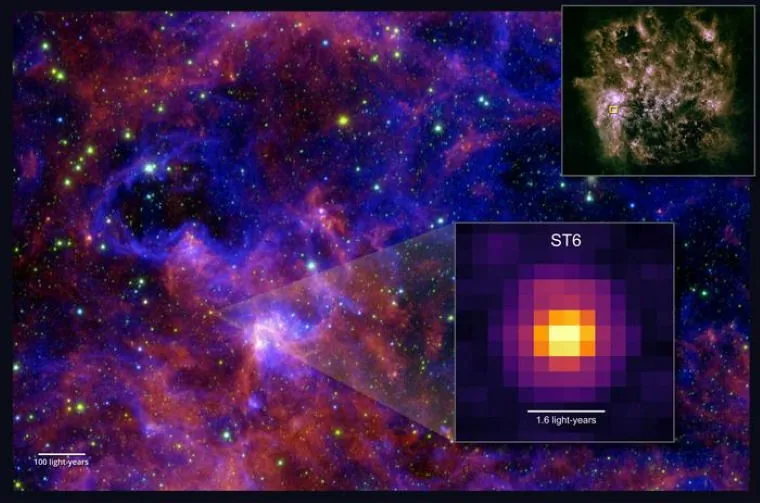
Observations with JWST’s MIRI instrument reveal multiple complex organic molecules embedded in ice around a protostar in the Large Magellanic Cloud, marking the first solid-state detections of several species outside the Milky Way.

Researchers using the James Webb Space Telescope (JWST) have identified multiple large organic molecules frozen in ice around a young protostar in the Large Magellanic Cloud (LMC), about 160,000 light-years from Earth. The observations were obtained with JWST’s Mid-Infrared Instrument (MIRI).

What was detected

The team reports spectral signatures of five complex organic molecules (COMs) within icy grains surrounding the protostar known as ST6. The detected species include:

  • methanol
  • ethanol
  • methyl formate
  • acetaldehyde
  • acetic acid

According to the study, acetic acid had not been conclusively identified in space before this result. The detections of ethanol, methyl formate and acetaldehyde in ice represent the first such solid-state identifications outside the Milky Way. The data also show a spectral feature consistent with glycolaldehyde, but that identification remains tentative pending further analysis.

Scientific context

Lead investigator Marta Sewilo emphasized that JWST’s sensitivity and angular resolution made the detections possible; prior to JWST, methanol was the only complex organic conclusively detected in protostellar ices even within our own galaxy.

Implications and limitations

The team cautioned the findings do not constitute evidence of life beyond Earth. Rather, they show that organic molecules considered precursors or "building blocks" of biological chemistry can form and survive in the icy environments around forming stars and may be incorporated into emerging planets.

Next steps

Researchers plan to expand the survey to additional protostars in the Large Magellanic Cloud and to targets in the Small Magellanic Cloud to build larger samples. Currently, the LMC result is based on a single source, and there are only a few detections of complex organics in protostellar ices within the Milky Way, so a broader dataset is needed to assess variations in COM abundances between galaxies.

Mattias Risberg

Mattias Risberg

Cologne-based science & technology reporter tracking semiconductors, space policy and data-driven investigations.

University of Cologne (Universität zu Köln) • Cologne, Germany

Readers

Readers Questions Answered

Q What did JWST detect around the protostar ST6 in the Large Magellanic Cloud?
A JWST’s MIRI collected spectra revealing five complex organic molecules frozen in icy grains surrounding the young protostar ST6: methanol, ethanol, methyl formate, acetaldehyde, and acetic acid; a spectral feature consistent with glycolaldehyde was observed but remains tentative pending further analysis. This also marks the first solid-state identifications outside the Milky Way for ethanol, methyl formate and acetaldehyde in ices.
Q Why is this detection significant in terms of location?
A The detections represent the first solid-state identifications of several complex organic molecules in protostellar ices outside the Milky Way, and they build on the previous Milky Way-only record where methanol was the only COM conclusively detected in protostellar ices; the findings show that these building blocks can form and survive in icy environments around forming stars in another galaxy, the Large Magellanic Cloud.
Q What are the limitations or caveats of the result?
A The researchers caution that the detections do not constitute evidence of life beyond Earth; they demonstrate that organic molecules considered precursors to biological chemistry can form and persist in protostellar ices and may become part of emerging planets, but the LMC result comes from a single source, requiring broader surveys to confirm patterns.
Q What are the planned next steps to expand or verify these findings?
A The team plans to expand the survey to additional protostars in the Large Magellanic Cloud and to targets in the Small Magellanic Cloud to build larger samples, enabling comparisons of COM abundances between galaxies and a better assessment of regional variations; currently the LMC result is based on one source, highlighting the need for more data.

Have a question about this article?

Questions are reviewed before publishing. We'll answer the best ones!

Comments

No comments yet. Be the first!