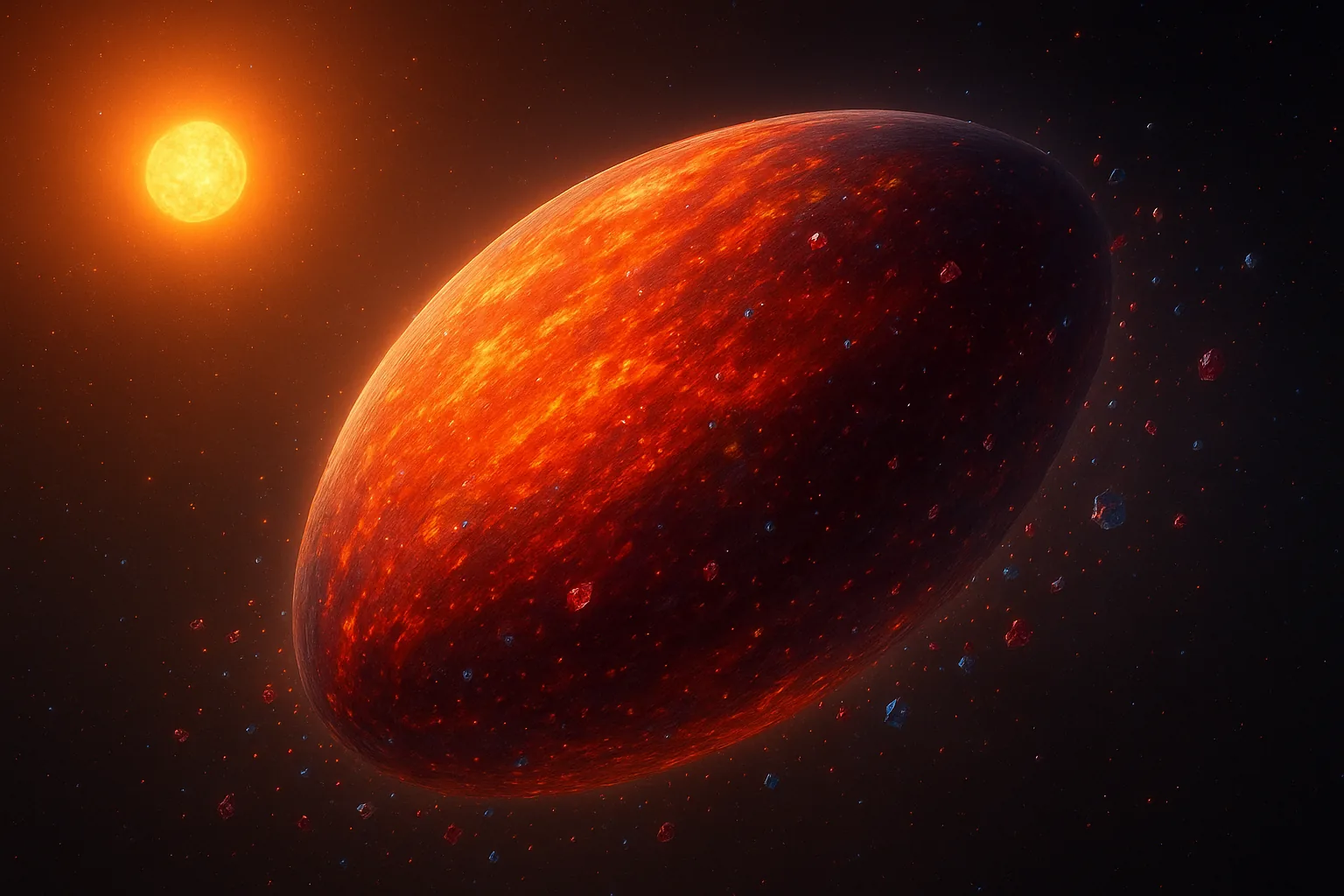
Imagine a world where the evening sky glows hot enough to tear water apart, where winds whip at 11,000 miles per hour, and where nightfall may bring showers of liquid rubies and sapphires. This is not speculative fiction but the latest weather forecast for WASP-121b, an ultra-hot Jupiter roughly 880 light-years from Earth, delivered today by the James Webb Space Telescope (JWST).
WASP-121b belongs to a class of exoplanets known as ultra-hot Jupiters, gas giants that orbit so close to their host stars that their years can be measured in hours rather than days. For this particular world, a full orbit takes just 30.5 hours, a proximity so punishing that the star’s gravity has warped the planet from a sphere into a football-like ellipsoid. The dayside, locked in a permanent stare at the furnace-like star, reaches temperatures above 2,500 Kelvin — hot enough not merely to vaporize metals like iron and magnesium but to tear apart molecules that are normally robust.
Because WASP-121b is tidally locked, one hemisphere bakes in perpetual daylight while the other languishes in eternal night. Previous observations with the Hubble Space Telescope had already hinted at escaping magnesium and iron, and theoretical work suggested that iron might condense and rain down on the cooler nightside. But beyond these broad strokes, the planet’s atmospheric dynamics remained largely opaque, a black box of meteorology under conditions that no planet in our solar system can replicate.
How the James Webb Space Telescope reads a planet’s weather
The technique at the heart of this study is transmission spectroscopy, a method that has been a workhorse of exoplanet science for two decades but gains extraordinary precision with JWST. As a planet passes in front of its star, a tiny fraction of the starlight travels through the planet’s upper atmosphere. Molecules there absorb light at specific wavelengths, imprinting a chemical fingerprint onto the spectrum we receive. By comparing spectra taken during transit with those taken when the planet is out of view, astronomers can tease out what gases are present.
The stakes of this approach go beyond a single exotic world. If the technique proves robust, astronomers could eventually apply it to smaller, cooler planets, perhaps even rocky ones, to map cloud cover, wind speeds, and temperature contrasts. For now, WASP-121b is the benchtop experiment, and the results are both startling and surprisingly coherent.
Dawn and dusk on a world of vaporized metal
The key finding is that the evening terminator is hotter than the morning one. The spectral signal of water vapor, for instance, was weaker on the evening side, a sign that the atmosphere there is so hot that water molecules are being broken apart — dissociated into hydrogen and oxygen — before they can absorb light. Conversely, the morning terminator showed a stronger water signal, implying a cooler environment where water can persist, at least for a while.
Carbon monoxide told a complementary story. Its absorption features also varied, consistent with a temperature gradient that drives a powerful circulation: super-rotating winds that whip around the planet at roughly 11,000 miles per hour, ferrying heat from the blistering dayside to the dark hemisphere. The morning side, the study proposes, may even host clouds made of silicate minerals — essentially rock vapor that has condensed into tiny particles — which could partly obscure the view into deeper layers. “More sophisticated models will be needed to determine whether such clouds are indeed present,” the authors caution, but the asymmetry is unmistakable.
The gemstone rain hypothesis: from vapor to crystal
The popular image of WASP-121b as a place where it rains rubies and sapphires rests on plausible chemistry, not direct visual evidence. Rubies and sapphires are both varieties of the mineral corundum — aluminum oxide — with trace impurities of chromium and iron giving the red ruby its colour, and titanium and iron creating the blue sapphire. For such crystals to form in a planet’s atmosphere, you need three things: a source of aluminum, plenty of oxygen, and a steep enough temperature drop for vapor to condense into solid grains.
WASP-121b appears to check all three boxes. Its dayside is hot enough to vaporize aluminum-bearing compounds, and spectra from earlier Hubble observations have shown that heavy elements are present and, in some cases, escaping the planet entirely. As gas travels from the dayside toward the nightside, it cools, and at some point aluminum oxide should condense. If the cooling happens slowly in a relatively calm region, crystals can grow, and if those crystals are swept upward by convection or downward by gravity, they might fall as a kind of glittering precipitation. The idea was first suggested in 2020 for other ultra-hot Jupiters, and the new JWST data — showing the stark temperature contrast and the presence of heat-transporting winds — strengthens the case, even if it cannot confirm that gemstone rain is actually occurring.
The researchers did not detect aluminum oxide directly in this study, and it remains possible that the temperature profile or chemical mixing prevents crystal growth. But the conditions they measured are consistent with the hypothesis, and future observations, perhaps with JWST’s MIRI instrument, could search for the telltale spectral features of corundum grains. For now, the gemstone rain is a compelling inference, not a confirmed observation.
Space weather on worlds beyond our own
When scientists talk about space weather on exoplanets, they are not usually referring to geomagnetic storms or solar flares, but to the broader atmospheric dynamics — winds, clouds, temperature gradients, and chemical cycling — that define a planet’s meteorological character. JWST’s ability to map the terminator asymmetry on WASP-121b is a form of space weather monitoring, and it expands the toolkit for studying worlds where conditions are utterly alien.
On Earth, space weather means solar wind and coronal mass ejections; on Mars, it includes dust storms and atmospheric escape. For a hot Jupiter, space weather is the interplay of extreme irradiation and powerful heat engines that drive supersonic winds and exotic condensation. The technique demonstrated by Gapp and colleagues could be applied to other planets to measure their longitudinal temperature profiles, reveal jet streams, and even track seasonal changes — provided the planet is not so hot that the signal is washed out.
There is a practical edge to this work. Understanding how atmospheres behave under extreme forcing helps refine climate models, both for exoplanets and for Earth itself. The same physics that drives a heat circulation on WASP-121b — the response to uneven heating, the role of clouds and molecular dissociation — is at play in our own stratosphere, albeit at vastly different temperatures. The universe, in this sense, is a laboratory of atmospheric extremes, and JWST is the new spectrometer on the bench.
A new lens for extreme climates
The team acknowledges that more complex models — ones that account for three-dimensional circulation, cloud microphysics, and the dissociation of molecules — will be needed to fully interpret the data. And the morning cloud hint, if confirmed, would be the first detection of silicate clouds on an ultra-hot Jupiter by JWST, opening another window into the physics of condensation in extreme conditions.
For a planet that orbits its star in just over a day, the pace of discovery has been remarkably slow — an ironic testament to the difficulty of observing worlds hundreds of light-years away. But the situation is changing. With each new transit, JWST pulls back another curtain on WASP-121b, and the forecast, however alien, is starting to read like a proper weather report: hot, windy, with a chance of liquid gemstones.
The instruments are sharp enough now that the imagination may soon have to catch up.
Sources
- Nature Astronomy (research paper: Gapp et al., “Longitudinal atmospheric structure of the ultra-hot Jupiter WASP-121b from JWST”)
- Max Planck Institute for Astronomy press materials
- NASA Exoplanet Science Institute (WASP-121b entry)




Comments
No comments yet. Be the first!