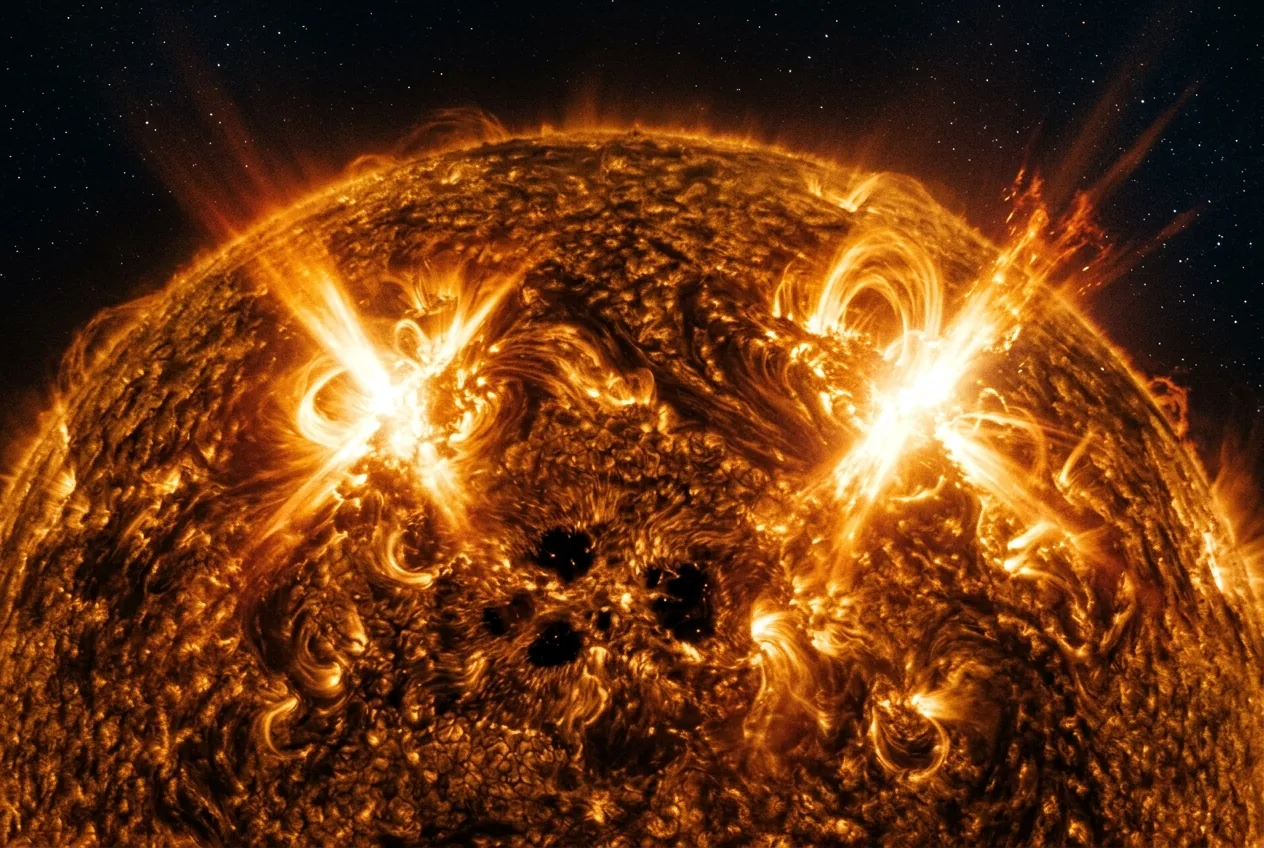
At roughly 150 million kilometres away, a tangle of magnetic field lines on the solar surface finally snapped. Within eight minutes, a torrent of X-ray and extreme ultraviolet radiation slammed into Earth’s ionosphere, flash-ionising the upper atmosphere and turning the air into a wall that shortwave radio signals could not penetrate. Before technicians in Africa and Europe could fully diagnose the sudden silence on their high-frequency bands, it happened again. Seven hours later, a second, even more intense eruption—measured at X4.2—burst from the same volatile sunspot group, this time blinding receivers across the Americas and the Pacific.
This double-tap of solar energy represents a significant escalation in the current solar cycle. While the public often associates solar activity with the aesthetic wonder of the aurora borealis, the immediate reality of these X-class flares is a functional breakdown of the invisible infrastructure that manages global logistics. The back-to-back events triggered R3-level (Strong) radio blackouts, according to the National Oceanic and Atmospheric Administration (NOAA) Space Weather Prediction Center. For aviators, maritime operators, and emergency responders relying on frequencies below 30 MHz, the horizon effectively disappeared.
The timing of these eruptions is not a fluke, but the predicted result of Solar Cycle 25 reaching its peak intensity. What has shifted in the last few months is the complexity of the sunspot regions currently rotating into Earth’s direct line of sight. We are moving out of a period of solar quiet into a phase where the biological and technological risks of living next to a variable star are no longer theoretical. The exposure here isn’t just to satellites in high orbit; it’s to the terrestrial supply chains and communication protocols that assume a stable atmosphere.
The Logarithmic Brutality of the X-Class Scale
To understand why a 7-hour interval between flares is alarming, one must look at the way we quantify solar tantrums. The classification system for flares—A, B, C, M, and X—is logarithmic, much like the Richter scale for earthquakes. An X-class flare is ten times more powerful than an M-class flare and hundreds of times more potent than the background radiation the Sun emits during its quieter years. When we see an X4.2, as recorded in the second of these two events, we are witnessing a release of energy equivalent to billions of hydrogen bombs detonating simultaneously.
The first flare acted as a primer, stripping electrons from atoms in the D-layer of Earth’s ionosphere. This layer normally reflects radio waves back to Earth, allowing for long-distance communication beyond the curve of the horizon. When it becomes over-ionised by an X-flare, it absorbs those waves instead of bouncing them. Because the second flare arrived before the atmosphere had fully recovered its neutral state, the resulting blackout was deeper and more persistent. This wasn't a momentary flicker; it was a sustained atmospheric blockage that lasted for tens of minutes at a time across different quadrants of the globe.
Infrastructure Blind Spots and the GPS Mirage
The primary reporting on these flares often focuses on shortwave radio, which sounds like a relic of the mid-20th century. However, the reliance on high-frequency (HF) radio remains a critical backup for trans-oceanic flights and a primary tool for amateur radio networks that form the backbone of emergency communications when cell towers fail. When an X-flare hits, the "skip" that these radios rely on vanishes. For a pilot over the Atlantic, the silence isn't just an inconvenience; it’s a loss of a primary safety redundant system.
Beyond radio, there is a growing concern among space weather analysts regarding Global Navigation Satellite Systems (GNSS), including GPS. While the flares themselves cause immediate radio interference, they are often the precursor to Coronal Mass Ejections (CMEs)—massive clouds of plasma that travel slower than light but carry a magnetic punch. If a CME follows an X-flare, it can induce currents in power grids and cause "signal scintillation" in GPS. This doesn't mean the GPS stops working, but it means the timing data—the precise nanosecond measurements required for everything from high-frequency stock trading to autonomous landing systems—can drift. In a world where the global economy is synced to the pulse of atomic clocks on satellites, a solar-induced timing error is a systemic risk that our current financial regulations are poorly equipped to handle.
Institutional responses to these risks remain fragmented. NOAA provides the data, but the implementation of safeguards is left to individual industries. Power grid operators in northern latitudes, such as Quebec or Scandinavia, have spent decades hardening their transformers. However, as the solar maximum intensifies, the risk moves southward. The infrastructure in the southern United States or Central Africa is not built for the geomagnetically induced currents that follow these colossal flares, creating a geographic disparity in biological and technological resilience.
The Biological Margin: Radiation and the Human Cell
As a geneticist, I find the most overlooked aspect of these flares is the sudden surge in the local radiation environment at high altitudes. While Earth’s magnetic field and thick atmosphere protect those of us at sea level, the story is different for those in the air. During an X-class event, the flux of high-energy protons can increase significantly. For frequent fliers and aircrews on polar routes, this isn't an abstract physics problem; it is a question of cumulative DNA damage.
The Earth's magnetic field funnels these particles toward the poles. A flight from New York to Hong Kong that crosses the Arctic during an X-flare event exposes passengers to a radiation dose equivalent to several chest X-rays in a single trip. While the regulatory bodies like the FAA provide guidelines for "Solar Particle Events," there is no real-time requirement for airlines to reroute or descend during an M-class or X-class flare. The industry operates on a model of acceptable risk that rarely accounts for the stochastic nature of genetic mutations caused by cosmic rays. We monitor the health of our satellites with more granularity than we monitor the genomic integrity of our high-altitude workforce.
Furthermore, the increase in solar activity poses a direct threat to the burgeoning private spaceflight industry. Space stations in Low Earth Orbit (LEO) lack the deep atmospheric shielding of the planet. When the Sun fires two X-flares in seven hours, the "safe" windows for extravehicular activities (spacewalks) vanish. If we are serious about a permanent human presence in orbit or on the Moon, our current space weather forecasting—which still struggles with a high rate of false positives and missed triggers—will need a radical overhaul in both funding and sensor deployment.
Policy Inertia in the Face of a More Active Star
There is a recurring irony in how we fund space science. We spend billions on rovers to look for dead life on Mars while underfunding the deep-space buoys needed to protect living civilization on Earth. The current fleet of solar observers is aging. The SOHO satellite, a workhorse of solar physics, has been in operation for nearly three decades, well past its design life. While newer missions like the Parker Solar Probe and Solar Orbiter are providing unprecedented data, they are scientific instruments, not early-warning systems designed for 24/7 operational resilience.
The disconnect between what the Sun is doing and what our policy reflects is widening. We are increasingly reliant on a "just-in-time" global economy that is exquisitely sensitive to communication disruptions. Yet, the regulatory frameworks for space weather are largely advisory. There are no federal mandates for grid hardening in the same way there are mandates for fire safety or earthquake building codes. We are essentially betting that the current solar cycle will be mild, despite the Sun’s recent double-X-flare demonstration to the contrary.
This lack of a cohesive strategy is particularly evident in the way we handle data gaps. Most of our solar monitoring is focused on the side of the Sun facing Earth. When a massive sunspot rotates to the "farside," we lose sight of its evolution until it reappears two weeks later. This lack of 360-degree solar situational awareness means we can be blindsided by a region that has grown in complexity while hidden from view. The two flares this week came from a region we knew was active, but its sudden rapid-fire eruption caught many regional communication hubs off guard.
The Sun is currently the most significant environmental variable in our near-term future, yet it remains outside the scope of most climate and environmental policy. We treat solar flares as "acts of God" rather than predictable environmental hazards that can be mitigated through better engineering and more robust monitoring. The genome is precise; the world it lives in is anything but. As Solar Cycle 25 continues its climb toward a peak, these back-to-back flares are a reminder that our technological sophistication has not made us immune to the star we orbit; it has only created more ways for its energy to disrupt our lives. The risk isn’t in the flare itself, but in the assumption that our silence on the radio bands is only a temporary glitch rather than a warning of a more systemic fragility.




Comments
No comments yet. Be the first!