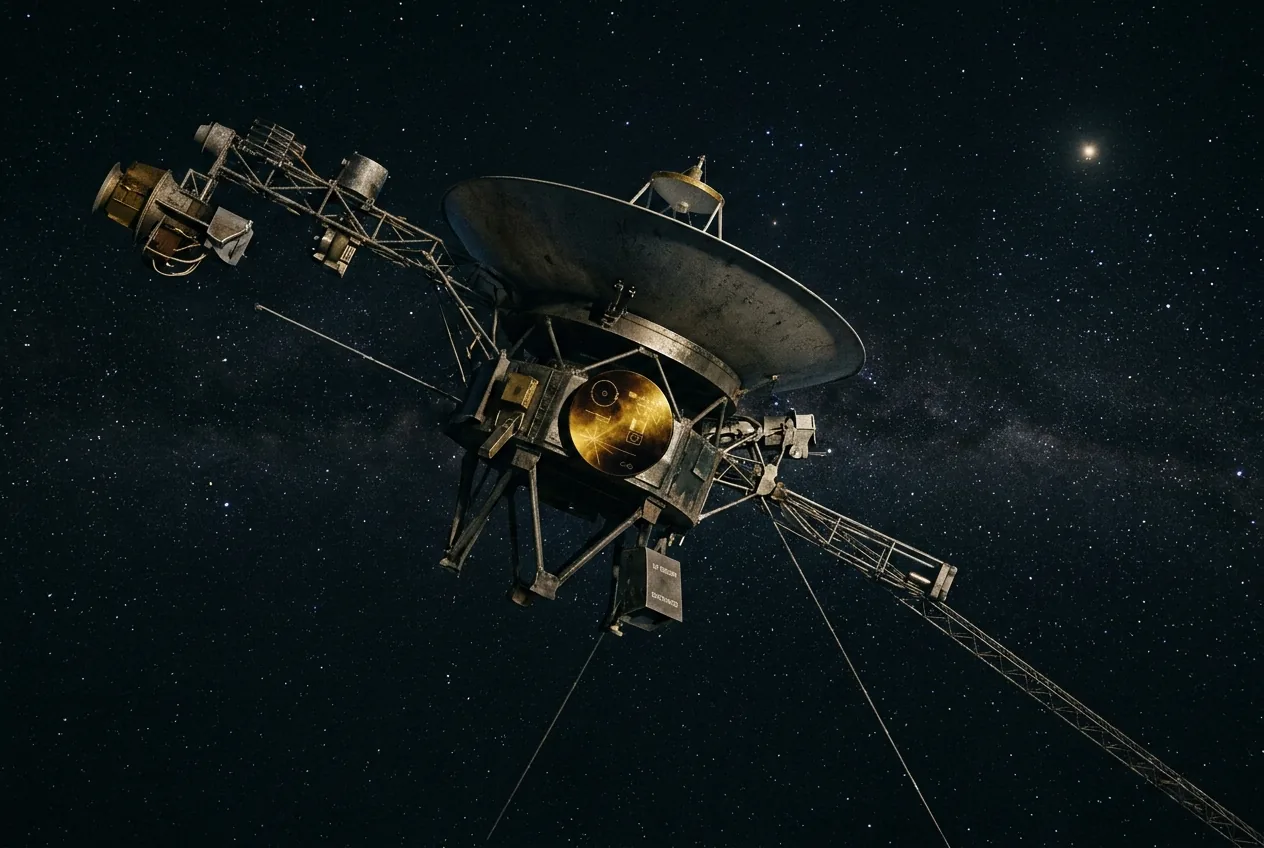
To figure out how memory is addressed on a computer currently travelling at 38,000 miles per hour, modern aerospace engineers are pulling archived paper manuals and placing calls to retired colleagues. When they finally decide on a command, a single radio ping takes nearly two days to complete its round trip. This is no longer deep-space exploration; it is long-distance digital archaeology.
At NASA’s Jet Propulsion Laboratory, the immediate threat is not a loss of data, but the activation of an undervoltage fault protection system. As Voyager 1’s plutonium power supply decays, the margins for error vanish. If the spacecraft’s voltage drops below a critical threshold, it triggers an automated survival mode that is practically impossible to reverse from Earth.
To stave off that thermal death, engineers have effectively initiated a controlled starvation. NASA has shut down the probe's Low-Energy Charged Particle (LECP) instrument, sacrificing functional hardware to keep the core platform alive.
The Undervoltage Trap
Kareem Badaruddin, the Voyager mission manager at JPL, called the shutdown the "best option available." It is a brutal calculus familiar to anyone managing heritage systems: you preserve the platform at the direct expense of the payload.
There is no PR spin that can alter the physics of plutonium decay. Voyager 1 is now stripped down to just two operational science instruments, one listening to plasma waves and another measuring magnetic fields. These remain online simply because they represent the bare minimum data stream required to justify the mission’s ongoing operational costs.
If those final sensors are turned off, the 700-kilogram probe becomes little more than a silent monument. Until then, engineers are playing a high-stakes game of power management, balancing the heat needed to prevent the hydrazine thruster lines from freezing against the electrical load of the vintage computers.
Silicon in the Cosmic Void
There is a stark contrast between the hardware fighting for its life in the heliosphere and the silicon currently rolling out of modern fabs. Modern semiconductor supply chains are heavily optimised for the two-year refresh cycles of consumer electronics, not half a century in a vacuum.
The gallium nitride and silicon carbide chips currently subsidised by European industrial policy offer massive efficiency gains. Yet, their ability to survive the deep-space cosmic radiation that routinely makes logic gates erratic remains a theoretical projection.
Voyager’s 1970s vacuum-sealed, radiation-hardened architecture was built under a different set of assumptions. We manufacture components vastly faster today, but the supply chain is no longer designed to produce bespoke hardware expected to endure decades of relentless radioactive bombardment.
The Early 2030s Hard Stop
Deactivating the LECP instrument is a triage measure, buying Voyager 1 perhaps another five to seven years of operational life. By the early 2030s, the output from the probe’s Radioisotope Thermoelectric Generators will inevitably drop below the wattage required to power even the transmitter.
When Voyager 1 finally falls silent, it will not be due to a catastrophic mechanical failure. It will simply run out of warmth. As the LECP instrument slowly cools to the ambient temperature of interstellar space, the mission moves one step closer to its final state.
We built a machine that outlived the engineers who drafted its schematics. Now, the main challenge is finding enough electricity to let it send a final goodbye.




Comments
No comments yet. Be the first!