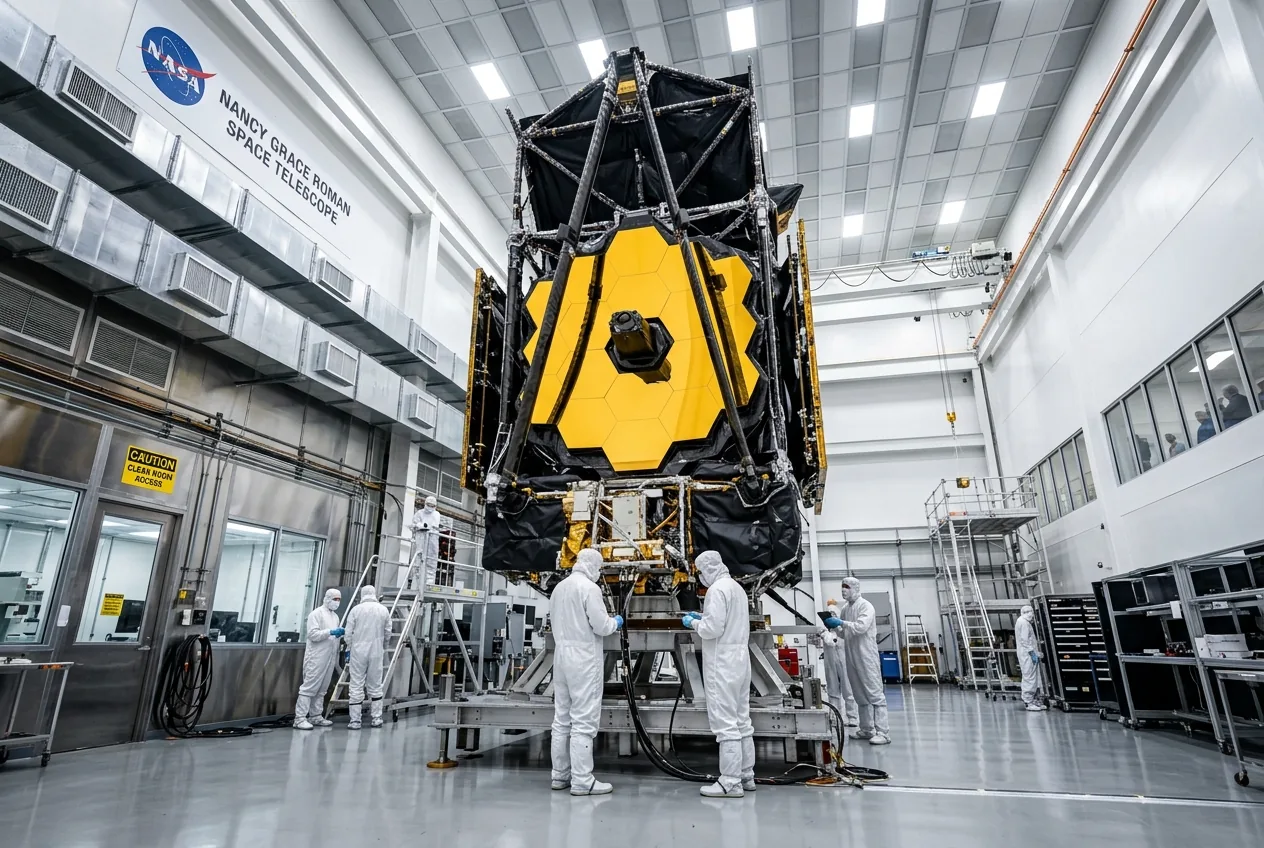
If you wanted to map the entire sky using the Hubble Space Telescope, you would need to settle in for a long wait—about 2,000 years, to be precise. That is two millennia of clicking, dragging, and stitching images together. By the time you finished, the stars would have moved, empires would have fallen, and your hard drive would likely be a pile of prehistoric dust. NASA’s Nancy Grace Roman Space Telescope, currently sitting in a clean room at the Goddard Space Flight Center, is about to turn that two-thousand-year slog into a twelve-month sprint.
NASA Administrator Jared Isaacman recently confirmed that the observatory is not only complete but is currently eight months ahead of schedule and, miraculously, under budget. In the world of high-stakes aerospace engineering, where delays are measured in decades and overruns in billions, Roman is the ultimate outlier. It is an absolute unit of a machine that has been built and integrated in just six years, ready to board a SpaceX Falcon Heavy rocket for an early September launch from Kennedy Space Center.
The telescope is named after Nancy Grace Roman, the woman often called the “Mother of Hubble.” It is a fitting tribute. While her namesake predecessor gave us our first clear eyes on the universe, this new mission is designed to solve the mysteries those eyes uncovered—chiefly, why the universe is flying apart at an accelerating rate and where all the missing matter is hiding.
Half a million 4K TVs for a single photograph
To grasp the scale of the data Roman will produce, you have to stop thinking in terms of gigabytes and start thinking in terms of infrastructure. Dr. Julie McEnery, the senior project scientist for the mission, puts it in a way that makes your brain ache: if you wanted to display just one single image from Roman’s main survey at full resolution, you would need more than 500,000 4K televisions. Not 500. Not 5,000. Half a million.
This is the “big data” era of astronomy arriving in earnest. Where Hubble gathered 172 terabytes of data over its first three decades, Roman is expected to beam back 1.4 terabytes of science data every single day. That is a firehose of information that will require entirely new ways of processing. We aren't just looking for one interesting galaxy anymore; we are looking at billions of them simultaneously to see how they clump, move, and evolve over eons.
This wide-angle approach is the only way to tackle the enigma of dark energy. Dark energy is the invisible “something” that makes up roughly 68% of the universe and is pushing everything away from everything else. You can’t see it directly, but you can see its effects if you look at enough galaxies across a large enough area. Roman will act like a cosmic census-taker, mapping the positions and distances of hundreds of millions of galaxies to see exactly how dark energy has been winning the tug-of-war against gravity since the Big Bang.
While one half of the telescope is obsessed with the largest structures in existence, the other half is looking for something much smaller: planets. We have already confirmed roughly 6,000 exoplanets, mostly by watching for the slight dip in light as they pass in front of their stars. Roman is expected to find tens of thousands more, but it’s going to do it with a piece of kit that sounds like pure science fiction.
The Roman Coronagraph is essentially a high-tech set of sunglasses for the telescope. Its job is to block out the blinding glare of a distant star so that the much, much fainter light reflecting off a nearby planet can be seen. To give you an idea of the difficulty, it’s like trying to see a firefly hovering next to a lighthouse from several miles away. If you don't block the lighthouse, you have zero chance of seeing the bug.
This instrument is the most advanced of its kind ever flown. It features a system of “active optics”—mirrors that can actually change their shape slightly while in space to maintain perfect precision. This isn't just about finding another gas giant; it is a proof-of-concept for the future Habitable Worlds Observatory. The goal is to eventually find another Earth, and Roman is the scout mission that proves we have the tech to actually look at one directly.
The telescope’s ability to find these worlds through microlensing—using the gravity of one star to magnify the light of another—will allow us to find planets that are further away from their stars than ever before. It will fill in the gaps of our current planetary maps, showing us the “cold” planets that other telescopes simply can't see. We are moving from knowing planets exist to understanding the true diversity of solar systems across the Milky Way.
The unicorn of government spending
Perhaps the most shocking part of the Roman story isn't the physics, but the paperwork. NASA projects are notorious for being “ten years and ten billion dollars” away from completion at any given moment. The James Webb Space Telescope became the poster child for this, eventually launching years late and billions over budget. Roman has flipped the script.
Completing a flagship mission eight months early and under budget suggests a masterclass in project management and engineering discipline. The team at Goddard and their industry partners managed to integrate the massive Wide Field Instrument and the Coronagraph in record time. This efficiency is why the telescope is already being prepped for shipment to Florida, where it will meet its Falcon Heavy ride.
The choice of the Falcon Heavy is significant. It is one of the most powerful rockets in the world, and it needs every bit of that power to send Roman to its destination: the second Lagrange point (L2). This is a stable spot in space about a million miles from Earth, where the telescope can stay in a fixed position relative to the Sun and the Earth, keeping its back to us while it stares into the deep dark.
Once it arrives and begins its five-year primary mission, Roman won’t be working alone. It is designed to work in a sort of cosmic tag-team with Hubble and Webb. While Webb focuses on the tiny, high-resolution details of specific objects, Roman will provide the context. It will find the interesting targets in its massive surveys, and then Webb can zoom in for a closer look. Together, they form a trifecta of observational power that will give us the most complete picture of the universe we have ever had.
Charting the weather of the deep cosmos
When we talk about space weather, we usually mean solar flares and radiation belts around Earth. But on the scale that Roman operates, “weather” refers to the grand movements of gas, dust, and stars across the galaxy. Roman will track tens of billions of stars and thousands of supernovae, effectively mapping the climate of the Milky Way and its neighbors.
The speed at which Roman operates means we can see things change. Astronomy is often seen as a slow science, where things take millions of years to happen. But with Roman’s 1,000x speed, we can catch the transient events—the things that go bump in the night—more effectively than ever before. It is the difference between taking a still photo of a crowd and filming it in high-definition video. You see the movement, the flow, and the unexpected collisions.
As we head toward that September launch date, the tension is building. Millions of hours of work are about to be distilled into a few minutes of rocket thrust. If Roman performs as expected, the next decade of astronomy won't just be about looking deeper into the past—it will be about seeing the universe at a scale and speed that makes Hubble look like it was working in slow motion. We are about to see more of the universe in one year than our ancestors saw in the last two thousand.




Comments
No comments yet. Be the first!