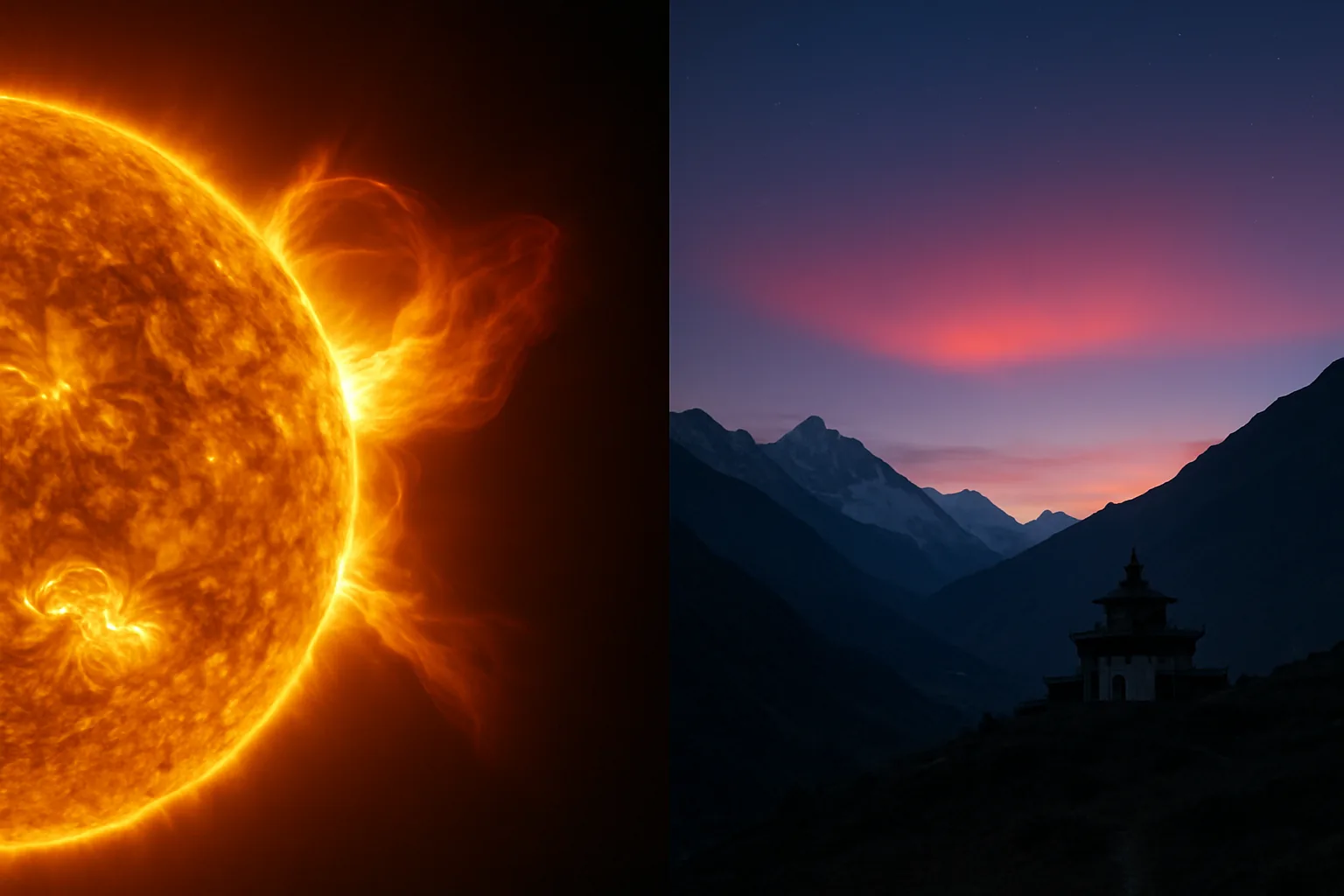
Late on 6 June a violent magnetic collapse on the Sun's disk sent a halo of plasma blasting into space, and today the sun explosion triggers massive plasma and a G4-class geomagnetic storm watch from NOAA. Agencies say the main impulse will arrive this evening (8 June 2026) and could push the auroral oval so far south that faint Northern Lights may appear over high-altitude sites in northern India. At the same time engineers are scrambling to protect satellites, polar flights and vulnerable transformers.
Sun explosion triggers massive G4 storm — what's heading our way?
The event started in an active region that forecasters labelled powerful and unstable: a large sunspot produced an X‑class flare and a full‑halo coronal mass ejection (CME). That explosion hurled billions of tonnes of magnetised plasma outward at more than a million miles per hour. When that cloud reaches Earth it will slam into the magnetosphere, compressing field lines and driving currents into the upper atmosphere — the precise recipe for a severe geomagnetic storm.
NOAA's Space Weather Prediction Center has flagged the arrival window for the bulk of the CME as Monday evening and issued watches that climb into the G3–G4 range on the NOAA scale. A G4 (Severe) geomagnetic storm corresponds to high Kp index values and is rare enough that it routinely triggers operational warnings for satellite operators, HF radio services and grid operators.
Put simply: the sun explosion triggers massive disturbances not just in the sky, but in long electrical conductors on the ground and in hardware orbiting the planet. This is why forecasters are using every real‑time monitor and predictive model they have — the orientation of the CME's magnetic field (its Bz) will decide whether the storm fizzles or spikes.
Sun explosion triggers massive aurora shifts — could India see the lights?
If you are in India the realistic viewing chances are limited to high, dark sites with clear skies: locations such as Leh and Hanle in Ladakh give the best shot because they sit at high altitude with minimal light pollution. Even there, NOAA warns the display may be a subtle horizon glow rather than a sweeping curtain — but subtle in this case would still be historic for most of the subcontinent.
What causes a solar storm and how a sun explosion triggers one
A solar storm typically begins with magnetic energy stored in sunspots. When those magnetic fields snap and reconnect they release energy as flares and launch attached coronal material as a CME. The flare produces fast photons — X‑rays and extreme ultraviolet — that can cause short radio blackouts on the day side of Earth. The CME is the slower, heavier payload that physically slams into our magnetosphere hours to days later.
Whether a CME produces a big geomagnetic storm depends on its speed, density and, crucially, the orientation of the magnetic field it carries. If the CME's Bz component is directed southward when it meets Earth's northward field, the two fields couple efficiently and let energy pour into the magnetosphere. That coupling is what drives auroras, injects particles into radiation belts, and induces currents in long conductors on the ground.
So when we say the sun explosion triggers massive effects, we mean a combination of all these factors: raw speed, volume of plasma, and magnetic orientation. Forecast models can forecast arrival times reasonably well but they often still struggle to predict the Bz orientation until the CME is close.
How do solar storms affect Earth, satellites, and power grids?
There are two practical threads here: visible spectacle and invisible hazard. Visually, charged particles follow Earth's magnetic field down into the upper atmosphere and light up oxygen and nitrogen atoms — that's the aurora. Technically, the storm induces rapid changes in magnetic flux. Those changes create electric fields which, over long distances, drive geomagnetically induced currents (GICs) into power grids, pipelines and undersea cables.
For satellites, the threats include sudden increases in surface charging, upset of onboard electronics, and additional drag in low Earth orbit from a heated, expanded upper atmosphere. HF radio and GPS navigation can degrade, and airline routes over polar regions may be rerouted to reduce radiation exposure and comms loss.
Can the aurora borealis be seen from India tonight, and where should you go?
The short answer: maybe, but only in a handful of high‑altitude, low‑light places and likely as a faint glow. Northern India is not normally within the auroral zone because it sits well south of the usual oval. The sun explosion triggers massive shifts in that oval only during the strongest storms, which is what NOAA says could happen tonight.
For the best chance in India head to Ladakh — Hanle, Leh and surrounding plateaus are the recommended spots. Those sites combine altitude, dry air and little artificial light. If you go, face north and give your eyes time to dark adapt. Bring a tripod and set your camera for multi‑second exposures; smartphone night modes work surprisingly well but a DSLR or mirrorless camera will catch more subtle colors.
Also check local weather: cloud cover is the single biggest natural blocker. Even with a textbook geomagnetic storm, broken clouds will ruin the view for most observers.
Practical tips and what to expect for infrastructure
If you're planning to watch the sky, aim for the magnetic midnight window — generally 10pm to 2am local time — and keep an eye on real‑time Kp and Bz feeds from official agencies. Use long exposures and avoid city lights. Expect faint red or pink horizons rather than vivid curtains unless the storm intensifies further.
If you run equipment or services that depend on satellites, HF radio or precise timing, treat today's watch seriously. Commercial and government satellite operators are already taking standard protective steps. Power grid operators in many regions run contingency procedures when NOAA issues G3/G4 watches because induced currents can cause transformer heating and protection trips.
Finally, treat social feeds with caution. Aurora photographs shared online are tempting, but raw human observation can differ from camera results. If you see the faint glow with your camera but not your eyes, it's still a valid detection — and probably a good picture to savour.
Sources
- NOAA Space Weather Prediction Center (SWPC)
- NASA (space weather modelling and solar observations)




Comments
No comments yet. Be the first!