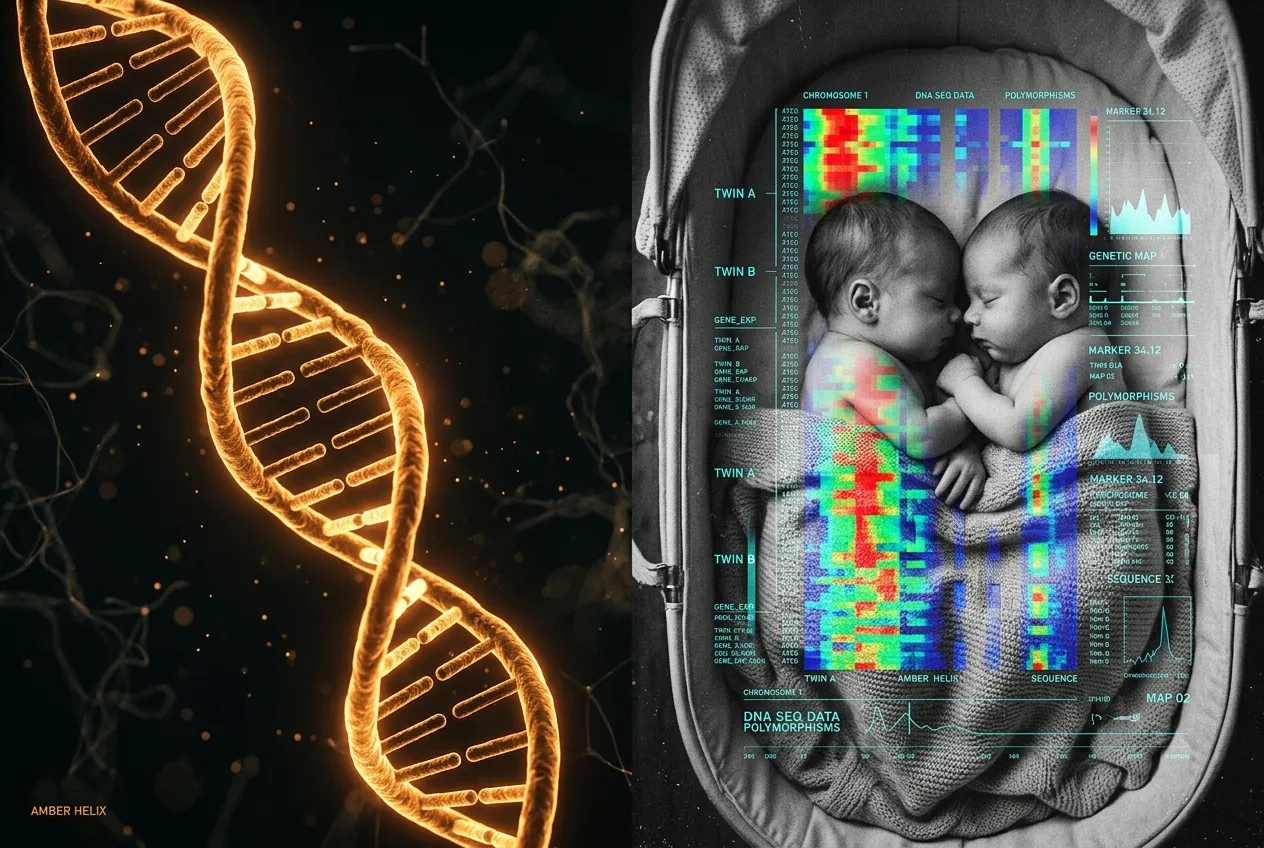
In a small apartment in South London, two sisters recently celebrated their 49th birthday with a shared history that was, until four years ago, a matter of simple biology. Michelle, a contestant on the first series of The Great British Sewing Bee, describes herself as a homebody. Lavinia, who runs a blockchain platform, is the exuberant one. For nearly five decades, their bond was forged in the fires of a precarious childhood spent moving through the UK’s care system, anchored by the assumption that they were fraternal twins born of the same union. When they finally spat into plastic tubes for a commercial Ancestry DNA kit, the resulting data didn't just flesh out a family tree; it exposed a biological event so rare it has been documented fewer than 20 times worldwide.
The results confirmed that while Michelle and Lavinia shared a mother, a womb, and a birthday, they did not share a biological father. This phenomenon, known as heteropaternal superfecundation, occurs when a woman releases two eggs during a single menstrual cycle and those eggs are fertilised by different partners within a narrow window of fertility. It is a stochastic alignment of hyperovulation and timing that challenges the very definition of “twins,” rendering the sisters both siblings and half-siblings simultaneously. This case, believed to be the first documented in British history, serves as a stark reminder that as genetic surveillance becomes a consumer hobby, our definitions of kinship and biological probability are being forcibly recalibrated.
The mechanics of superfecundation rely on the surprising longevity of sperm and the occasionally erratic timing of the human ovary. Typically, hormonal feedback loops prevent a second ovulation once one egg has been released. However, in rare instances of hyperovulation—often driven by genetic predisposition or, increasingly, fertility medications—the window remains open. If multiple sexual encounters occur within that 12-to-48-hour period, the uterus becomes a shared space for two entirely different genetic experiments. In the case of the Osbourne twins, this biological glitch remained hidden for nearly half a century, obscured by the limitations of traditional observational medicine and the lack of necessity for paternal verification.
There is a significant tension between the rarity of this event in medical literature and its likely frequency in the wild. Scientists have long suspected that heteropaternal superfecundation is underreported, largely because there is rarely a clinical reason to test the paternity of both fraternal twins. In the absence of striking physical differences or legal disputes, the assumption of shared paternity is the default social and medical setting. The fact that this discovery emerged from a consumer database rather than a clinical study highlights a growing shift: the primary custodians of rare genetic data are no longer public health institutions or university laboratories, but private corporations with proprietary algorithms and minimal oversight.
This data shift creates an uncomfortable paradox for public health. While companies like Ancestry and 23andMe have democratised access to genomic information, they have also created a reservoir of “biological secrets” that can be unceremoniously dumped on individuals without the scaffolding of genetic counselling. For the Osbournes, the revelation arrived decades after their mother’s death, leaving them with a genomic reality they could not cross-reference with lived testimony. The sisters are left to navigate the emotional fallout of a “shattered” family history, where the certainty of their shared identity must now accommodate a bifurcated lineage. It raises a question often ignored by the tech-optimists of the genomics world: is the right to biological truth absolute, even when it arrives as a cold data point forty-five years late?
The discovery also illuminates the widening gap in genetic surveillance between the global north and south, or even between different socio-economic strata within the UK. The ability to identify such rare occurrences is a privilege of those who can afford the testing fee and who exist in a database large enough to provide a match. Much of our understanding of human genetic diversity is currently filtered through the lens of those with the disposable income to participate in “recreational” genomics. This skews the baseline of what we consider “normal” or “rare,” as the data is harvested from a self-selecting population rather than a representative one.
When we look at other recent genetic anomalies, such as the IVF mix-up in Florida where a couple discovered their child was not biologically related to them, the common thread is the erosion of biological anonymity. Whether through clinical error or natural freak occurrence, the database eventually catches the deviation. In the Florida case, the failure was institutional; in the UK case, it was a quirk of nature. Both, however, ended with a computer screen informing a family that their fundamental understanding of their own bodies was a statistical error. The risk in the modern era isn't just a genetic mutation or a rare environmental exposure, but the sudden, unbuffered collision with a truth that was never meant to be measured.
As the cost of whole-genome sequencing continues to plummet, we should expect more of these “impossible” stories to surface. The medical community often treats heteropaternal superfecundation as a curiosity, a footnote in a textbook on reproductive biology. Yet, for the individuals involved, it is a structural shift in their reality. It highlights a recurring theme in environmental genomics: the genome is a precise ledger, but the human lives it records are messy, opportunistic, and rarely follow the clean lines of a simplified model. We are entering an era where our pasts are no longer protected by the passage of time or the privacy of the womb.
The genome is a remarkably stable archive, holding on to secrets that the world above it has long forgotten. But as these twins have discovered, the database doesn't care about your sense of self or the stability of your childhood memories. The models are getting sharper, and the ability to hide within a conventional narrative is disappearing. The irony is that in searching for our roots, we often find that the soil is far more complex than we were prepared to dig into. The risk isn't in the gene itself, but in the assumption that we already know what it says.




Comments
No comments yet. Be the first!