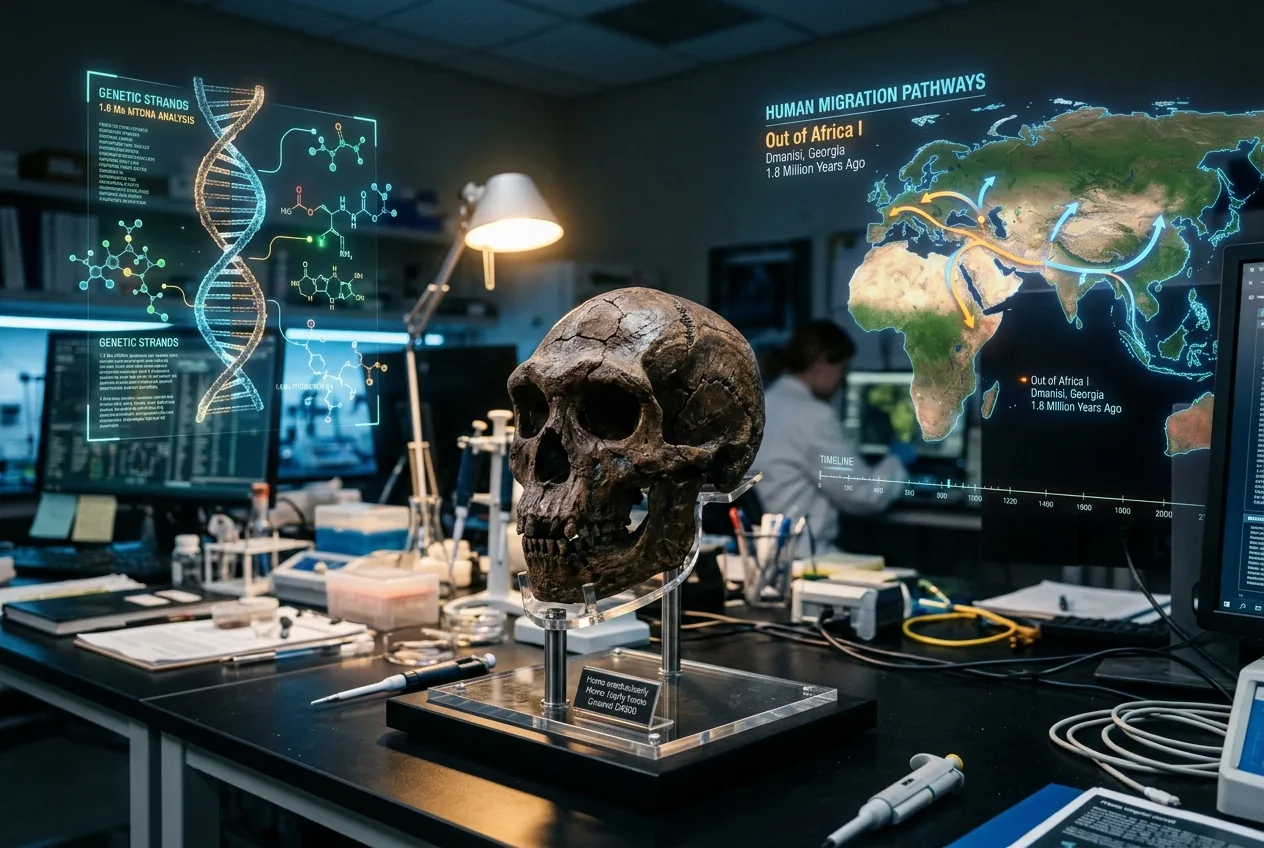
In a laboratory in Hubei Province, researchers recently took a million-year-old human skull—distorted, crushed, and long dismissed as a relic of a primitive ancestor—and performed a digital resurrection. The fossil, known as Yunxian 2, had spent decades categorized as Homo erectus, a wide-ranging but essentially “pre-modern” human. But when the 3D reconstruction was finished, the features that emerged did not fit the template. Instead of the archaic proportions expected from the era, the skull revealed a mosaic of traits that suggest the lineage of modern humans was already beginning to coalesce nearly half a million years earlier than the standard textbook narrative allows.
This digital reframing is part of a broader, more disruptive shift in paleoanthropology and genetics. For decades, the dominant model for our species has been a relatively tidy one: a single ancestral population in Africa gave rise to Homo sapiens, who then replaced all other hominid groups as they moved across the globe. However, a synthesis of new genetic data and re-evaluated fossil evidence is painting a much messier, more interesting picture. We are moving away from the idea of a single “point of origin” and toward a model of a “braided stream”—a network of multiple, distinct human lineages that coexisted, interbred, and collectively contributed to the modern genome for nearly a million years.
The Collapse of the Linear Timeline
Professor Chris Stringer of the Natural History Museum, a co-lead on the study, has noted that this pushes the divergence of the “big three” lineages—Sapiens, Neanderthals, and the newly defined Longi group—back into the deep past. This is not just a matter of changing dates on a museum plaque. It suggests that for 800,000 years, three distinct types of large-brained humans were wandering the Earth simultaneously. They were not isolated islands of biology; they were likely interacting in ways that our current genomic tools are only just beginning to disentangle. The assumption that we are the “winners” of a linear race ignores the fact that the race was actually a massive, multi-generational merger.
The Muddle in the Middle Gets Clearer
Paleoanthropologists have long referred to the period between 800,000 and 100,000 years ago as the “muddle in the middle.” It is a graveyard of fossils that don’t quite fit: some look like Neanderthals but have modern teeth; others have modern brow ridges but archaic brain cases. Historically, researchers tried to force these into a single evolutionary ladder, often inventing new species names like Homo heidelbergensis to act as a catch-all “dumpster taxon.”
The latest genetic and morphological modeling suggests the muddle was actually a period of high connectivity. Rather than being a single species slowly evolving into us, the human population was likely split into diverse subgroups across Africa, Europe, and Asia. These groups would occasionally meet as climates shifted and green corridors opened through deserts or over mountain ranges. This explains why some million-year-old fossils in China show features that wouldn’t become standard in Homo sapiens for another 700,000 years. They weren’t our ancestors in a direct, father-to-son line; they were part of a genetic pool that we would eventually dip into.
Can We Trust the Molecular Clock?
While fossil reconstructions offer physical evidence, the real tension in this field lies in the molecular clock—the method of using DNA mutation rates to estimate when species diverged. This is where the narrative often frays. Genomicists like Dr. Aylwyn Scally from Cambridge University point out that these estimates are notoriously slippery. A molecular clock depends on the mutation rate you choose and the generation time you assume. If humans in the Pleistocene had children at age 25 versus age 15, the entire timeline of our “origin” shifts by hundreds of thousands of years.
The skepticism is well-founded. Genetic data from ancient remains is rare, especially in the heat and acidity of tropical regions where much of this evolution likely occurred. Most of our “origin” DNA studies are actually extrapolations from modern populations. When researchers claim that Homo sapiens emerged 800,000 years ago based on Yunxian 2, they are triangulating between a physical skull and a mathematical model. It is a brilliant bit of detective work, but it rests on the assumption that mutation rates stayed constant across a million years of Ice Ages and volcanic eruptions. In biology, “constant” is a relative term.
The Asian Connection and Migration Waves
The focus on Chinese fossils like Yunxian 2 also marks a significant shift in the geography of human origin research. For much of the 20th century, the narrative was Eurocentric (Neanderthals); in the late 20th century, it became Afrocentric (Out of Africa). Now, Asia is asserting its place in the sequence. New studies of mitochondrial DNA have revealed that migrations were not a one-way street out of Africa. For instance, recent research into the origins of Paleo-Siberians and Native Americans has identified at least two distinct migration waves from Northern China and Japan, one during the last Ice Age and another shortly after.
This suggests that East Asia was not just a cul-de-sac where humans arrived and stayed, but a secondary “pump” of human diversity. The genetic markers found in ancient Chinese populations are showing up in unexpected places, including the Americas. This complicates the political and nationalist narratives that often surround paleoanthropology. If human origins are a braided stream, then no single region can claim to be the exclusive cradle of humanity. We are the product of a global network that functioned long before the concept of a globe existed.
The Politics of Hominid Funding
Behind the high-minded talk of ancient ancestors lies the grittier reality of research funding and institutional prestige. The reclassification of fossils is rarely a neutral act. Identifying a new species or a “rewritten timeline” is the surest way to secure grants and high-impact publications. When the Fudan University team argues that Yunxian 2 “totally changes” our understanding, they are navigating a field where the loudest claim often dictates the direction of the next decade’s research.
There is also a persistent data gap in surveillance. We have an abundance of fossil and genetic data from cold, dry regions like Europe and Northern Asia because DNA survives there. We have almost nothing from West Africa or Southeast Asia, where the humidity destroys the very molecules we need to prove these braided-stream theories. This means our current “rewritten” story is still heavily biased toward the places where the ground is cold enough to keep a secret. We are drawing a map of the world based on the few patches of land where the light happens to be hitting.
The Risks of Genomic Reinterpretation
As we move toward these more complex models, there is a risk of over-correcting. The enthusiasm for “interbreeding” and “multiple ancestors” can sometimes obscure the fact that Homo sapiens did, eventually, become a biologically distinct entity. We have a specific suite of genetic adaptations related to brain development, social cooperation, and perhaps most importantly, a unique susceptibility to certain environmental diseases that our cousins did not share.
The danger in the “braided stream” metaphor is that it might imply all these ancient groups were essentially the same. They weren’t. They were distinct lineages adapted to vastly different environments—from the freezing steppes of Siberia to the tropical forests of Sundaland. When they interbred, they weren’t just swapping neutral “junk DNA”; they were swapping functional genes that helped our ancestors survive new climates and new pathogens. The modern human genome is a patchwork of these survival strategies, a biological record of every ecological challenge our various ancestors managed to overcome.
The deeper we dig, the more we realize that our obsession with finding a single “Adam” or “Eve” is a relic of our own cultural storytelling, not a reflection of biological reality. Evolution doesn’t work through singular moments of transformation; it works through the slow, messy accumulation of traits across space and time. We are finally beginning to see that our history isn't a single line drawn in the dust, but a map where every path eventually loops back on itself. The genome is a precise ledger of our past, but the world it describes has always been beautifully chaotic.




Comments
No comments yet. Be the first!