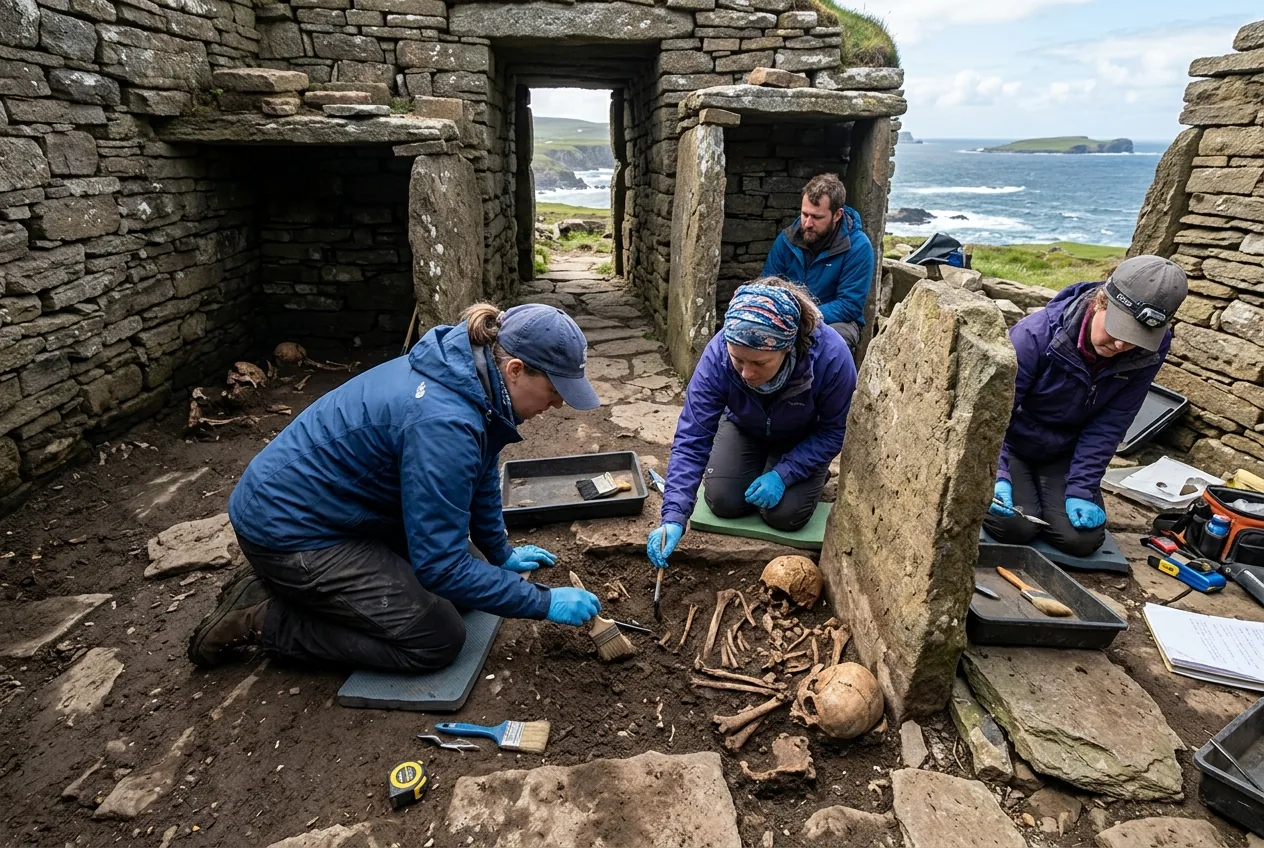
In the acidic, bone-destroying soils of northern Scotland, human DNA usually does not stand a chance. But locked inside the dense inner-ear bones of roughly 40 individuals buried in Orkney and Caithness, a biological archive managed to survive for 5,000 years. When researchers sequenced genomes from samples at sites like Tulloch of Assery B and the Holm of Papa Westray North, they found more than a collection of ancient islanders. They found a family tree carved into the architecture itself.
For decades, the towering megaliths and communal tombs of Neolithic Britain were widely interpreted as monuments to an egalitarian society. The genetics suggest something far more rigid and territorial. By mapping high-resolution ancient DNA against radiocarbon dates, researchers have revealed a web of patrilineal descent spanning at least seven generations. These tombs were not simply communal resting places; they were physical deeds, leveraging the dead to secure a living lineage's claim to land, grazing rights, and coastal resources.
Mapping patrilineage onto stone
The stalled cairns of northern Scotland are defined by their internal partitions, with the chilly, dark interiors chopped into discrete compartments. According to the new genomic data, these architectural dividers functioned as literal lineage markers.
Men tied by direct Y-chromosome descent were not scattered randomly across the tomb floor. Instead, they were clustered in specific stalls alongside their close relatives, a pattern of spatial segregation that persisted for centuries. The architecture was deliberately designed to encode social hierarchy, transforming the cairn into a long-term mnemonic anchor for familial power.
Moving brides and anchored sons
The genetic data paints a stark picture of how these Neolithic communities managed their borders. By comparing Y-chromosome markers—passed directly from father to son—with mitochondrial DNA inherited from mothers, a clear biological asymmetry emerges.
The men buried in the cairns share a highly homogeneous Y-chromosome lineage, while the mitochondrial sequences represent a wide diversity of women. In population biology, this is the classic genetic footprint of patrilocality. The men stayed anchored to their natal communities and the monumental tombs that secured their estates, while women moved across fragmented landscapes and rough waters to form marital alliances.
Selective archives and missing commoners
There is a danger, however, in letting monumental graves dictate the entire social history of prehistoric Scotland. Tombs are highly selective archives. Not everyone in the fourth millennium BC was granted a spot inside a stalled cairn, and those who were likely represent a specific elite class whose status justified the enormous labor required to build them.
Funding incentives in modern archaeology still heavily favor excavating big, broadly comparative, and highly visible monumental projects. This creates a survivor bias in the genetic record. If sampling concentrates strictly on conspicuous tombs, the illusion of dominant patriarchal dynasties is inflated, while the genetic and social reality of everyday, non-monumental communities remains entirely unsequenced.
Because these tombs were used intermittently over hundreds of years, they can project a false image of uninterrupted, stable dynastic rule. DNA can tell us who fathered whom, but it cannot measure the rituals, threats, or collapsed alliances required to actually hold an island headland for seven generations. The genome remembers the biological winners; the stone remembers what they wanted us to see.
Sources
- University of the Highlands and Islands




Comments
No comments yet. Be the first!