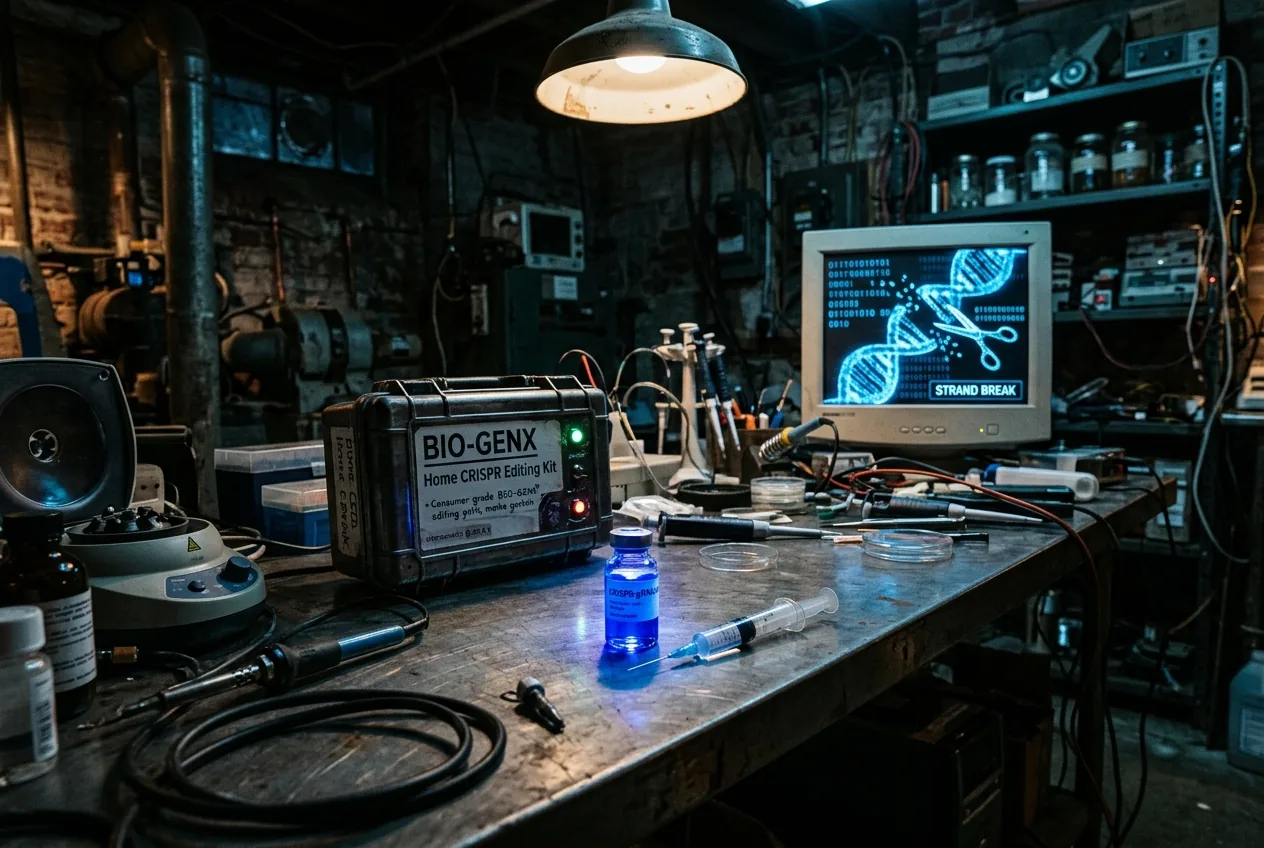
In 2017, a former NASA biochemist stood on a stage at a biotech conference and injected himself with a CRISPR-Cas9 construct intended to suppress myostatin and trigger muscle growth. The video went viral, effectively launching the public face of the “biohacking” movement. Since then, the specter of the DIY geneticist has haunted both regulatory agencies and tabloid editorial boards. The latest iteration of this anxiety suggests a specific, cinematic threat: the criminal who, armed with a $160 online kit, rewrites their own genetic code to render police databases obsolete. It is a compelling narrative of high-tech evasion, but it rests on a fundamental misunderstanding of both human biology and the stubborn machinery of forensic science.
The tension here isn't just between science and sensationalism; it is between the theoretical precision of a laboratory tool and the messy, trillion-cell reality of a human body. When reports surfaced in the British press claiming that “genetic kits” could allow suspects to dodge detection, they conflated the ability to manipulate a single-cell organism with the ability to overhaul the systemic biological identity of a multicellular mammal. For a criminal to truly outsmart the law using CRISPR, they would not just need to edit a gene; they would need to achieve a level of systemic chimerism that currently eludes even the most well-funded clinical gene therapy trials.
The logistical hurdle is insurmountable for a kitchen-table scientist. Even if a criminal could design a CRISPR guide RNA to target these specific STRs, they face the problem of delivery. Injecting a CRISPR solution into your arm might, in the most optimistic (or terrifying) scenario, edit a few thousand cells at the site of the needle prick. But a suspect leaves behind a variety of biological signatures at a crime scene: epithelial cells from a touch, white blood cells in a drop of blood, or buccal cells in a smear of saliva. To evade a match, every single one of those disparate tissue types would need to carry the same genetic modification. You would effectively have to rewrite your entire body, cell by cell, to ensure that the skin cell left on a door handle matches the blood cell left on a floorboard, and that neither matches the profile already on file.
The current state of gene therapy demonstrates just how difficult this is. When doctors treat a patient with sickle cell anemia, they don't just give them a shot; they often have to remove the patient's bone marrow, edit the stem cells in a controlled laboratory environment, and then re-implant them after clearing out the original, unedited marrow with chemotherapy. This is a brutal, expensive, and highly controlled process. The idea that a fugitive could replicate this systemic overhaul in a basement using a kit designed for bacterial experiments is not just unlikely; it is a category error. The kits sold online are primarily designed to teach basic molecular biology, such as making E. coli glow under UV light by inserting a jellyfish gene. Humans, with our complex immune systems and specialized tissues, are not nearly as cooperative as bacteria.
Moreover, the tools available to the DIY community are notoriously prone to “off-target effects.” Even in professional laboratory settings, CRISPR-Cas9 can act like a pair of scissors that occasionally slips, cutting DNA in places it wasn't supposed to. For a criminal, this creates a massive risk: rather than erasing their identity, they might inadvertently create a unique genetic signature or, more likely, trigger a cellular response that leads to systemic inflammation or malignancy. There is a dark irony in the fact that an attempt to delete one's forensic presence could result in a biological crisis that requires immediate medical intervention, creating a paper trail far more traceable than the original DNA.
If there is a genuine risk to forensic integrity, it doesn't come from the criminal rewriting their own code, but from the potential for environmental contamination or the intentional planting of synthetic DNA. We have already seen the “phantom of Heilbronn” case, where a mysterious female serial killer seemed to be present at dozens of crime scenes across Europe, only for police to realize the DNA belonged to a factory worker who had contaminated the cotton swabs used for collection. The democratization of DNA synthesis technology means it is theoretically possible to manufacture a specific person's DNA sequence and scatter it at a scene. This is a much more plausible threat to the justice system than self-editing, yet it receives significantly less tabloid attention because it lacks the “super-villain” allure of a man changing his own genes.
The regulatory response to these kits also reveals a disconnect between perceived and actual risk. The FDA and other international health bodies have tightened rules on the sale of DIY gene-editing materials, largely citing concerns over self-administration and public health. However, the focus on “identity evasion” serves as a convenient distraction from the much larger and more pressing issue of genetic privacy. As police increasingly turn to investigative genetic genealogy—using platforms like GEDmatch or 23andMe to find suspects through their distant relatives—the individual's own genome becomes less important than the collective genome of their family tree. Even if you could edit your own STRs, you cannot edit your second cousin's DNA, and it is their data that will likely lead the police to your door.
There is also the uncomfortable reality of the “CSI effect” on the legal system itself. Juries have been conditioned to see DNA as an infallible, digital truth. If a defense attorney can even introduce the suggestion that a defendant might have altered their genetic profile, it could create just enough unreasonable doubt to derail a prosecution, regardless of the biological feasibility. In this sense, the myth of the self-editing criminal doesn't need to be true to be effective; it only needs to be plausible enough to a layperson who has been told that CRISPR is a “magic wand” for biology.
In the long term, the biological risk we face isn't that criminals will become invisible, but that our forensic tools will become noisier. As we enter an era of increased somatic gene therapies for legitimate medical conditions, we will eventually encounter individuals who are natural chimeras—people whose blood DNA might not match their skin DNA because of a treatment they received. This will complicate forensic analysis, but it will do so in a way that is documented, regulated, and understood by experts. The DIY biohacker is a peripheral character in this transition, a symbol of our anxiety about losing control over the biological self.




Comments
No comments yet. Be the first!