In a sterilized lab in Durham, North Carolina, a zebrafish is undergoing a feat of biological engineering that would be impossible for any human. After a surgical resection of its heart tissue, the fish does not develop a thick, obstructive scar. Instead, it triggers a cascade of genetic signaling that rebuilds the muscle, cell by cell, until the organ is indistinguishable from the original. For decades, this has been the holy grail of regenerative medicine: finding the precise sequence of commands that allows some species to treat a catastrophic injury as a mere temporary setback.
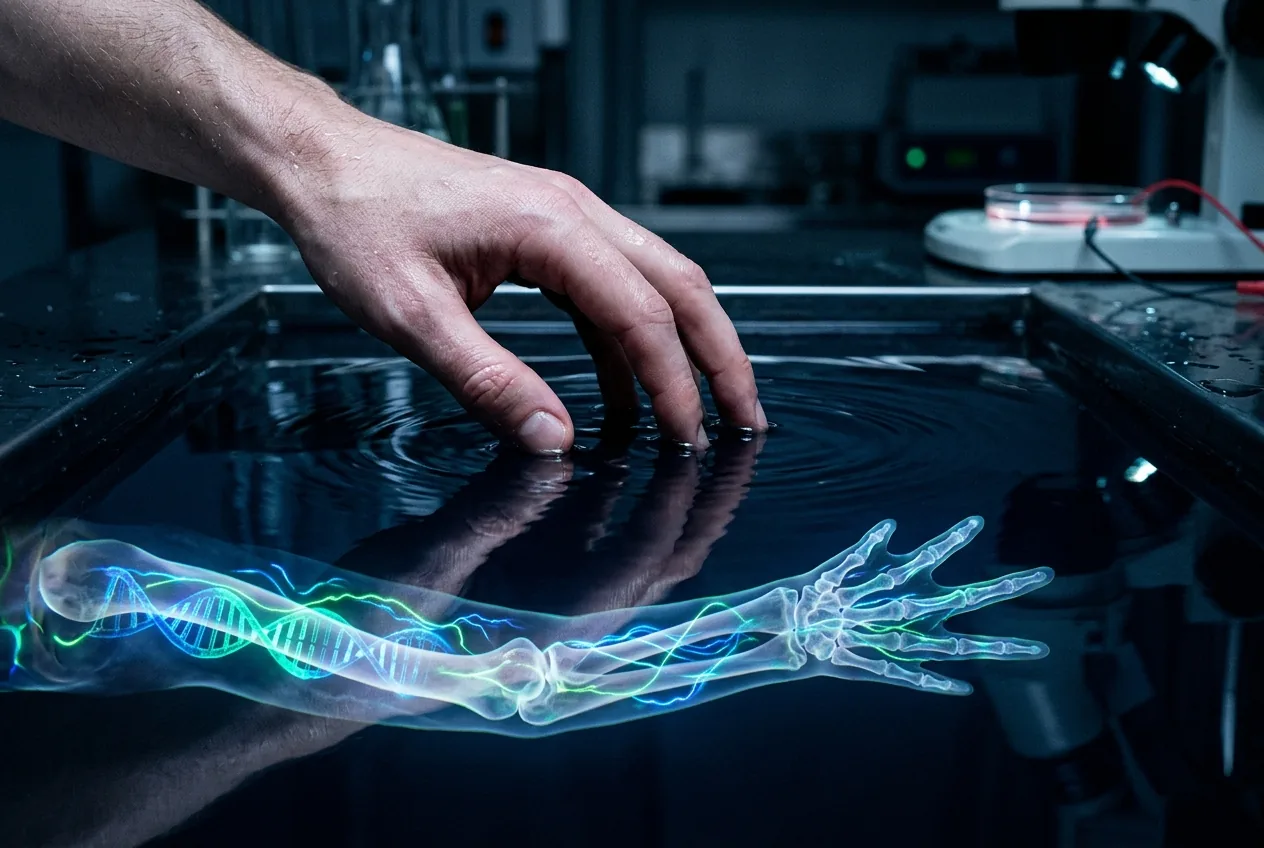
Recent genomic mapping has now isolated what some are calling a 'hidden switch' within the human genome—highly conserved non-coding elements that are structurally nearly identical to those found in regenerating salamanders and fish. The discovery suggests that the blueprint for limb and organ regeneration was never actually deleted from the human lineage; it was simply placed under a heavy epigenetic lock. The question shifting through the corridors of the NIH and private biotech firms is no longer whether we possess these genes, but why evolution decided we should never be allowed to use them.
The implications for public health are theoretically vast, promising a future where the 1.9 million people living with limb loss in the United States alone might find solutions beyond carbon-fiber prosthetics. However, the move from identifying a genetic switch to safely flipping it involves navigating a biological minefield. The same pathways that allow a blastema—the mass of undifferentiated cells that forms a new limb—to grow are uncomfortably similar to the pathways that drive metastatic cancer. In the world of genomics, 'unlimited growth' is rarely a benevolent term.
The Evolutionary Trade-off Between Scars and Regrowth
To understand the current tension in regenerative research, one must look at the divergence between mammals and amphibians roughly 320 million years ago. Amphibians like the axolotl retained the ability to regrow limbs, tails, and even portions of their brains. Mammals, however, prioritized rapid wound healing. If an early human was mauled by a predator, the evolutionary pressure was to seal the wound immediately with scar tissue to prevent exsanguination and infection. A slow, energy-intensive limb regeneration process would be useless if the organism died of sepsis in the interim.
The contradiction lies in our own development. As embryos, humans are remarkably regenerative. In the womb, certain types of tissue damage can heal without scarring, utilizing the same pathways found in axolotls. Shortly after birth, this window slams shut. Identifying the 'switch' isn't just about finding a gene like Lin28 or p21; it’s about understanding the systemic repression that occurs when we transition from a developing organism to a stable, adult one.
The Oncogenic Shadow: Why Regeneration is Dangerous
The primary concern among skeptical geneticists is the inherent risk of oncogenesis. To regrow a limb, a cell must undergo dedifferentiation—essentially 'forgetting' that it is a specialized skin or muscle cell and reverting to a pluripotent-like state. Once in this state, the cell must proliferate rapidly to create the new tissue. If this description sounds familiar, it is because it is the exact protocol followed by a malignant tumor.
Species that regenerate well, like the axolotl, have remarkably robust tumor-suppression mechanisms that humans lack. Mammals appear to have traded the ability to regenerate for a lower baseline risk of early-life cancer. By locking away the enhancers that drive massive cellular proliferation, our bodies effectively keep a lid on potential malignancies. When we talk about 'activating' a hidden genetic switch in humans, we are talking about dismantling a 300-million-year-old safety protocol. The risk isn't just that the limb won't grow; it’s that the limb will grow, and then it won't stop.
Regulatory Blind Spots and the Funding Gap
While the science is advancing, the regulatory and institutional frameworks are struggling to keep pace. Most federal funding from agencies like the NIH is channeled into incremental treatments for chronic diseases—diabetes, heart disease, and kidney failure. Regenerative medicine, by contrast, is increasingly dominated by 'longevity' startups funded by Silicon Valley venture capital. This shift in funding source changes the nature of the questions being asked.
Furthermore, the FDA currently lacks a specific pathway for 'systemic epigenetic remodeling.' Most gene therapies are designed to fix a broken gene (like in sickle cell anemia). A therapy designed to 'turn on' a dormant evolutionary pathway is a different beast entirely. It doesn't fix a defect; it alters the fundamental operating parameters of human biology. Regulators are rightfully wary of interventions that could have multi-generational effects or latent risks that don't manifest until decades after treatment.
The Problem of Complexity Beyond the Gene
Even if we successfully unlock the 'switch,' we face a massive structural hurdle. A human arm is vastly more complex than a zebrafish tail. It requires the precise coordination of bone density, complex nerve networks, and vascular systems that must integrate perfectly with the rest of the body’s circulatory system. This isn't just a matter of cellular growth; it is a matter of architectural instruction.
There is a growing realization that the 'hidden switch' is only the first step in a very long sequence. We may have found the button that turns on the lights in the factory, but we still haven't found the blueprints for the product. In axolotls, the positional information—the internal map that tells the body 'this is where an elbow goes'—is baked into the connective tissue. In humans, that positional memory appears to degrade or be overwritten by the scarring process almost immediately after injury.
The missing data in our current models involves the 'microenvironment' of the wound. It is not enough to change the genes inside the cell; we must change the signals coming from the environment *around* the cell. If the surrounding tissue is shouting 'form a scar,' no amount of internal genetic switching will convince the cells to build a finger instead. Our research is currently heavily weighted toward genomics, perhaps at the expense of the biomechanics and bioelectricity that actually guide tissue formation.
The genome is precise; the world it lives in is anything but. We have discovered that we still carry the ghost of our more resilient ancestors within our DNA, but we are a long way from being able to summon it safely. The evolutionary lock exists for a reason, and as we move toward picking it, we should be very careful about what we let out of the room.




Comments
No comments yet. Be the first!