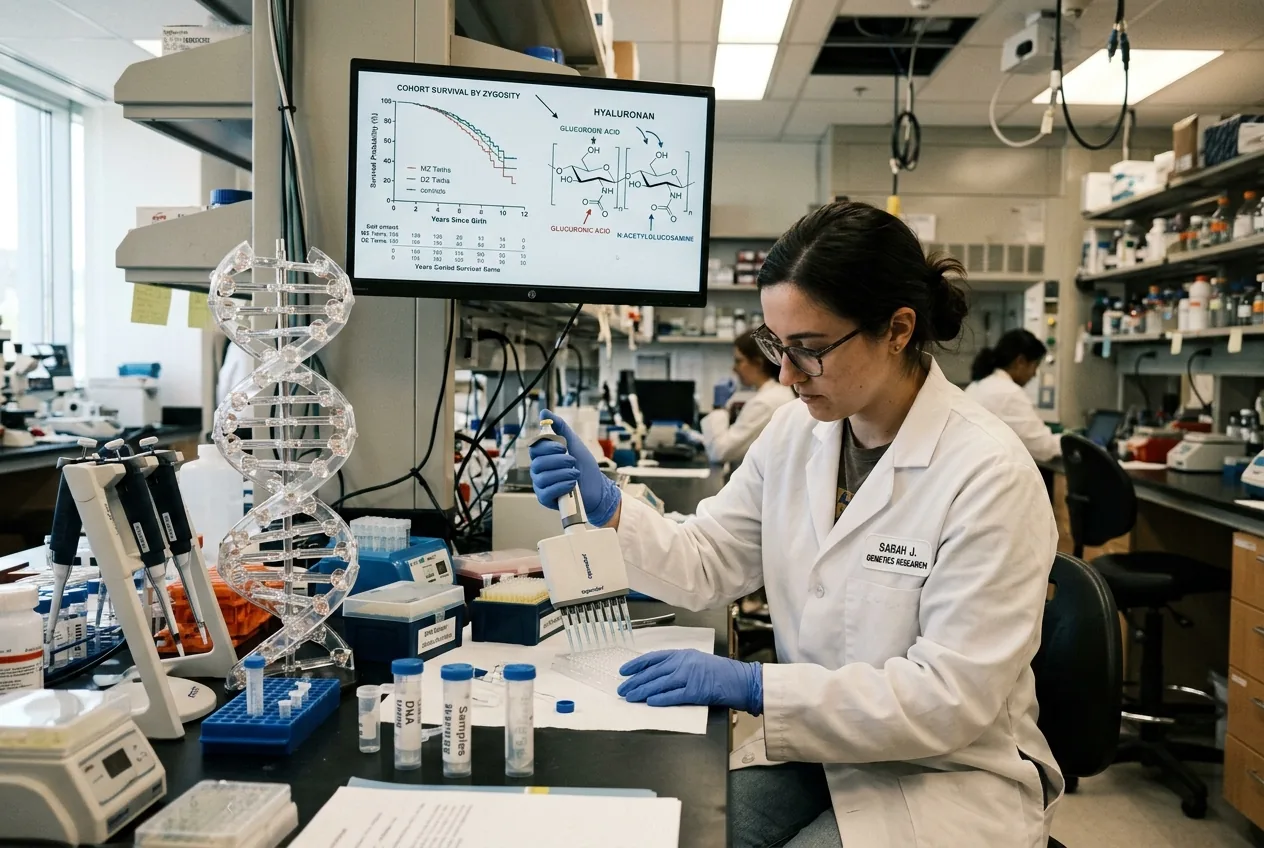
To calculate how much of human aging is programmed by our DNA, you first have to subtract the chaos of living. That is the premise behind a recent analysis from the Weizmann Institute, which used mathematical simulations to strip away "extrinsic mortality"—accidents, infections, and environmental hazards—from the health records of northern European twins. What remains is intrinsic mortality: the quiet, systemic failure of human biology.
By isolating that internal clock, the researchers found that genetic heritability accounts for roughly 50 percent of human lifespan variation, effectively doubling older, widely cited estimates. That recalibration fundamentally changes the risk-reward calculus for longevity research. If biology holds this much sway over decline within a population, the rationale for building polygenic predictors and pathway-focused drugs shifts from theoretical biology to an immediate, bankable target for the pharmaceutical industry.
The Homogeneity Problem in Twin Registries
Heritability is a notoriously slippery metric. It does not measure a fixed biological fate; it measures how much of the variation in a trait is tied to genetics within a specific population at a specific time. The Weizmann cohorts rely heavily on Scandinavian twin registries, which represent populations with historically uniform healthcare access, diets, and exposure profiles.
When environmental noise drops, genetic signals artificially amplify. The 50 percent figure likely represents an upper limit for human heritability, assuming a level of environmental stability completely absent in regions dealing with volatile climates, polluted air, or fractured health infrastructure. A genome can only dictate longevity if the environment gives the body a chance to grow old.
Mole Rats, Hyaluronan, and Uneven Decline
Translating a population-wide genetic signal into a tangible therapy requires mechanistic levers, and those are usually found in cages. Ever since biologist Cynthia Kenyon demonstrated that tweaking a single gene circuit could double the lifespan of microscopic worms, longevity research has chased similar biological switches in mammals.
Recently, researchers at the University of Rochester engineered mice to carry a specific gene (HAS2) from the famously long-lived naked mole rat. The modification boosted production of high-molecular-mass hyaluronan, a cellular matrix molecule. This reduced chronic tissue inflammation and gave the mice a measurable improvement in late-life health, increasing their median lifespan by a few percent.
But the results also highlighted the stubborn unevenness of mammalian aging. While the engineered mice showed enhanced protection against certain cancers and gut-barrier decline, a follow-up study revealed they still suffered from age-related hearing loss. A single genetic pathway can preserve the bowel while ignoring the ear, a biological trade-off that complicates any ambition of a unified anti-aging therapy.
Drugging the Aging Apparatus
Because the genetic architecture of human longevity is highly polygenic—spread across thousands of tiny regulatory networks—broad systemic gene editing remains a distant, high-risk prospect. Instead, the near-term focus is on small molecules and biologics that mimic protective genetic pathways.
The Rochester findings have already triggered searches for druggable targets, such as using hyaluronidase inhibitors to prevent the breakdown of protective molecules. Delphinidin, a naturally occurring pigment, has shown early promise in preclinical models by increasing high-molecular-weight hyaluronan and restricting metastatic behaviour in cancer cells.
Other pharmacological tracks are advancing in parallel, including senolytics designed to clear degraded cells, metabolic modulators like metformin and rapamycin analogues, and epigenetic reprogramming. But altering fundamental processes like cellular turnover and inflammation carries steep biological risks. A drug that modifies immune function to extend life may simultaneously compromise wound repair or trigger unforeseen metabolic cascades.
The Regulatory Vacuum
Developing these therapies requires decades-long surveillance, staggering capital, and a regulatory apparatus that knows what to do with the data. Currently, agencies like the FDA, NIH, and WHO lack a coordinated framework for evaluating aging as a clinical indication, forcing researchers to wedge preventative therapies into traditional approval pathways for specific diseases.
This structural bottleneck heavily favours deep-pocketed biotech firms capable of funding massive, multi-decade trials. It ensures that any successful early interventions will be priced exclusively for affluent demographics. We are looking at a future where intrinsic genetic decline is clinically managed for the wealthy, while extrinsic mortality continues to dictate life expectancy for everyone else.
The mathematical models for isolating human lifespan are getting much sharper. The environment required to actually reach it is entirely another matter.
Sources
- Weizmann Institute of Science
- University of Rochester




Comments
No comments yet. Be the first!