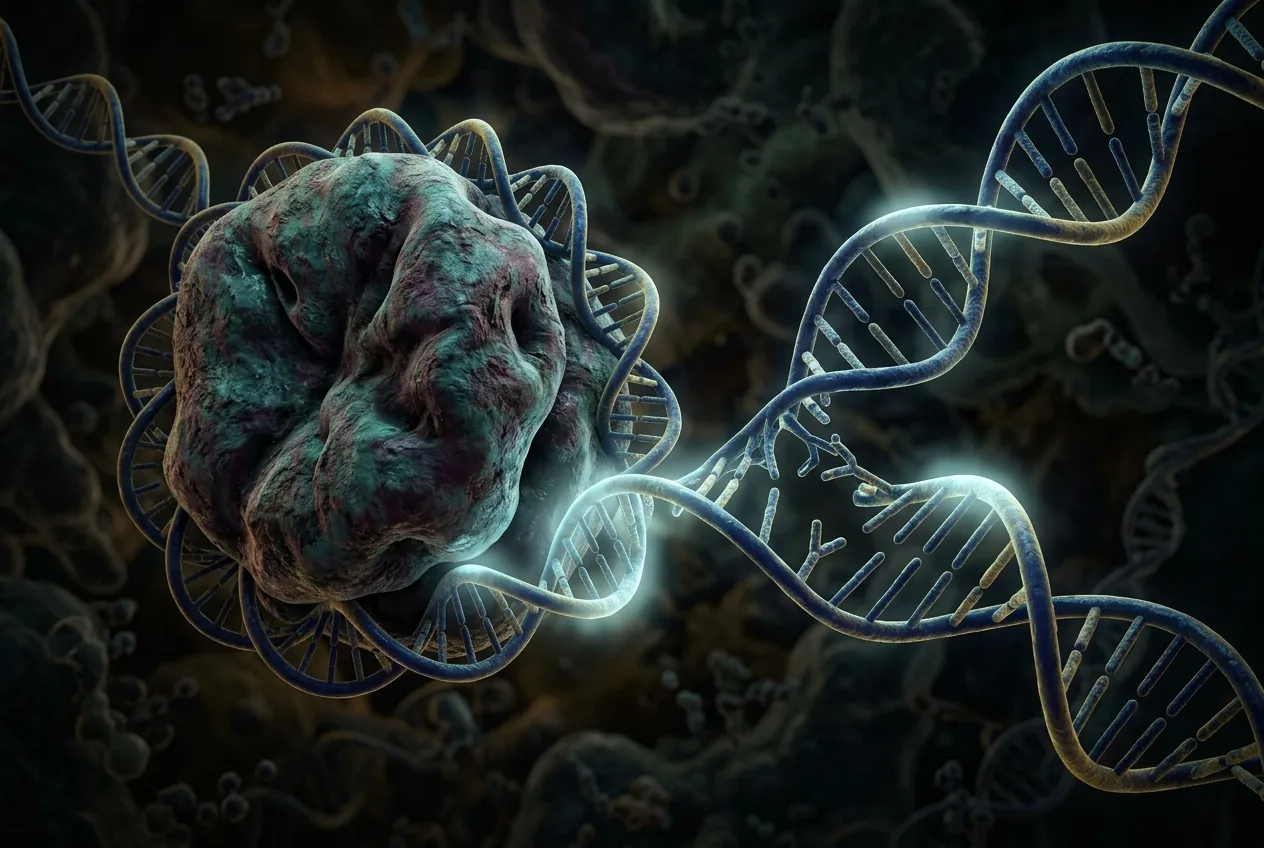
For decades, the standard textbook illustration of human DNA has relied on a deceptively tidy metaphor: the bead on a string. To cram two meters of genetic material into a nucleus only a few microns wide, the cell winds DNA around spool-like proteins called nucleosomes. The prevailing wisdom taught to every biology undergraduate is that this process is a binary lockbox. If the DNA is wrapped, it is silent, sequestered, and inaccessible; if it is unwrapped, it is active. It was a clean, elegant model that allowed researchers to treat the genome like a library where books are either on the shelf or in a reader's hands.
The discovery shifts our understanding of genetic regulation from a simple on-off switch to something resembling a 14-position dimmer dial. This is not merely a nuance of molecular biology; it is a fundamental rewrite of the genomic code that governs how we age and how diseases like cancer bypass the cell’s natural defenses. If the genome is the blueprint, we have just discovered that the ink is visible even when the pages are folded shut.
The statistical ghosts of the nucleosome
The problem with the old model wasn't a lack of curiosity; it was a lack of resolution. For years, the scientific community relied on “enrichment-based” assays that looked at populations of millions of cells at once. These methods provided a blurry average, where the subtle distortions of individual DNA-protein interactions were smoothed out into a statistical mean. It was like trying to understand the brushwork of a Van Gogh by looking at a low-resolution satellite photo of the museum.
Vijay Ramani, a Gladstone Investigator and one of the study's leads, had previously pushed the envelope with a technology called SAMOSA (Single-molecule Adenine Methylation Oligo-level Sequencing Assay). While SAMOSA allowed scientists to map where nucleosomes were located on individual DNA strands, it still treated the nucleosomes themselves as black boxes. To peer inside, the team developed IDLI (Iteratively Defined Lengths of Inaccessibility), an AI model trained to recognize the specific signatures of structural variation within the nucleosome itself.
Fourteen shades of genomic access
The research team identified 14 distinct structural states that a nucleosome can inhabit. This is where the discovery moves from a technical curiosity to a regulatory bombshell. These 14 states were not randomly distributed; they appeared to be a programmed language. The team observed the same patterns in human stem cells, liver-like cells, and primary mouse tissue, suggesting that this “crumpling” is a conserved mechanism across species and cell types.
The existence of these states challenges the current obsession with “open chromatin” in biotechnology. For the last decade, the goal of many epigenetic therapies has been to flip the switch from closed to open. But if 85 percent of the “closed” genome is actually varying degrees of open, then we have been aiming at the wrong targets. A gene might be “on” not because its nucleosomes have been stripped away, but because they have been precisely distorted to allow a specific transcription factor to sneak in.
This adds a layer of complexity to the search for disease drivers. In many complex conditions—think Alzheimer's or autoimmune disorders—researchers have struggled to find the “smoking gun” mutation. The AI’s discovery suggests the fault may not lie in the sequence of the DNA, but in the structural state of the spool. A gene that should be at 10 percent volume might be stuck at 40 percent because its nucleosome is in state #7 instead of state #2. Over a lifetime, that subtle leak in gene expression could be the difference between a healthy cell and a malignant one.
The architects of the distortion
One of the more unsettling aspects of the study is the role of transcription factors. Historically, these proteins were viewed as the “readers” of the genome—they found an open spot on the DNA and landed there to begin the process of making RNA. The Gladstone and Arc team found that transcription factors are actually active architects of nucleosome distortion. When the researchers chemically removed specific transcription factors, the nucleosome patterns didn't just stay the same; they shifted back toward a more “locked” state.
This suggests a recursive power dynamic: the proteins that are supposed to read the instructions are the same ones physically warping the filing system to make those instructions easier to find. It is a level of cellular agency that complicates our attempts to model genetic networks. If a transcription factor can force a nucleosome to “crumple,” then the physical structure of the DNA is as much a result of activity as it is a precursor to it.
This also points toward a potential blind spot in current pharmaceutical development. If we design drugs to block a transcription factor from binding to an “open” site, we might be ignoring the fact that the factor has already altered the “closed” site next door. We are treating the symptoms of a structural shift rather than the cause.
A new lens for the cost of aging
The implications for aging research are particularly acute. We know that as we age, our chromatin becomes “leaky.” Genes that should be silenced in a heart cell start to flicker on, creating cellular noise that degrades organ function. Until now, we attributed this to a general failure of the cell to maintain its nucleosome density—a sort of genomic wear and tear.
This perspective also raises uncomfortable questions about environmental risk. We know that pollution, heavy metals, and even chronic stress can leave epigenetic marks on our DNA. If these external factors are influencing the “grammatical” structure of nucleosome distortion, we are looking at a much more sensitive interface between our environment and our biology than previously imagined. The regulatory agencies like the EPA or the FDA are barely equipped to monitor DNA damage or methylation; they are nowhere near prepared to regulate substances that might subtly alter the “crumple” of a stem cell’s genome.
The transition from observation to intervention
There is also the institutional inertia to consider. The scientific community has invested billions into the binary model of chromatin. Thousands of papers have been published based on the assumption that “inaccessible” DNA is truly dark. To suddenly admit that the majority of the genome is in a state of partial, programmable visibility requires a massive pivot in how we design experiments and analyze data. As Hani Goodarzi noted, we have been reading a text of sound and silence; now we have to learn a grammar of infinite gradients.
The discovery is a reminder that in genetics, simplicity is often a mask for our own technical shortcomings. We preferred the lockbox model because it was easy to draw and easier to count. The reality—a messy, crumpled, highly dynamic landscape of 14 structural states—is much harder to manage, but it is likely where the answers to our most persistent medical mysteries are hidden. The genome is precise; the world it lives in is anything but, and we are only just beginning to see the fingerprints of that messiness on the very spools that hold our lives together.




Comments
No comments yet. Be the first!