In a cramped laboratory setting, a petri dish holds a cluster of induced pluripotent stem cells, each vibrating with the genetic signature of Trisomy 21. For decades, the presence of that third copy of chromosome 21 has been viewed as an immutable biological fact, a foundational blueprint that dictates the development of the brain, the heart, and the immune system. Recent reports from molecular biologists, however, suggest that the blueprint might finally be subject to a heavy-handed revision. By deploying specialized versions of CRISPR-Cas9, researchers are no longer just looking to snip away single-point mutations; they are attempting to silence an entire macro-structure of DNA.
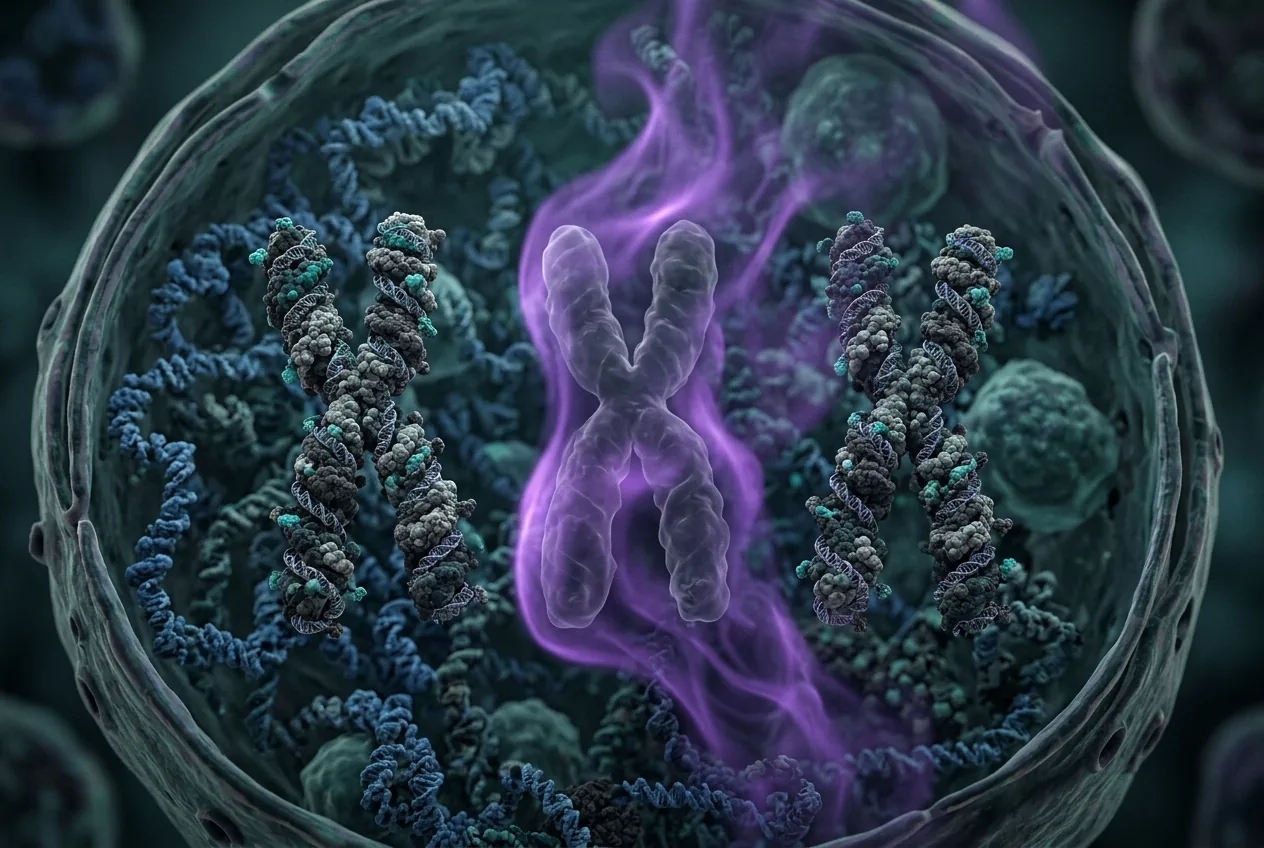
The technical shift involves moving away from the molecular scissors that define early gene editing and toward a more subtle form of epigenetic control. Rather than trying to physically remove a chromosome—a chaotic process that usually ends in cell death—scientists are experimenting with 'switching off' the extra genetic material. The goal is to mimic the natural process of X-inactivation, where the body naturally silences one of the two X chromosomes in female cells. If the dosage of proteins produced by chromosome 21 can be dialed down to match those of a typical pair, the theory suggests that the systemic health complications associated with Down syndrome could be mitigated or even prevented.
This is the nut of the current moment in genomic medicine: the transition from editing genes to managing genomes. As tools like CRISPR become more refined, the medical establishment is shifting its gaze from rare, single-gene disorders like sickle cell anemia toward more complex, chromosomal conditions. But while the laboratory data suggests that silencing a chromosome is possible in a dish, the translation to a living, breathing human population exposes a massive disconnect between molecular capability and clinical reality. We are witnessing the birth of a technology that can rewrite the most fundamental aspects of human biology before we have decided whether we have the right, or the resources, to do so.
The Scale of the Chromosomal Dosage Problem
To understand the sheer audacity of 'switching off' Down syndrome, one must appreciate the scale of the target. Most CRISPR therapies currently in clinical trials target a single gene. Chromosome 21, the smallest human autosome, contains over 300 genes. These genes don't act in isolation; they interact in a complex, rhythmic dance with the rest of the genome. Down syndrome is not caused by a single 'broken' protein but by a 'dosage effect'—an over-expression of hundreds of proteins that alters the trajectory of an individual's development from the moment of conception.
Current research efforts, such as those building on the foundational work at the University of Massachusetts, utilize a specific gene called XIST. In nature, XIST produces a large RNA molecule that acts like a molecular blanket, coating a chromosome and preventing its genes from being expressed. By using CRISPR to insert the XIST gene into the third copy of chromosome 21 in stem cells, researchers have successfully demonstrated that they can induce 'chromosomal silence.' The resulting cells show gene expression levels that look remarkably similar to those without Trisomy 21. However, the signal-to-noise ratio in these experiments is often obscured by the fact that stem cells in a controlled environment do not face the environmental stressors of a developing embryo or an aging adult.
The skepticism from the wider genetics community stems from the 'all-or-nothing' nature of this approach. Silencing a chromosome in every cell of a human body is a task of near-impossible proportions. If a therapy only reaches 20% or 30% of cells, does it actually improve health outcomes, or does it create a mosaicism that introduces new, unpredictable biological risks? The assumption that the body will simply adapt to a sudden drop in protein production from a silenced chromosome ignores the plasticity and the rigid checkpoints of human development.
The Delivery Deadlock and Institutional Blind Spots
Even if the molecular mechanism worked perfectly, the logistics of delivery remain the primary roadblock. For a condition like Down syndrome, which affects the development of every organ system, a genetic intervention would ideally happen in utero. This introduces a level of risk that current regulatory frameworks, including those of the FDA and the EMA, are fundamentally unequipped to handle. The history of fetal intervention is a cautious one, defined by the high probability of triggering miscarriage or unintended developmental defects. Using a viral vector or a lipid nanoparticle to deliver CRISPR components to a developing fetus is a proposition that sits firmly in the realm of high-stakes biological gambling.
Furthermore, there is a glaring contradiction in how research funding is allocated. Millions of dollars are being funneled into these high-tech 'cures,' while the basic public health infrastructure for people with Down syndrome remains underfunded. In regions like Maharashtra, India, recent headlines highlight the disbursement of massive medical aid funds for immediate clinical needs, yet these funds are often reactive, focusing on surgery and acute care rather than the long-term, integrated support that genomic research promises but cannot yet deliver. There is a palpable tension between the 'moonshot' genetics being performed in New York or Boston and the reality of healthcare delivery in the rest of the world.
The question of who carries the biological risk is also geographic and economic. In many high-income nations, the prevalence of Down syndrome has decreased due to prenatal screening and selective termination. This has created a shrinking cohort of individuals for clinical trials, leading some to worry that the technology will eventually be marketed as a 'designer' upgrade for those who can afford it, rather than a therapeutic tool for those who need it. The risk is that we are developing a technology for a population that is being systematically selected against before they are even born.
The Ethics of 'Fixing' and the Disability Rights Lens
Beyond the technical hurdles lies an uncomfortable ethical dilemma: the medical model of 'fixing' Down syndrome versus the social model of disability. Many in the Down syndrome community and their advocates argue that the drive to 'switch off' the extra chromosome is a form of modern eugenics. They point to the fact that people with Down syndrome are living longer, more integrated lives than ever before, thanks to better cardiac care and educational support, not genetic editing. When scientists talk about 'switching off' the genetic cause, they are implicitly stating that the condition itself is a defect to be erased.
This perspective is often missing from the press releases that tout CRISPR as a 'miracle tool.' As a geneticist, I have seen how the allure of a precise molecular solution can blind researchers to the human complexity of the condition. Down syndrome is not just a collection of medical comorbidities; it is an identity. By framing it as a 'dosage problem' to be solved with RNA silencing, the industry risks ignoring the environmental and social factors that contribute most significantly to the quality of life for these individuals. The obsession with the genome can lead to a policy of neglect for the person.
Moreover, the biological risk of off-target effects remains a persistent ghost in the machine. CRISPR-Cas9 is notoriously prone to making cuts or changes in places it shouldn't. In the context of chromosomal silencing, an off-target effect could mean accidentally silencing a crucial gene on a different chromosome, potentially leading to cancer or other severe metabolic disorders. The trade-off between the perceived benefit of 'normalizing' chromosome 21 and the risk of catastrophic genetic damage is a calculation that no institutional review board is currently ready to sign off on.
Is the goal to improve cognitive function, or is it to prevent the early-onset Alzheimer's that many people with Down syndrome face in their 40s and 50s? These are two very different clinical targets with very different risk profiles. Targeting Alzheimer's later in life through epigenetic silencing might be more ethically and technically feasible than trying to reshape an entire brain during embryonic development. Yet, the current research push often conflates these goals into a single, vague narrative of 'curing' the condition.
The Persistence of the Extra Copy
The models in the lab are getting sharper, and our ability to manipulate the epigenome is undeniably impressive. We have moved from being readers of the genetic code to being active editors. However, the assumption that we can simply 'switch off' a fundamental part of a person's biological makeup without consequences is a reflection of scientific hubris. The genome is a highly integrated, responsive system; it is not a set of independent light switches that can be flipped at will.
As we move forward, the real breakthrough might not be the ability to silence a chromosome, but the realization that our technical capacity has outpaced our social wisdom. We are approaching a point where we can offer a 'genetic undo' button for one of the most common human conditions, but we haven't yet built a world that is truly ready to support those who choose not to press it. The funding for high-tech intervention continues to flow, even as the infrastructure for basic human support remains fragile and fragmented.
The genome is precise; the world it lives in is anything but. The risk isn’t in the gene or the extra chromosome alone, but in the assumption that a molecular silence can replace the loud, messy work of building an inclusive society.




Comments
No comments yet. Be the first!