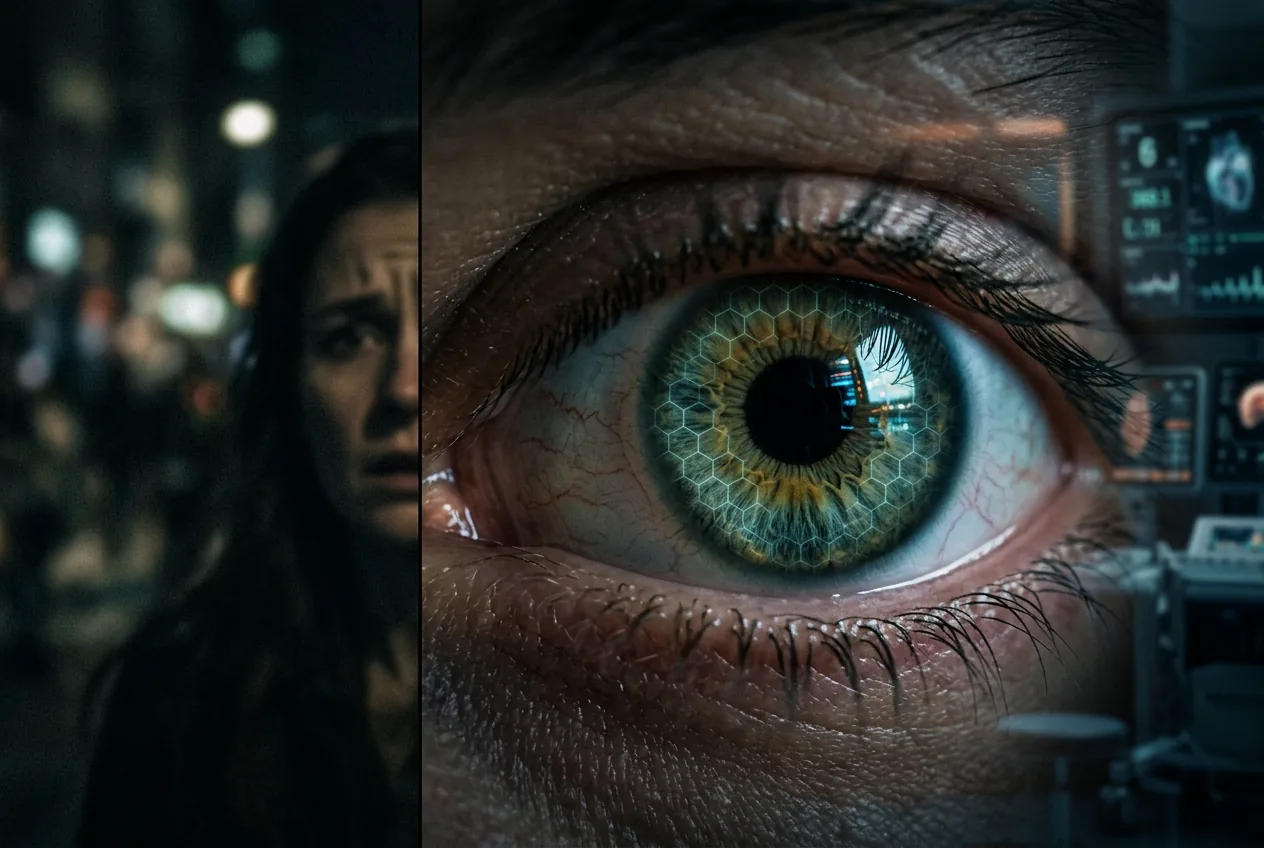
In the quiet, low-lit corridors of a suburban home in Stevenage, a six-year-old girl recently performed a task that, until a few months ago, was biologically impossible for her. Saffie Sandford, born with a rare genetic mutation that effectively shuttered her vision in low light, looked up and saw her parents’ faces in the dark. It is the kind of domestic detail that sounds like a medical cliche, yet it represents the culmination of a high-stakes clinical gamble using a viral vector to rewrite the instructions inside her retinas.
The core of the issue lies in the RPE65 gene. In a healthy eye, this gene provides instructions for making a protein essential for normal vision, specifically within the retinal pigment epithelium. This protein is part of the visual cycle, the process by which light hitting the back of the eye is converted into electrical signals the brain can interpret. Without it, the light-sensing cells—the photoreceptors—eventually die off from lack of nourishment and the accumulation of toxic byproducts. For Saffie, the therapy involved a subretinal injection: a surgical delivery of a functional copy of the RPE65 gene, tucked inside a modified adeno-associated virus, directly into the space behind her retina.
The developmental clock and the limits of late-stage intervention
While the clinical success in Sandford’s case is undeniable, the broader data emerging from GOSH and University College London (UCL) indicates that the efficacy of these genetic “patches” is heavily dependent on the age of the recipient. Researchers followed 15 children treated with the therapy between 2020 and 2023, and the results underscore a hard biological truth: the eye may be the target, but the brain is the gatekeeper. The youngest children in the cohort showed the most significant improvements, not just in their retinal sensitivity, but in the strength of the visual pathways leading to the cortex.
This raises an uncomfortable reality for families of older children or adults living with LCA. As the disease progresses, the physical structure of the retina degrades, and the visual cortex—the part of the brain responsible for processing sight—begins to repurpose itself for other senses, a phenomenon known as cross-modal plasticity. If the brain hasn't received a clear signal from the eyes during the “critical period” of early childhood, simply fixing the genetic hardware in the eye later in life may not be enough to restore functional vision. The hardware is upgraded, but the software has already been written for a different set of inputs.
The use of pattern visual evoked potentials—a test that measures the electrical activity in the brain in response to visual stimuli—allowed the GOSH team to prove that the therapy was actually strengthening these pathways. However, the improvements in clear, sharp vision (visual acuity) were notably more limited in older participants. This suggests that while gene therapy can restore the ability to detect light and movement—essentially “turning the lights on” in the dark—it cannot necessarily reconstruct the fine-tuned neural architecture required for reading or recognizing distant faces if that architecture was never built in the first place.
A question of access in a high-cost therapeutic landscape
The deployment of Luxturna (voretigene neparvovec) within a publicly funded system like the NHS is its own kind of anomaly. At a list price that can exceed £600,000 per patient, it sits at the center of a growing tension between revolutionary biotechnology and the sustainability of public health budgets. In many ways, the eye is the perfect testing ground for these therapies; it is an “immune-privileged” site, meaning the body is less likely to launch a massive inflammatory response against the viral vector, and because the space is small, only a tiny amount of the expensive drug is required.
Yet, the success of the Sandford case highlights a gap in our current screening infrastructure. Her parents had no idea they were carriers of the LCA mutation until the diagnosis was made. This is a common story in the world of rare autosomal recessive disorders. While we possess the technology to screen for these risks pre-conception, the cost and logistical burden of population-wide genomic screening remain prohibitive. We are currently in a reactive phase of medicine—treating the child once the symptoms manifest—rather than a proactive one that identifies risk before the biological damage begins. For every child like Saffie who receives a timely intervention, others are missed because their symptoms are initially dismissed as standard myopia or “clumsiness” in the dark.
The regulatory path for such therapies is also fraught with uncertainty regarding long-term durability. We do not yet know if the effects of a single RPE65 injection will last twenty, thirty, or fifty years. If the transgene expression fades over time, can a patient be re-treated, or will the initial exposure to the viral vector have primed their immune system to reject a second dose? These are the questions that current clinical trials are not yet old enough to answer. We are essentially conducting a multi-decade experiment in real-time, with the visual independence of a generation of children at stake.
Bioethics and the ‘miracle’ trap
There is a persistent risk in the way these stories are told. Media narratives frequently lean into the “magic wand” or “miracle cure” framing, which, while reflecting the very real joy of a family, can inadvertently skew public perception of what gene therapy actually is. Luxturna is a monumental achievement, but it is not a cure in the sense that it returns the eye to a state of perfect, wild-type health. It is a biological stabilization. It stops the clock on degeneration and improves functional vision, but the patient still lives with a modified genome and a retina that remains structurally fragile.
Furthermore, the focus on high-cost genetic interventions can sometimes overshadow simpler, more equitable public health goals. While we celebrate the restoration of sight for a handful of children with LCA, millions globally suffer from preventable blindness due to lack of basic cataract surgery or vitamin A deficiency. The disparity between the cutting-edge genomics of London and the basic clinical needs of the developing world is a biological risk in itself, creating a two-tiered system of human sensory experience.
As Saffie Sandford moves forward, her case will continue to be monitored as a bellwether for the durability of genomic medicine. The immediate victory is hers and her family's, but the broader scientific community remains tasked with a harder job: figuring out how to make these interventions more than just rare, expensive exceptions. The ability to see in the dark is an extraordinary gift, but the true test of this technology will be its ability to withstand the slow, inevitable light of the decades to come.
The genome is precise; the brain it informs is an adaptable, time-sensitive machine. The real breakthrough isn't just in the injection, but in catching the brain while it’s still willing to learn how to see.




Comments
No comments yet. Be the first!