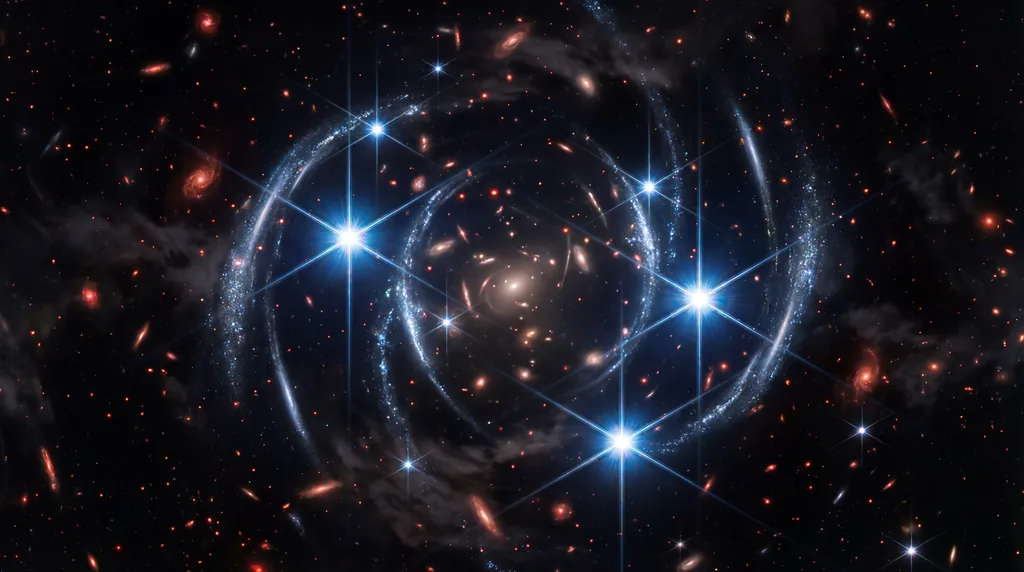

Since its deployment, the James Webb Space Telescope (JWST) has functioned as a time machine, capturing the faint glimmers of star clusters from the universe's first billion years. However, as astronomers peer deeper into high-redshift environments—reaching as far back as redshift z ≈ 10—they have encountered a cosmic puzzle. In the dense gravitational fields of massive galaxy clusters, the light from these distant objects is often split into multiple "mirror images." While standard gravitational theory suggests these duplicates should be identical in their light composition, recent observations have revealed surprising spectral mismatches. This phenomenon, now dubbed the "Mirror Image Paradox," is being recognized not as a flaw in our models, but as a groundbreaking diagnostic tool for identifying the most massive and elusive stars in the early universe.
The Mechanics of Cosmic Mirrors
To understand why these mismatched images are so significant, one must first understand the role of gravitational lensing. In the vast stretches of the cosmos, massive structures like galaxy clusters act as natural telescopes. Their immense gravity warps the fabric of spacetime, bending the path of light from even more distant background objects. When a background star cluster aligns perfectly behind a foreground lens, the light is stretched into arcs and occasionally split into two or more mirror images that appear on opposite sides of a theoretical line known as the "critical curve."
Historically, the assumption in observational astronomy has been that these mirror images possess identical spectral energy distributions (SEDs). An SED is essentially a fingerprint of a star cluster’s light, mapping how much energy it emits at different wavelengths. Because both images originate from the same source at the same moment in its evolution, they should, in theory, look exactly the same once the geometric distortions of the lens are accounted for. However, the high-resolution capabilities of the JWST are now revealing that this symmetry is frequently broken, suggesting that a more localized physical process is at play.
Breaking the Symmetry: The Microlensing Effect
The primary culprit behind these spectral discrepancies is gravitational microlensing. While the galaxy cluster provides the "macro" lens that creates the mirror images, individual stars or compact objects within that foreground cluster act as "micro" lenses. These smaller objects can pass directly in front of the background star cluster, providing an additional, localized boost in magnification. Because the two mirror images take slightly different paths through the foreground cluster, one image might be subject to intense microlensing while the other remains unaffected.
Research led by Angela Adamo, Erik Zackrisson, and Jose M. Diego indicates that this microlensing does not amplify the entire star cluster uniformly. Instead, it selectively magnifies the brightest, most massive stars within that cluster. If a single "monster star" in a distant cluster is magnified by a factor of ten or one hundred in only one of the mirror images, the total SED of that image will shift significantly compared to its twin. The study argues that these detectable differences in JWST observations are likely limited to star clusters with a mass of less than 100,000 solar masses and ages younger than 5 million years, where the light is still dominated by short-lived, high-mass stars.
The Hunt for Population III and Top-Heavy IMFs
The implications of these findings extend to the very foundations of how we understand star formation in the early universe. Astronomers use the Initial Mass Function (IMF) to describe the distribution of stellar masses in a newly formed population. In the modern, "local" universe, the IMF is typically "bottom-heavy," meaning for every massive star, there are hundreds of smaller, sun-like stars. However, theorists have long proposed that the first generation of stars—known as Population III stars—formed in a "top-heavy" environment where massive "monster stars" (potentially exceeding 100 or even 500 solar masses) were common.
The research team suggests that the prevalence of lensed star clusters with highly discrepant mirror-image SEDs could serve as a direct probe of these extreme stellar populations. If the early universe was indeed populated by top-heavy IMFs, the probability of a single massive star dominating the cluster's light—and thus being susceptible to microlensing-induced spectral shifts—increases dramatically. Therefore, when JWST identifies a pair of mismatched mirror images at high redshift, it may be witnessing the specific "fingerprint" of a Population III star that would otherwise be far too distant to see individually.
Detailed Findings: Age and Mass Constraints
In their comprehensive analysis, Adamo, Zackrisson, and Diego explored the specific circumstances under which these mismatches become observable. They found that for older or more massive star clusters, the "noise" from thousands of smaller, cooler stars tends to average out the light, making the impact of microlensing on a single star negligible to the overall SED. Specifically, they argue that once a cluster exceeds 5 million years in age, its most massive stars have already ended their lives in supernova explosions, leaving behind a more stable and uniform light profile.
This creates a narrow but vital observational window. When JWST detects a significant spectral mismatch, astronomers can infer with high confidence that they are looking at an exceptionally young and relatively low-mass star cluster. This allows researchers to "weigh" the upper end of the stellar population in the early universe, providing empirical data to constrain models of how the first stars influenced the reionization of the cosmos and the chemical enrichment of early galaxies.
Implications for JWST Deep Field Surveys
These findings fundamentally change how astronomers interpret high-redshift (z ~ 10) observations in lensing-cluster fields. Rather than viewing spectral differences between mirror images as observational errors or dust interference, researchers can now use them as a diagnostic tool. This method effectively turns the entire universe into a high-magnification laboratory. By analyzing the delta in the SEDs between two lensed images, scientists can mathematically isolate the contribution of the individual stars that are being microlensed.
This "differential" approach provides a way to study stars across cosmic time that were previously thought to be beyond the reach of any telescope. In the context of the JWST’s deep-field surveys, this means every mismatched lensed arc is a potential candidate for a Population III discovery. It moves the search for the "first light" from a broad search for distant galaxies to a precise hunt for individual stellar titans hidden within those galaxies.
What’s Next: Future Directions
The next phase of this research involves a systematic survey of known lensed clusters in JWST's archive to identify more candidates for spectral mismatching. As the sample size of these "broken mirrors" grows, astronomers will be able to determine if the top-heavy IMF was a universal feature of the early universe or if it was localized to specific environments. Furthermore, follow-up spectroscopy with JWST’s NIRSpec instrument could potentially identify the chemical signatures of these massive stars, confirming whether they lack the "metals" (elements heavier than helium) characteristic of Population III stars.
Ultimately, the "Mirror Image Paradox" highlights the ingenuity required to study the dawn of time. By leveraging the quirks of gravitational physics, astronomers are finding that the very distortions that once confused our view of the deep past are now the keys to unlocking its greatest secrets. The mismatched light of twin star clusters may be the closest we ever get to seeing the first "monster stars" that paved the way for the universe we inhabit today.
Addressing Common Questions
What are Population III stars?
Population III stars are a hypothetical class of stars consisting of the first stars to form in the universe, composed entirely of primordial hydrogen and helium. They are theorized to be much larger and hotter than modern stars, playing a crucial role in early cosmic evolution.
How does gravitational microlensing affect JWST observations?
Microlensing occurs when a compact object in a foreground lens galaxy passes in front of a background source. For JWST, this can cause a temporary but extreme magnification of individual stars within a distant cluster, leading to the spectral mismatches observed in mirror images.
Can JWST see the first stars in the universe?
While JWST is powerful, individual Population III stars are generally too faint to be seen directly at such extreme distances. However, through the combination of macro-lensing (from galaxy clusters) and microlensing (from individual stars), JWST can detect their influence on the light of their parent star clusters.




Comments
No comments yet. Be the first!