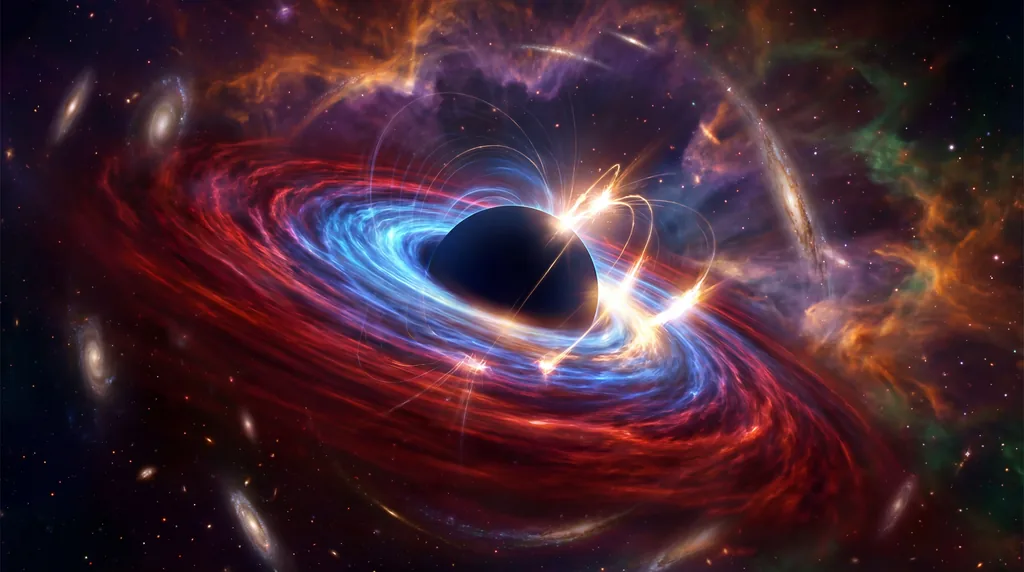

The Comisso-Asenjo mechanism is a sophisticated process for extracting energy from rotating black holes through magnetic reconnection in the ergosphere. This phenomenon occurs when a black hole is immersed in a high-intensity magnetic field and surrounded by magnetized plasma, causing field lines to break and reform. During this "magnetic short-circuit," plasma particles are accelerated into two streams: one falling into the event horizon with negative energy and another escaping with positive energy, effectively "stealing" rotational energy from the black hole itself.
Recent research by Ke Wang, Xiao-Xiong Zeng, and Yun Hong has pushed the boundaries of our understanding of this mechanism by applying hotspot imaging to the "plunging region." For years, the area just outside a black hole's event horizon remained a visual mystery due to the extreme acceleration of matter. This study, titled "Hotspot Images from Magnetic Reconnection Processes in the plunging Region of a Kerr Black Hole," provides a numerical framework for tracking plasma as it makes its final, turbulent descent into the gravitational well. By simulating these trajectories, the research team has identified unique visual signatures that distinguish matter on a terminal plunge from matter in stable orbits.
What is the Comisso-Asenjo mechanism?
The Comisso-Asenjo mechanism describes the conversion of magnetic energy into kinetic and thermal energy within the ergosphere of a rotating Kerr black hole. Unlike the traditional Penrose process which relies on particle decay, this mechanism utilizes magnetic reconnection in highly magnetized plasma environments. It is most efficient when the black hole spin is near-maximal and the plasma is strongly magnetized (σ₀ > 1/3), resulting in bursty, detectable radiation emissions.
In this process, the magnetic field lines within the accretion disk undergo a rapid reconfiguration. As these lines "snap" and reconnect, they act as an engine, accelerating plasma to relativistic speeds. One portion of this plasma is flung outward, while the other is driven into the black hole. The researchers focused specifically on how this mechanism operates within the plunging region—the space between the Innermost Stable Circular Orbit (ISCO) and the event horizon—where gravity is so intense that matter can no longer maintain a stable path and must spiral inward.
The Invisible Frontier: Exploring the Plunging Region
The plunging region serves as a critical laboratory for testing General Relativity because it represents the final transition of matter before it is lost to the event horizon. Until recently, this zone was often treated as a visual "void" in simulations because particles move through it so rapidly. However, by modeling magnetic reconnection events as localized "hotspots," the research team has demonstrated that this region can be illuminated and studied through high-resolution imaging.
Tracking matter in this zone is inherently difficult because the Kerr black hole's rotation drags spacetime itself, a phenomenon known as frame-dragging. Particles entering the plunging region are subject to extreme gravitational redshifts and Doppler shifts, which warp their light before it reaches a distant observer. The study by Wang, Zeng, and Hong successfully utilized numerical simulations to trace these light paths, allowing for the creation of synthetic hotspot images that reflect the actual physical conditions of the plasma's final moments.
How do hotspot images differ in the plunging region vs. circular orbits?
Hotspot images in the plunging region exhibit a rapid decrease in flare intensity over time, whereas images in circular orbits maintain a nearly constant luminosity. This distinction arises because plasma in the plunging region is accelerating toward the black hole, causing the emitted light to be severely redshifted and dimmed as it approaches the event horizon. In contrast, plasma in stable circular orbits remains at a consistent distance, providing a steady "flicker" of light.
- Plunging Orbits: Flare intensity gradually fades as the plasma moves deeper into the gravitational well.
- Circular Orbits: Flare intensity remains stable, providing a continuous signal for observers.
- Energy Extraction: The signal for energy extraction is notably weaker in the plunging zone compared to the ISCO.
- Escape Velocity: Only specific magnetic reconnection conditions allow plasma to gain enough energy to flee the black hole.
The researchers found that while the Comisso-Asenjo mechanism is effective at accelerating plasma, the overwhelming gravity of the black hole in the plunging region often "muffles" the visual signal. This means that while energy is being extracted, the observational evidence—the hotspot image—appears fainter and more ephemeral than similar events occurring further out in the accretion disk. This discovery is vital for astronomers who must distinguish between different types of flares in real-time data.
What role does the plunging region play in black hole imaging?
The plunging region is essential for black hole imaging because it provides the most direct evidence of the transition between the accretion disk and the event horizon. By observing magnetic reconnection within this zone, astrophysicists can map the curved geometry of spacetime and measure the black hole's spin more accurately. These dynamic hotspots act as "beacons" that illuminate the otherwise dark space surrounding the singularity.
Using these simulation models, the researchers were able to identify the specific "flicker" of light that marks the transition of matter across the event horizon. This has profound implications for the Event Horizon Telescope (EHT) and future interferometry projects. By knowing what a "plunging flare" looks like compared to a "stable flare," scientists can better interpret the complex, turbulent images of Sgr A* and M87*, potentially revealing the real-time dynamics of plasma as it disappears from our observable universe.
Results: Comparing Signals and Energy Extraction
Numerical analysis revealed that the energy extraction signals are significantly weaker in the plunging zone due to the extreme gravitational environment. When magnetic reconnection occurs within the ISCO, the resulting hotspots are short-lived. The study indicates that even when the Comisso-Asenjo mechanism successfully accelerates plasma, the "escape condition" is much harder to meet once the matter has entered the plunging region. Most of the energy redirected by the magnetic field is still swallowed by the black hole.
This finding suggests that the most visible "jets" and flares associated with black hole energy extraction likely originate just outside the plunging region. However, the weak signals that do emerge from the plunging zone are highly informative. They carry the unique signature of the Kerr black hole's inner-most physics, providing a "fingerprint" of the spacetime curvature that cannot be found anywhere else in the cosmos. The research emphasizes that if the escape condition is not met, the hotspot simply vanishes into the horizon, a process the authors documented through rigorous ray-tracing simulations.
Future Directions for the Event Horizon Telescope
Applying these hotspot simulation models to future observations of Sgr A* and M87* could allow scientists to resolve the motion of plasma in near-real-time. The work of Wang, Zeng, and Hong provides a theoretical roadmap for identifying the magnetic reconnection process in actual telescope data. As imaging technology improves, the ability to distinguish between plunging trajectories and circular orbits will be the key to confirming the existence of the Comisso-Asenjo mechanism in nature.
Beyond the black hole itself, the study of high-energy plasma has interesting parallels to high-latitude atmospheric phenomena on Earth. For instance, researchers often look at how magnetic fields guide particles in our own atmosphere. Moderate (G1) geomagnetic activity, such as a Kp-index of 5, can lead to aurora visibility as far south as a latitude of 56.3. While the scales are vastly different, the underlying plasma physics of moving charged particles in magnetic fields remains a universal constant, linking the light displays in our northern skies to the violent flares of a black hole.
As of February 26, 2026, these simulations represent the cutting edge of Black Hole astrophysics. The next step for the scientific community is to integrate these hotspot imaging techniques into the global network of radio telescopes. By doing so, we may finally move from taking static "shadow" photos of black holes to filming the high-speed, magnetic "short-circuits" that power some of the most energetic objects in the known universe.





Comments
No comments yet. Be the first!