
How does the quantum rotor formalism apply to time-frequency measurements?
The quantum rotor formalism applies to time-frequency measurements by providing a mathematical framework for signals confined to finite time windows, where traditional Heisenberg uncertainty relations no longer hold. By treating these finite temporal domains as analogous to a rotating system, researchers can derive saturable uncertainty relations that govern the simultaneous determination of arrival time and carrier frequency with unprecedented precision.
For decades, the Heisenberg uncertainty principle has served as the definitive boundary for measurement precision in the quantum world, dictating that certain pairs of physical properties cannot be known simultaneously with absolute certainty. However, new research led by Christine Silberhorn and her team at Paderborn University reveals that when measuring light pulses within finite time windows, the traditional equations provide an incomplete map of physical reality. This discovery suggests that the standard harmonic oscillator model—long the workhorse of quantum optics—is insufficient for the demands of modern photonics and quantum networking.
The transition to a quantum rotor framework is not merely a theoretical exercise; it represents a fundamental shift in how physicists calculate the "noise" or uncertainty inherent in a quantum signal. In a laboratory setting, signals are never infinite; they are gated by time and space. The researchers found that within these restricted windows, the geometry of the measurement space changes, requiring a rotor-based approach to accurately describe the quantum-limited detection of a photon's arrival time and its carrier frequency.
The Precision Challenge in Quantum Networking
Precision synchronization is the backbone of the emerging Quantum Internet, where light pulses serve as the primary carriers of information across vast distances. As researchers push toward higher data rates and more complex networks, traditional methods of determining when a photon arrives and what its frequency is are approaching a physical plateau. This plateau is defined by the inherent "fuzziness" of quantum states, which limits how tightly information can be packed into a single pulse of light.
Current Quantum Key Distribution (QKD) systems and distributed quantum sensors rely on the extreme stability of time-frequency-encoded signals. If the arrival time of a pulse is misidentified or its frequency drifts beyond a certain threshold, the quantum information it carries becomes corrupted or lost. To overcome this, the scientific community has sought a more rigorous understanding of the Heisenberg uncertainty principle as it applies to real-world, time-gated measurements. The ability to precisely characterize these pulses is essential for the synchronization of remote quantum clocks and the stability of global quantum infrastructure.
The research conducted by Silberhorn, Benjamin Brecht, and Patrick Folge addresses this need by re-evaluating the fundamental limits of measurement. By focusing on the time-dependent signals that form the pulses of a quantum network, they have paved the way for detection schemes that operate at the ultimate edge of what physics allows. This work ensures that as we scale quantum technologies, our measurement tools are as refined as the quantum states they are designed to detect.
What are the quantum uncertainty bounds for joint time-frequency measurements?
The quantum uncertainty bounds for joint time-frequency measurements are defined by saturable relations derived from the quantum rotor formalism, replacing the standard Heisenberg relation for signals in finite windows. These new bounds provide the ultimate limit for the simultaneous precision of arrival time and carrier frequency, allowing for the reconstruction of the Wigner function with quantum-limited accuracy. This framework proves that precision is constrained by the geometry of the temporal window used during detection.
In standard quantum mechanics, the Heisenberg uncertainty principle is often visualized using a harmonic oscillator model, which assumes an infinite range for variables. However, the Paderborn University researchers demonstrated that for pulses confined to a specific duration, the uncertainty relationship must be "periodized." This is where the quantum rotor becomes essential, as it accounts for the "wrap-around" effects and boundaries that occur in finite-time detection. Using this model, the team successfully mapped the fundamental uncertainty bounds that researchers must navigate when performing joint measurements.
Key findings regarding these uncertainty bounds include:
- Saturability: Unlike generalized bounds, these new relations can be fully saturated, meaning detection schemes can theoretically reach the absolute minimum noise floor allowed by physics.
- Geometric Sensitivity: The bounds shift based on the shape and duration of the measurement window, providing a "custom" limit for different experimental setups.
- Information Density: By understanding these limits, scientists can maximize the amount of information encoded in the time-frequency degrees of freedom of a single photon.
What is a quantum pulse gate used for in time-frequency detection?
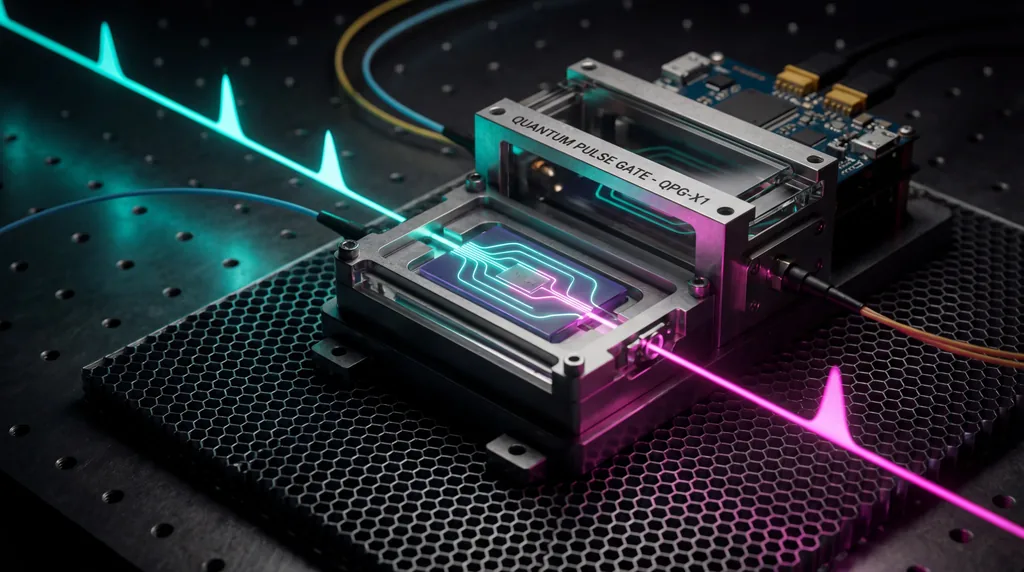
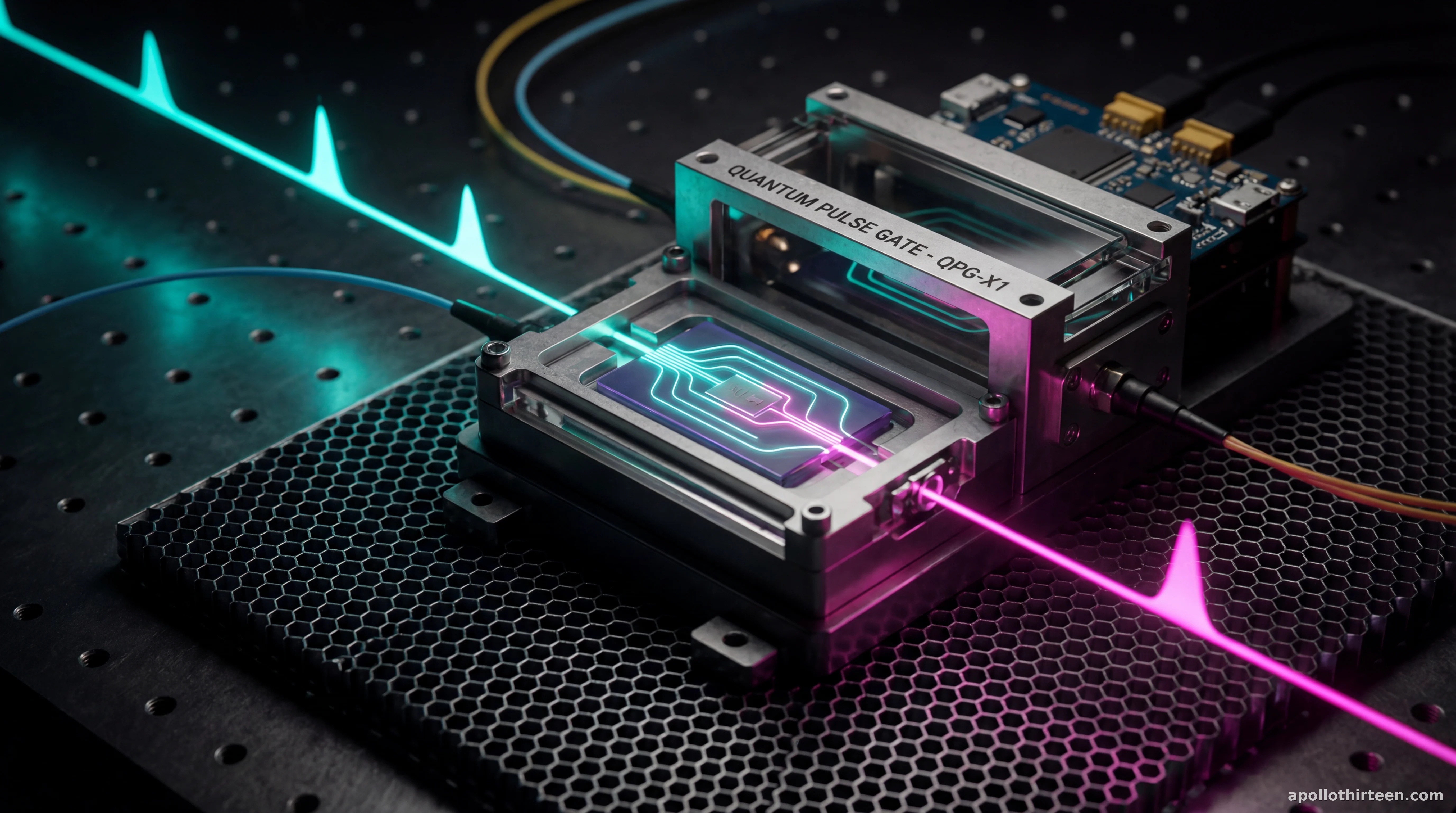
A quantum pulse gate (QPG) is used in time-frequency detection to selectively pick and analyze specific temporal modes of light, enabling the sampling of the Q-function. In this research, the QPG allowed the team to implement an optimal detection scheme that reconstructs the Wigner function of a signal, effectively bypassing the limitations of traditional detectors. This device acts as a high-precision filter that can isolate a photon's state within a complex time-frequency landscape.
The experimental implementation of the Quantum Pulse Gate was central to verifying the team's theoretical predictions. By using the QPG, Silberhorn and her colleagues were able to perform what is known as joint time-frequency detection. This process involves measuring both the "when" (arrival time) and the "color" (frequency) of the light pulse simultaneously. Because the QPG can be tuned to different modes, it serves as a versatile tool for probing the quantum uncertainty of time-dependent signals without destroying the delicate information they carry.
Furthermore, the use of the QPG allowed the researchers to demonstrate the reconstruction of the Wigner function beyond the constraints of the traditional harmonic oscillator. The Wigner function is a quasi-probability distribution that provides a complete picture of a quantum state in phase space. Successfully reconstructing this function using the quantum rotor framework confirms that the proposed detection scheme is not only theoretically sound but experimentally viable for high-stakes quantum applications.
Reaching the Ultimate Quantum Limit
The Paderborn University experiment successfully demonstrated a detection scheme that saturates the fundamental quantum limits for simultaneous time-frequency measurements. By comparing their proposed optimal detection method against traditional measurement techniques, the researchers proved that their quantum rotor approach offers a more precise route to signal characterization. This laboratory verification marks a significant milestone in quantum mechanics, as it moves the field closer to "perfect" measurement capabilities.
The data collected during the experiment showed that by sampling the Q-function—a phase-space representation of the quantum state—the team could reach the quantum-limited detection threshold. This is the point where the only remaining noise in the measurement is the unavoidable uncertainty dictated by the laws of physics. Achieving this level of precision requires a deep understanding of the Heisenberg uncertainty principle and its nuances in finite domains, proving that the theoretical "rotor" framework is an accurate reflection of physical reality.
The implications of reaching this limit are profound for photonics. In practical terms, it means that we can now design detectors that are essentially as accurate as the universe allows. This "optimal detection" minimizes the errors that currently plague long-distance quantum communication and high-sensitivity measurements, providing a benchmark for all future time-frequency detection hardware.
Future Implications: From Theory to Infrastructure
The shift toward a quantum rotor framework will have immediate impacts on high-speed quantum key distribution (QKD) and the synchronization of global quantum sensors. As we transition from laboratory experiments to a functional Quantum Internet, the ability to maintain precise timing and frequency standards across distributed nodes will be the difference between a secure network and a failed one. This research provides the mathematical and experimental blueprint for the next generation of quantum hardware.
Beyond communication, these findings enhance the stability of distributed quantum sensors, which are used for everything from gravitational wave detection to ultra-precise clock synchronization. By operating at the quantum-limited detection bound, these sensors can achieve a level of sensitivity that was previously thought to be impossible under the traditional interpretation of the Heisenberg uncertainty principle. This opens the door for new discoveries in fundamental physics and earth observation.
Looking ahead, the work of Silberhorn, Brecht, and Folge sets a new standard for quantum measurement. Future research will likely focus on:
- Integrating Quantum Pulse Gate technology into compact, chip-based photonics for commercial use.
- Applying the quantum rotor formalism to other bounded variables in quantum mechanics beyond time and frequency.
- Developing error-correction protocols that leverage these new uncertainty bounds to enhance Quantum Internet resilience.
This paradigm shift from infinite-domain models to finite-window quantum rotors represents a maturing of quantum science. By acknowledging the practical boundaries of our measurements, we have ironically found a way to see further into the quantum world than ever before.


Comments
No comments yet. Be the first!