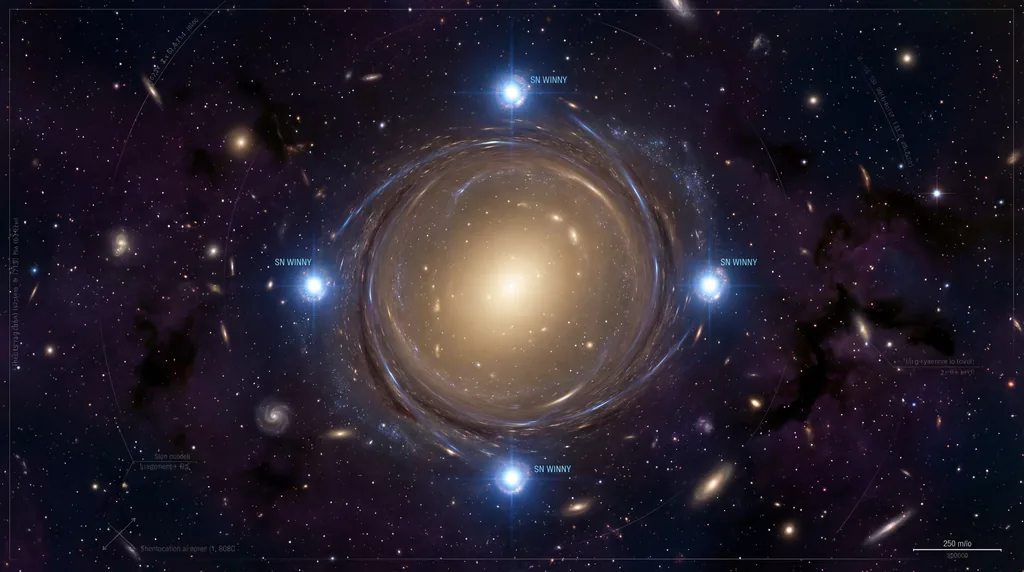

The rate at which our universe expands, known as the Hubble constant, remains one of the most significant disputes in modern physics, creating a discrepancy that challenges the standard model of cosmology. A research team at the Technical University of Munich (TUM), the Ludwig Maximilians University (LMU), and the Max Planck Institutes (MPA and MPE) has identified a rare celestial event that may finally resolve this conflict. In August 2025, astronomers discovered SN 2025wny, nicknamed SN Winny, a superluminous supernova whose light has been split into five distinct images by a gravitational lens. This unique alignment provides an independent, one-step tool to measure cosmic distances and calculate the expansion rate with unprecedented accuracy.
What is the Hubble Tension?
The Hubble tension refers to the significant disagreement between two primary methods used to calculate the expansion rate of the universe. One method measures the "local" universe using the cosmic distance ladder, while the other analyzes the cosmic microwave background (CMB) from the early universe. Despite high precision in both approaches, the results do not match, suggesting that our fundamental understanding of physics or dark energy may be incomplete. Resolving this tension is critical because the Hubble constant dictates the age, size, and ultimate fate of the cosmos.
Traditional measurements often rely on complex calibration steps. The local method uses "standard candles," such as specific types of stars or supernovae, to estimate distances. However, because each step in the cosmic distance ladder depends on the accuracy of the previous one, small systematic errors can accumulate. Conversely, the CMB method relies on models of how the universe evolved over billions of years. If these models contain even slight inaccuracies regarding the behavior of dark energy or matter, the calculated expansion rate will be skewed. SN Winny offers a way to bypass these issues through a direct geometric measurement.
How does gravitational lensing create multiple images of a supernova?
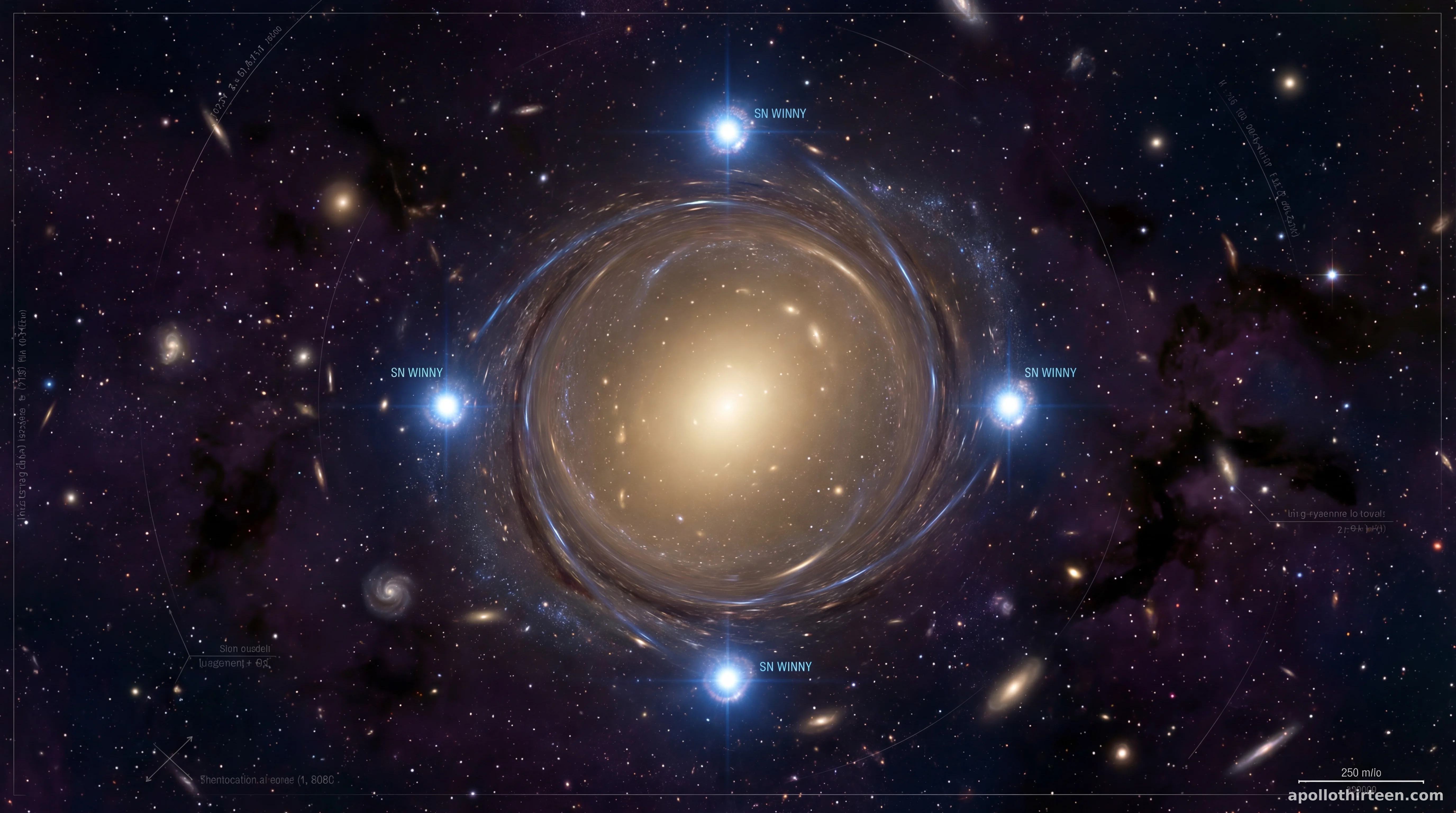
Gravitational lensing creates multiple images of a supernova when a massive foreground galaxy or galaxy cluster bends and magnifies the supernova's light along separate pathways. According to Einstein's general relativity, gravity warps the fabric of space-time; as the light from SN Winny traveled 10 billion light-years toward Earth, it encountered two foreground galaxies. This massive alignment acted as a natural cosmic magnifying glass, splitting the light into five distinct paths of varying lengths, resulting in five bluish copies of the same exploding star appearing in the night sky.
The geometry of this specific lens system is exceptionally clean, which is a departure from previous discoveries. "Until now, most lensed supernovae were magnified by massive galaxy clusters, whose mass distributions are complex and hard to model," explains Allan Schweinfurth, a researcher at TUM. Because SN Winny is lensed by just two individual galaxies with smooth mass distributions, the team can model the system with high precision. This simplicity reduces the uncertainty in how much the light was bent, providing a clearer "map" of the journey the light took to reach the Large Binocular Telescope in Arizona.
Why is the discovery of SN 2025wny (SN Winny) so rare?
SN 2025wny is exceptionally rare because it is a superluminous supernova perfectly aligned with a gravitational lens at a high redshift of z = 2. The mathematical probability of a supernova being positioned so precisely behind a foreground lens to produce five separate images is lower than one in a million. This discovery was the result of a targeted six-year search by the SN Winny Research Group, which compiled a list of promising gravitational lenses before the event finally matched in August 2025.
The rarity is further compounded by the nature of the star itself. SN Winny is a superluminous supernova, meaning it is far brighter than typical stellar explosions. This extreme brightness allowed the Large Binocular Telescope on Mount Graham to capture high-resolution color images of the system, even though it is located 10 billion light-years away. Sherry Suyu, Associate Professor of Observational Cosmology at TUM and Fellow at the Max Planck Institute for Astrophysics, noted that the event is a key milestone for observational cosmology, as only a handful of such lensed measurements have ever been attempted.
How can time delays in lensed supernovae measure the universe's expansion rate?
Time delays in lensed supernovae measure the universe’s expansion rate because each of the five images travels a path of a different length to reach Earth. Although the supernova is a single event, the images do not appear simultaneously; instead, they "flicker" on at different times. By measuring the specific time delay between these appearances and combining that data with the known mass of the lensing galaxies, astronomers can directly calculate the Hubble constant without needing the multi-step cosmic distance ladder.
This "one-step" approach is championed by Stefan Taubenberger, the lead author of the identification study published in Astronomy & Astrophysics. Because the method relies on different physics and fewer assumptions than previous techniques, it serves as a crucial tie-breaker for the Hubble tension. Leon Ecker and Allan Schweinfurth built the first mass distribution models for the lens, confirming that the galaxies have not yet collided, which preserves the regularity of the light paths. This regularity is what allows for the high-accuracy calculation of how fast the space between the galaxies is stretching.
What is the significance of the Large Binocular Telescope observations?
The Large Binocular Telescope (LBT) in Arizona played a pivotal role in this discovery by providing the first high-resolution color images of the SN Winny system. Using two 8.4-meter diameter mirrors and an advanced adaptive optics system, the telescope corrected for atmospheric blurring to reveal the two warm-toned foreground galaxies and the five bluish copies of the supernova. These observations are essential for determining the exact positions of the images, which are used to calculate the gravitational potential of the lens.
- Instrument: Large Binocular Telescope, Mount Graham, Arizona.
- Technology: Dual 8.4-meter mirrors with adaptive optics.
- Findings: Five distinct images of a single supernova at redshift z = 2.
- Institutions: Collaboration involving MPE, LMU, and TUM researchers.
Implications for the Future of Cosmology
The data from SN Winny could potentially confirm a deviation from the Standard Model of Cosmology. If the expansion rate calculated from this lensed supernova aligns with local measurements rather than the early-universe data, it may indicate that dark energy evolves over time or that new physics is required to explain the universe's growth. This would force a massive shift in how scientists view the "cosmic recipe" of matter and energy that governs our universe.
Furthermore, the success of the HOLISMOKES research project (Highly Optimised Lensing Investigations of Supernovae, Microlensing Objects, and Kinematics of Ellipticals and Spirals) sets the stage for future observatories. The Vera C. Rubin Observatory and the James Webb Space Telescope (JWST) are expected to find hundreds of lensed supernovae in the coming decade. SN Winny serves as the gold standard for how these future discoveries will be modeled and analyzed to solve the mystery of the Hubble constant.
What's Next for SN Winny and Cosmological Research?
Astronomers worldwide are currently conducting follow-up observations of SN Winny using both ground-based and space-based assets. The immediate goal is to refine the time-delay measurements as the supernova fades, ensuring the highest possible precision for the Hubble constant calculation. These results, supported by the Excellence Cluster ORIGINS and the Max Planck Society, will likely be a cornerstone of cosmological debate for years to come.
As the scientific community awaits the finalized expansion figures, the SN Winny discovery proves that "cosmic fireworks" are more than just a visual spectacle; they are precise mathematical tools. By turning a 10-billion-light-year journey into a geometric ruler, researchers are closer than ever to understanding the fundamental speed limit of our expanding universe. The transition from a six-year search to a groundbreaking measurement highlights the power of international collaboration in observational cosmology.




Comments
No comments yet. Be the first!