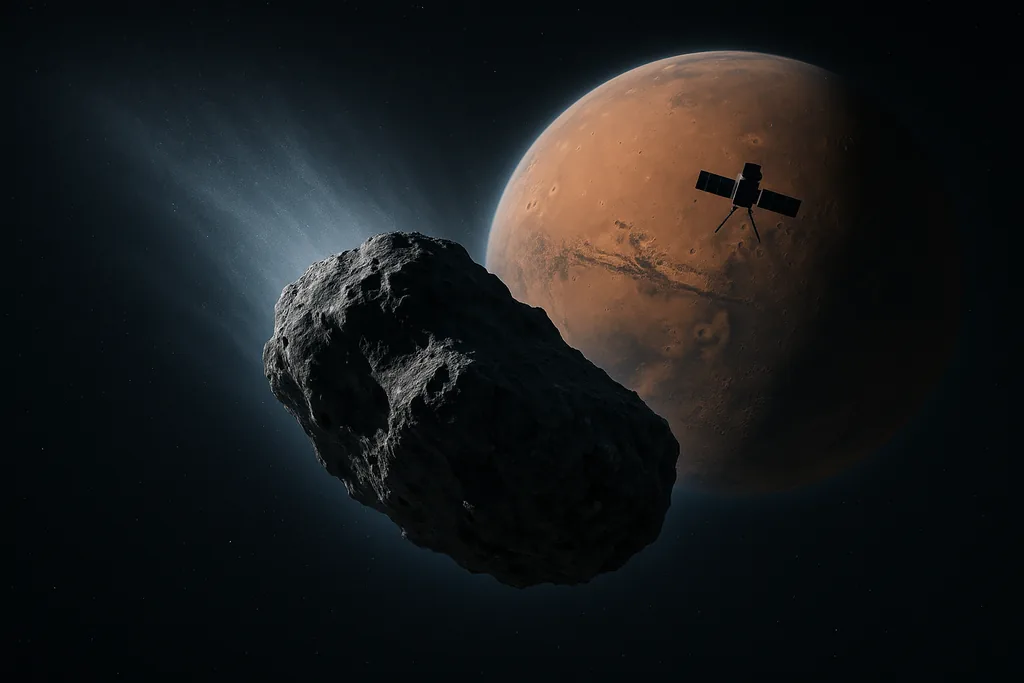
This week space agencies and observatories around the world confirmed an extraordinary event: the interstellar comet 3I/Atlas brakes near Mars, slowing to a near‑stationary state with respect to the background stars for several days in October 2025. The anomaly—detected by a network of ground telescopes and corroborated by orbiting spacecraft—occurred roughly 27 million kilometres from Mars and has already forced teams at NASA and the European Space Agency to re‑examine assumptions that underpin modern celestial mechanics.
interstellar comet 3i/atlas brakes: observations and validation
Initial reports of the stop were met with scepticism inside mission control. Telemetry glitches, timing errors and software artefacts are the standard first explanations when an object appears to defy conservation laws. Over the following weeks, however, independent datasets were cross‑checked: long‑baseline optical astrometry from multiple ground observatories, infrared and visible imaging from space telescopes, and Doppler‑tracking and imaging from Mars‑orbiting spacecraft including the Mars Reconnaissance Orbiter. That triangulation removed instrument bias as the cause. The result was an unusual, reproducible record showing the comet's apparent proper motion fall to near zero relative to distant stars for a measurable interval before it resumed an outbound hyperbolic trajectory.
Observers timed the event to within hours and measured velocity changes orders of magnitude larger than those typically attributed to subtle non‑gravitational effects such as solar radiation pressure or conventional cometary outgassing. The dataset includes high‑cadence position measurements, time‑tagged spectroscopic scans of the coma and contemporaneous magnetometer and plasma observations from orbiters. NASA mission analysts have described the event as 'unprecedented' and priority data for follow‑up modeling and laboratory work.
interstellar comet 3i/atlas brakes: proposed mechanisms
With classical gravity unable to explain a temporary halt of an object on a hyperbolic escape path, scientists are debating a short list of mechanisms that could produce strong, sudden braking. The leading astrophysical hypothesis invokes electromagnetic interaction: spectroscopic analyses show evidence for metallic grains in the coma and a predominance of frozen carbon dioxide over water ice in the nucleus. Metal‑rich dust becomes electrically charged when exposed to solar ultraviolet light and the solar wind; in a region of complex interplanetary magnetic structure the resulting Lorentz forces on charged grains could, in principle, create a substantial effective drag on the object.
Another avenue under active study is interaction with a dense patch of solar plasma or a transient magnetic anomaly. If 3I/Atlas passed through a localized plasma structure with the right orientation and field strength, the coupling between the comet's charged coma and the field could produce a magnetic 'anchor' strong enough to counter a portion of its momentum. A more conventional but less likely explanation is a near‑perfectly symmetric, powerful outgassing episode that produced thrust opposite the motion. While outgassing is common in comets, the symmetry and magnitude required to cancel momentum almost exactly are considered statistically improbable for a kilometre‑scale, irregular nucleus.
Composition and what Mars‑era instruments recorded
Mars‑orbiting hardware contributed critical environmental data. Magnetometers aboard orbiters recorded transient perturbations in the local interplanetary magnetic field coincident with the stall window; plasma instruments logged localized increases in charged particle density. High‑resolution cameras photographed coma morphology changes and subtle vibrations in the nucleus that match the timing of the braking episode. Taken together, these instruments provide the physical context needed to test electromagnetic and plasma interaction models against the observed timing, magnitude and spatial structure of the anomaly.
Consequences for orbital models and planetary defence
The practical impact of the 3I/Atlas braking event is immediate: orbital prediction software and planetary‑defence planning assume gravity, solar radiation pressure and relatively well‑characterised outgassing are the dominant forces acting on small bodies. The demonstrated possibility of strong, rapid, non‑gravitational decelerations—if caused by electromagnetic or plasma processes—requires those codes to be expanded. Simulations used to forecast impact risk must begin to include coupling of charged dust and magnetic fields in regions where such interactions could occur, and Monte Carlo ensembles used for hazard assessment should widen their parameter space.
That does not mean Earth is suddenly vulnerable to unpredictable impacts. Most near‑Earth objects are tracked for years and their thermal and outgassing behaviour measured; only in special circumstances—an interstellar visitor with unusual composition or an encounter inside a rare plasma structure—would the unpredictability be comparable to what was seen with 3I/Atlas. Nevertheless, agencies responsible for planetary safety are already incorporating additional non‑gravitational force models and running sensitivity studies to see how much lead time and observational coverage would be required to avoid missing similar surprises.
Could the trajectory indicate new physics beyond current theories?
Extraordinary anomalies naturally invite speculation about fundamental physics—alternative gravity laws, exotic dark‑matter interactions, or previously unseen forces. Scientists emphasize that extraordinary claims require extraordinary evidence: the current dataset is rich but still consistent with electrodynamic and plasma phenomena within known physics, albeit in an extreme regime not often observed. Researchers are cautious: resolving whether this is a manifestation of messy environment‑driven classical physics or a true pointer to new physics will take careful modelling, laboratory experiments on charged dust dynamics, and ideally, detection of a repeatable signature in other objects.
At present, theorists are prioritising extensions to existing models—magnetohydrodynamic coupling, charge exchange, and electrodynamic drag—because they can be framed, tested and falsified quickly against the available observations. Only if those avenues fail to reproduce the measured accelerations will radical revisions of core laws be entertained by the broader community.
Where scientists will look next
Teams will mine every available trace of the October 2025 encounter. From Mars‑orbit data the most valuable diagnostics are time‑resolved magnetometer traces, plasma density and velocity records, and radio science ranging and Doppler residuals that tightly constrain any unmodelled accelerations. Ground‑based radial velocity and astrometric archives will be reprocessed to tighten the timeline. Laboratory experiments will focus on charging of mixed ice‑metal grains and the force coupling between charged dust clouds and background magnetic fields.
Observationally, survey telescopes and comet watchers will increase cadence on newly discovered interstellar objects and comets exhibiting metal‑rich comae to see whether similar braked episodes recur. Mission teams are also evaluating whether a targeted flyby by a fast spacecraft could be justified for a future interstellar visitor to obtain in‑situ plasma and magnetic measurements during any anomalous interaction.
For now, 3I/Atlas remains on its outbound path, leaving the Solar System and carrying with it a set of questions that will reshape parts of planetary science and aerospace modelling. The episode is a reminder that space is not an inert vacuum filled only with gravity: it is a dynamic plasma environment in which charged dust and magnetic fields can, under the right conditions, alter the motion of even large objects.
Sources
- NASA (Mars Reconnaissance Orbiter telemetry and mission analysis)
- European Space Agency (optical and imaging data)
- NASA Jet Propulsion Laboratory (orbital dynamics and telemetry cross‑checks)




Comments
No comments yet. Be the first!