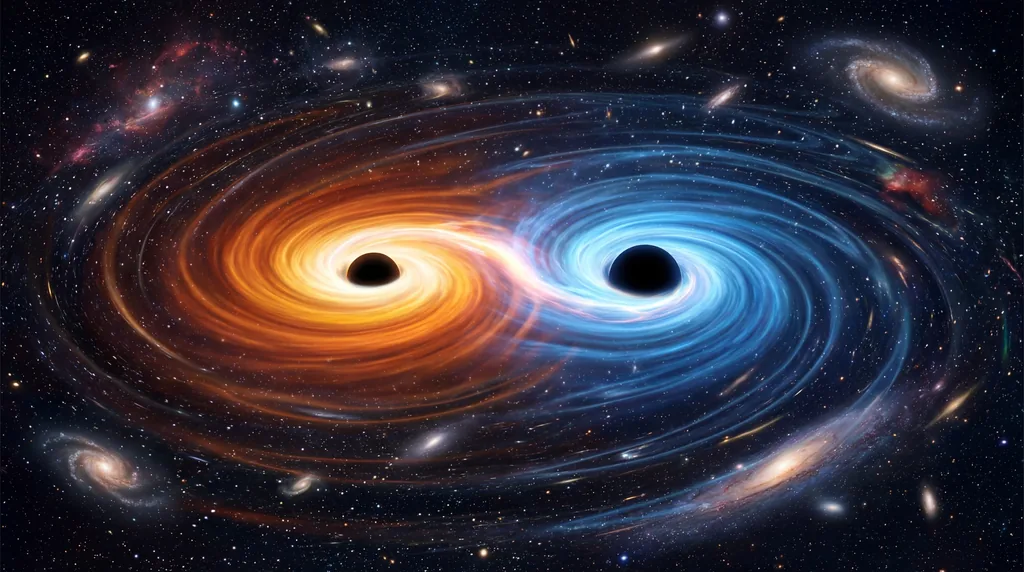

The gravitational-wave background (GWB) detected by pulsar timing arrays constrains the growth history of supermassive black holes by revealing discrepancies between simulated and observed signal amplitudes. Recent research by Sownak Bose, Chiara M. F. Mingarelli, and Lars Hernquist suggests that black hole growth is likely more efficient or occurs significantly earlier in cosmic history than current models predict. This "cosmic hum" serves as a primary metric for determining how the most massive objects in the universe evolve alongside their host galaxies.
For decades, astrophysicists have relied on electromagnetic observations to track the evolution of Supermassive Black Holes (SMBHs). However, the emergence of Pulsar Timing Arrays (PTAs), such as NANOGrav and the European Pulsar Timing Array, has opened a new window into the universe. By measuring minute variations in the arrival times of radio pulses from stable millisecond pulsars, researchers can detect long-wavelength gravitational waves generated by the slow, orbital decay of SMBH binaries across the cosmos.
The research investigates the specific implications of the nanoHertz gravitational-wave background for galactic feedback mechanisms. These feedback processes—driven by both intense star formation and the energy released by active galactic nuclei—act as a cosmic thermostat. By regulating the amount of gas available for accretion, feedback directly determines the final mass of a black hole and the structural properties of its surrounding galaxy, creating a complex interplay that defines the Black Hole Mass Function (BHMF).
How does AGN feedback affect gravitational wave predictions?
AGN feedback regulates the growth of supermassive black holes by altering the high-mass end of the black hole mass function, which directly impacts the predicted GWB amplitude by a factor of 2 to 10. High-efficiency feedback models suppress the formation of massive binaries, resulting in a quieter gravitational signal, while low-efficiency models allow for more abundant high-mass black holes and a louder cosmic hum.
Active Galactic Nucleus (AGN) feedback is a critical component of modern cosmology. In simulations, when a black hole reaches a certain mass threshold, it releases vast amounts of energy that clear out cold gas from the galaxy’s center. This process effectively "starves" the black hole, halting its growth. The study found that in the IllustrisTNG and MillenniumTNG suites, the standard AGN feedback prescriptions are so effective that they significantly lower the number of massive binaries, leading to a predicted GWB amplitude that is lower than what PTAs have observed.
Conversely, the Simba simulation suite uses a different approach to feedback, including powerful "jets" that impact the surrounding intergalactic medium. The research highlights that the specific nuances of these feedback loops—how they are triggered and how they distribute energy—are the primary drivers of the variance in GWB predictions. When feedback is less efficient, black hole populations swell, increasing the probability of massive mergers that generate detectable nanoHertz waves.
The magnitude of this effect was most evident in the CAMELS (Cosmological Advanced Machine Learning Simulations) suite. Researchers found that:
- Fiducial models typically under-predict the observed GWB signal.
- Extreme variations in feedback parameters can shift the GWB amplitude by a factor of 10.
- Models without AGN feedback produce the highest GWB amplitudes but fail to create galaxies that resemble our actual universe.
Can the GWB constrain models of galactic feedback?
The GWB provides a powerful probe to constrain models of galactic feedback as pulsar timing array measurements highlight mismatches between simulations and observed data. By comparing the "loudness" of the cosmic background to the outputs of various simulation suites, scientists can determine which feedback prescriptions most accurately reflect the historical growth of supermassive black holes.
Utilizing a quasar-based SMBH binary population framework, the authors mapped how different feedback strengths influence the resulting gravitational signal. This approach is revolutionary because it moves beyond traditional light-based observations. Instead of seeing the black hole through the gas it consumes, we are "hearing" its mass through the ripples it creates in spacetime. This provides an independent check on the stellar and AGN feedback models used in flagship simulations.
One of the most striking findings of the study is that PTA data currently favors models that would otherwise be considered "failed" in a traditional astronomical context. For instance, simulations that produce a GWB amplitude consistent with the loudest signals often result in galaxies that are far too massive or lack the expected distribution of stars. This suggests that the relationship between black hole growth and galactic feedback is more complex than currently modeled, requiring a more nuanced understanding of how these giants grow.
The study specifically mentions that the mismatch could be mitigated by reconsidering black hole seeding and early-growth prescriptions. If black holes began their lives as heavier "seeds" or experienced bursts of super-Eddington accretion in the early universe, they could reach the necessary masses to produce the observed GWB without requiring the weak feedback that would ruin galaxy formation models. This highlights the GWB's role as a diagnostic tool for high-redshift physics.
What are the implications of the GWB for supermassive black hole growth?
The GWB constrains the growth history of supermassive black holes by revealing that they likely reach massive sizes earlier or more efficiently than captured by current cosmological models. This discovery suggests that the transition of binaries through the "final parsec" and their subsequent mergers are more frequent than anticipated, forcing a re-evaluation of how mass is accumulated in the early universe.
For years, the "Final Parsec Problem"—the question of how two black holes overcome the last bit of distance to actually merge—has been a major hurdle in astrophysics. The robust GWB signal detected by PTAs suggests that black hole binaries are successfully navigating this gap and merging at significant rates. This implies that environmental factors, such as gas-driven migration or interactions with nearby stars, are highly effective at driving these massive pairs toward coalescence.
The findings also have significant implications for future cosmological surveys. As PTAs continue to gather data over the next decade, the precision of the GWB measurement will increase. This will allow researchers to:
- Identify the specific mass ranges of the most active SMBH binaries.
- Distinguish between different models of galactic evolution with higher confidence.
- Integrate gravitational data with electromagnetic observations from the James Webb Space Telescope (JWST).
- Refine the black hole mass function across cosmic time.
Looking ahead, the integration of GWB measurements with large-scale simulation suites like IllustrisTNG will be essential for solving the puzzle of galaxy-black hole co-evolution. The work of Bose, Mingarelli, and Hernquist demonstrates that we are entering an era of "multi-messenger" cosmology, where the invisible hum of the universe provides the most direct evidence of the violent and massive growth of its largest inhabitants. As the signal grows clearer, our understanding of the fundamental forces shaping galaxies will inevitably shift, bridging the gap between the smallest feedback loops and the largest structures in the cosmos.




Comments
No comments yet. Be the first!