
Probing the Local Void: Five Isolated Black Hole Candidates Identified Near the Solar System
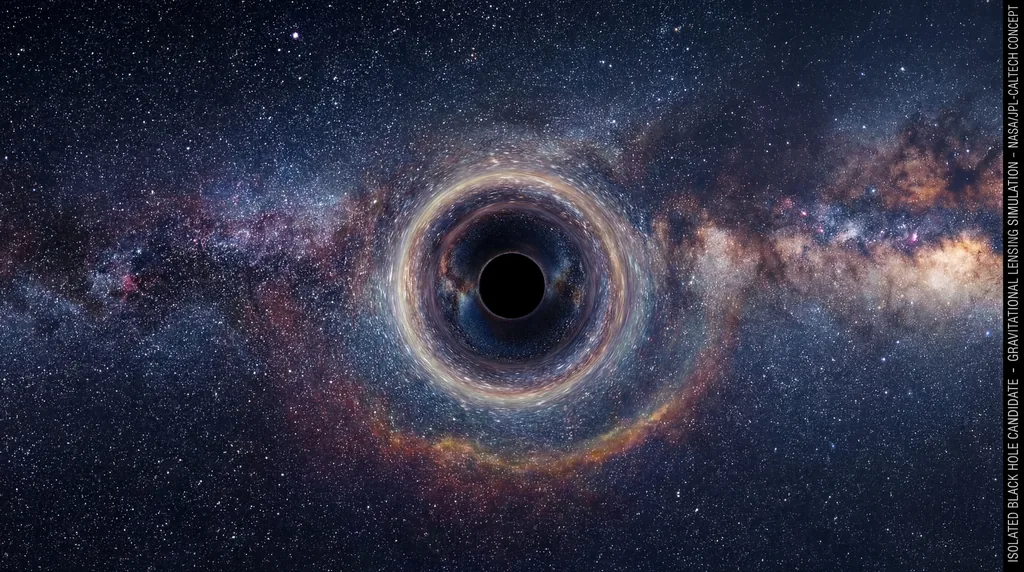
While the Milky Way is estimated to harbor up to a billion black holes, most remain invisible as they drift through the interstellar void without companion stars to fuel their luminosity. These "dark" remnants of collapsed stars represent one of the most significant missing pieces in our map of the local cosmos. However, a new study led by researchers including Abdurakhmon Nosirov, Cosimo Bambi, and Andrea Santangelo has utilized the European Space Agency’s Gaia DR3 catalog to hunt for these elusive objects. The team’s analysis has identified five potential isolated black hole candidates within just 15 parsecs (approximately 50 light-years) of the Solar System, marking a critical step in identifying the nearest gravitational monsters to Earth.
The Invisible Billion: A Hidden Population
Theoretical models of galactic evolution suggest that the Milky Way is a graveyard for massive stars. Between 100 million and 1 billion stellar-mass black holes are predicted to exist within our galaxy, formed from the gravitational collapse of stars that lived fast and died in supernova explosions. While many of these black holes were born in binary systems, the majority are expected to be isolated today. The violent processes of supernova "kicks" or the expansion of a dying star into a red supergiant often disrupt binary bonds, leaving the resulting black hole to wander the galaxy alone. Because these isolated black holes lack a companion star from which to siphon gas—a process that creates the bright X-ray emissions typically used to find them—they remain largely undetectable by conventional telescopes.
Scanning the 50 Light-Year Perimeter
The research focused on a specific "local volume" within 15 parsecs of the Sun. This distance is not arbitrary; it represents a frontier for both current observational precision and future scientific ambition. As noted by the study’s authors, including Cosimo Bambi of Fudan University and the New Uzbekistan University, identifying a black hole within this 50 light-year radius is essential for visionary future projects, such as sending interstellar probes to study the event horizon up close. At greater distances, the travel time for even a high-speed spacecraft would exceed a century, making a 15-parsec radius the practical limit for human-scale exploration. Statistical estimates suggest that at least one to a few black holes should theoretically reside within this local neighborhood, yet until now, none have been definitively identified.
The Gaia DR3 Methodology
To find these hidden objects, the team turned to the Gaia spacecraft, which provides the most precise astrometric map of the Milky Way to date. The methodology relied on searching for "dark" sources—objects that possess mass and a measurable position but lack the expected light profile of a standard star. The researchers filtered the Gaia Data Release 3 (DR3) catalog, looking for anomalies in proper motion and parallax that could hint at the presence of a massive unseen companion or an isolated compact object. This search is notoriously difficult because at a distance of 15 parsecs, the local stellar density is relatively low, making it rare for a black hole to pass close enough to a visible star to reveal itself through gravitational perturbations. Instead, the team looked for evidence of light emitted not by a companion star, but by the vacuum of space itself.
Feeding on the Interstellar Medium
Even an isolated black hole is not entirely silent if it passes through a sufficiently dense environment. The study explains that the "Local Interstellar Clouds" (LICs)—regions of warm, partially ionized gas—occupy roughly 5% to 20% of the volume within 50 light-years of Earth. If an isolated black hole resides within one of these clouds, it can accrete gas directly from the interstellar medium (ISM). This process, though much fainter than the accretion seen in binary systems, can produce a detectable electromagnetic signal across various wavelengths. Outside of these clouds, however, the interstellar medium is too thin, and the accretion rate drops so low that the black hole remains effectively invisible to current observatories.
Identification of Five Candidates
After a rigorous screening of the Gaia data, the research team, which included contributors from the University of Warwick and the Shanghai Astronomical Observatory, identified five specific sources that fit the profile of isolated black hole candidates. These objects exhibit astrometric characteristics consistent with compact masses but lack the typical signatures of hydrogen-burning stars. However, the discovery comes with significant caveats. "All candidates lie close to the Galactic plane," the researchers note, which introduces the possibility of "spurious astrometric solutions." In crowded regions of the sky, background stars or unmodeled binary systems can mimic the signals of an isolated black hole, complicating the verification process.
Challenges in Verification and Follow-up
Distinguishing a true isolated black hole from a dim brown dwarf, a high-mass white dwarf, or simply a data error is a primary hurdle. Because the local stellar density is low, the probability of a black hole revealing its presence through a "close encounter" with a neighbor star—where gravity would visibly alter the star's path—is extremely small. Consequently, the scientific community must rely on multi-wavelength follow-up observations. If these five candidates are genuine, they should exhibit specific spectra associated with ISM accretion. If they are instead spurious results caused by "crowding" or "unmodelled binarity," further high-resolution imaging will eventually reveal the hidden stars or data artifacts responsible for the Gaia signal.
Implications for Physics and Exploration
The confirmation of even one isolated black hole within 50 light-years would be transformative for the field of astrophysics. Such a discovery would provide a nearby laboratory to test the Kerr metric of General Relativity without the "noise" of a massive companion star. As researchers like Andrea Santangelo and Jiachen Jiang emphasize, the environments around these objects are ideal for testing gravity in its strongest regime. Furthermore, the existence of a local black hole would validate population synthesis models that currently struggle to reconcile the number of massive star progenitors with the observed number of remnants in the solar neighborhood.
What’s Next: The Future of the Search
The journey to confirm these five candidates has only just begun. Future data releases from Gaia (DR4 and beyond) will provide longer baselines of observation, allowing astronomers to refine the orbits and proper motions of these sources with even greater accuracy. Additionally, the next generation of radio and X-ray observatories may be sensitive enough to detect the faint "hiss" of gas falling into these candidates. While the researchers remain cautious, noting that the five sources cannot be definitively ruled in or out without further data, the search has successfully narrowed the hunt for the Milky Way's most elusive residents. Identifying our nearest black hole neighbor is no longer a matter of "if," but "when."




Comments
No comments yet. Be the first!