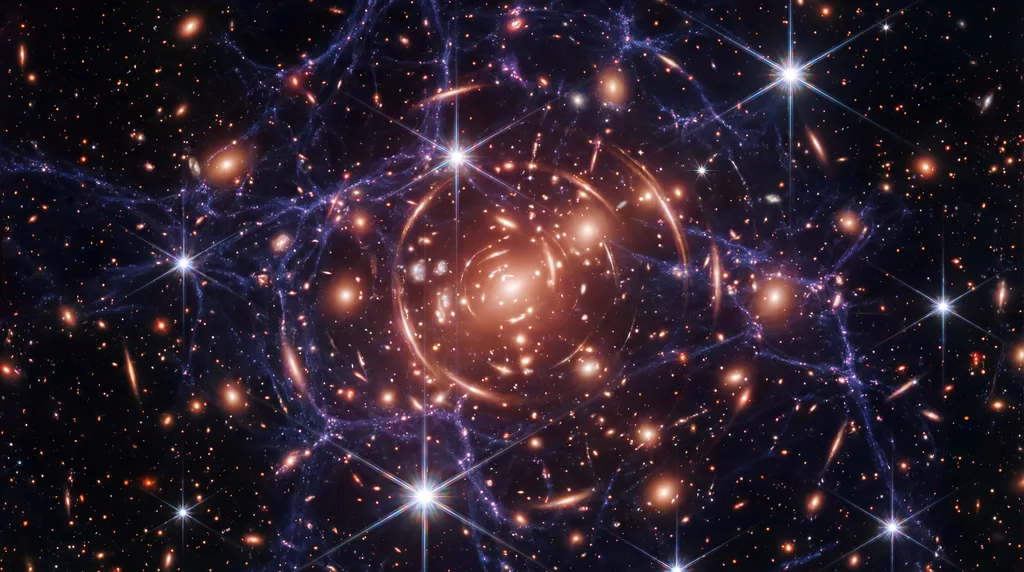

In a landmark study published on January 26, 2026, in the journal Nature Astronomy, an international team of scientists has unveiled one of the most detailed, high-resolution maps of dark matter ever produced. Utilizing the unprecedented sensitivity of NASA’s James Webb Space Telescope (JWST), the research provides a transformative look at the invisible "ghostly" material that constitutes the vast majority of the universe's mass. By observing how this dark matter overlaps and intertwines with visible galaxies, the study offers a new level of clarity regarding the invisible scaffolding that dictates the structure and evolution of the cosmos, from the largest galaxy clusters down to the formation of systems like our own.
Understanding the Dark Matter Problem
For decades, dark matter has remained one of the most significant enigmas in modern astrophysics. It is defined as a substance that does not emit, reflect, or absorb light, making it entirely invisible to traditional telescopes that rely on the electromagnetic spectrum. Despite its invisibility, dark matter exerts a massive gravitational pull, acting as the "gravitational glue" that prevents galaxies from flying apart as they rotate. Without dark matter, the universe as we know it—composed of stars, planets, and life—would lack the structural integrity to form.
Before the era of the James Webb Space Telescope, mapping this substance was a challenge characterized by significant technological limitations. While previous observatories like the Hubble Space Telescope provided foundational insights, the resulting maps were often described by researchers as "blurry" or low-resolution. The inability to see the fine-grained distribution of dark matter left gaps in our understanding of how ordinary matter—the "baryonic" matter that makes up stars and humans—is directed and molded by the dark matter that surrounds it.
How JWST Sees the Invisible
The breakthrough in this research lies in Webb’s ability to utilize a phenomenon known as gravitational lensing. Because dark matter possesses mass, it warps the fabric of space-time around it. When light from distant background galaxies passes through these warped regions, it bends and distorts, much like light passing through a magnifying glass. By precisely measuring these distortions in the light of nearly 800,000 galaxies, Webb’s Near-Infrared Camera (NIRCam) allowed scientists to calculate the exact location and density of the dark matter causing the effect.
The methodology involved processing immense volumes of high-resolution data from the Cosmic Evolution Survey (COSMOS). "This is the largest dark matter map we’ve made with Webb, and it’s twice as sharp as any dark matter map made by other observatories," said Diana Scognamiglio, an astrophysicist at NASA’s Jet Propulsion Laboratory (JPL) and the lead author of the study. The technical precision of the JWST allows for the detection of much smaller dark matter structures than previously possible, effectively bringing the "invisible scaffolding" of the universe into sharp focus for the first time.
The High-Resolution Cosmic Map
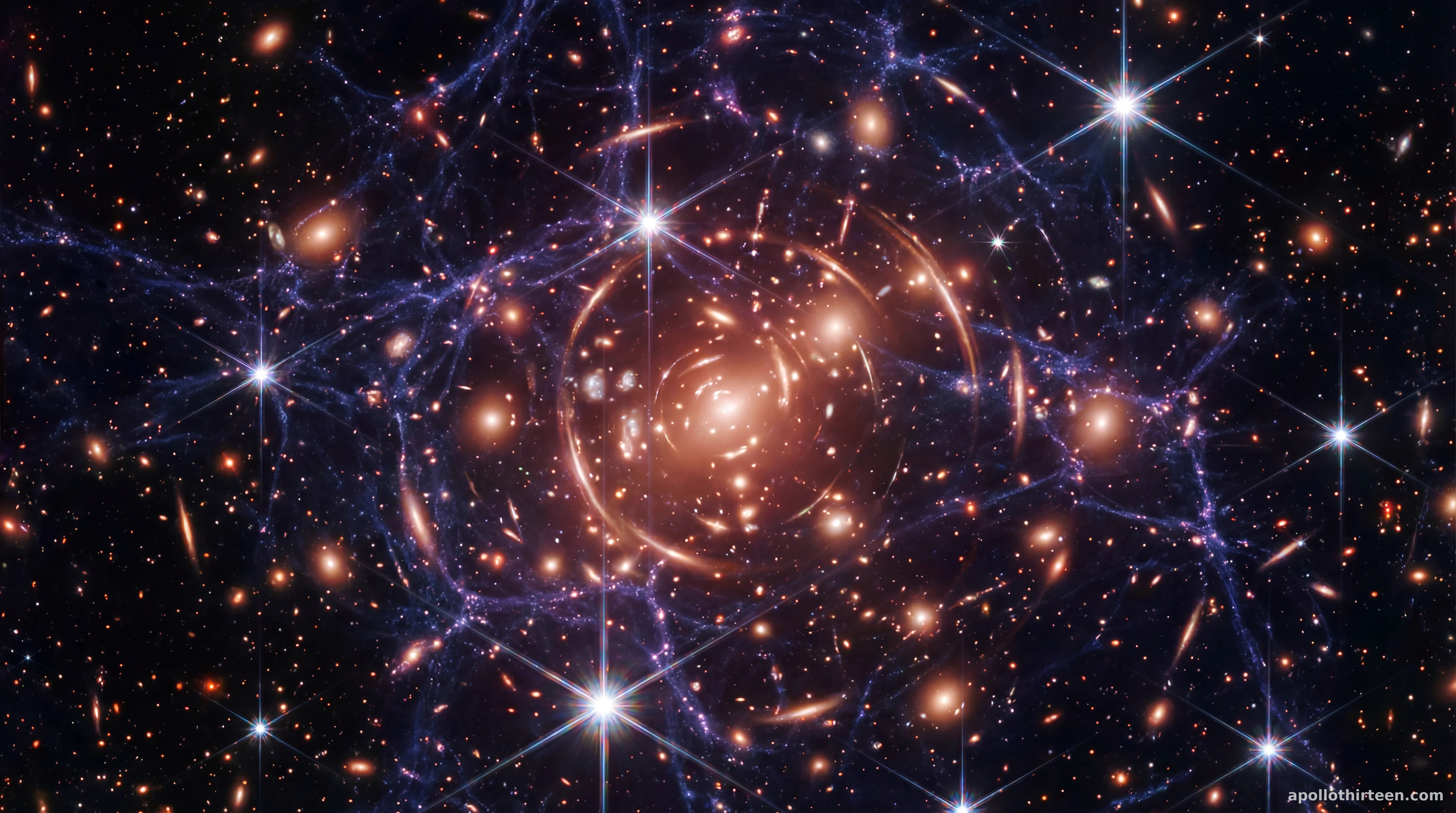
The newly produced map covers a region in the constellation Sextans, an area of the sky approximately 2.5 times larger than the full Moon. The visualization depicts a complex network where dense regions of dark matter are connected by lower-density filaments, creating what astronomers refer to as the Cosmic Web. This map confirms that regular matter, including vast galaxy clusters, sits directly within the densest "nodes" of this dark matter web.
The data reveals a striking overlap between dark matter filaments and visible galaxy clusters, reinforcing the theory that dark matter acts as the primary driver of cosmic architecture. By comparing the 2026 Webb data with 2007 Hubble data of the same region, researchers noted that many structures that previously appeared as monolithic blobs are actually composed of distinct, smaller clusters. This refined granularity allows scientists to better confine the size and location of dark matter concentrations, providing a more accurate blueprint of the universe's mass distribution.
Key Discoveries in the Map:
- Precision Alignment: Webb confirmed that the alignment of dark matter and regular matter is not coincidental; the two have been inextricably linked throughout cosmic history.
- Filamentary Structure: The "strings" of dark matter connecting galaxy clusters are more visible than ever, showing how matter migrates across the universe.
- Resolution Leap: The map identifies dark matter clusters in the lower-left regions of the survey area that were entirely invisible to previous generations of sensors.
Influence on Earth and the Local Universe
While dark matter exists on a gargantuan scale, its influence extends to the local environments where planets like Earth form. Although dark matter passes through regular matter without physical contact, its gravitational presence is what allowed the Milky Way to coalesce and retain the gas and dust necessary for star formation. The stability of our solar system is, in a broad sense, a byproduct of the gravitational well provided by the dark matter halo surrounding our galaxy.
The study highlights how the distribution of dark matter dictates the "habitability" of certain regions of the universe. In areas where dark matter is too sparse, galaxies may never form; where it is too dense, the resulting gravitational turbulence might prevent the long-term stability required for planetary systems. By understanding the density of dark matter within the Milky Way and its local influence, scientists can better model the history of our own sun’s birth and the evolution of the Earth within the larger galactic framework.
Galaxy Evolution and the Cosmic Web
The findings provide critical validation for the current Lambda-CDM model, the standard cosmological model that describes the Big Bang and the expansion of the universe. The way dark matter and regular matter have "grown up together" supports the idea that dark matter provided the initial gravitational seeds that pulled in hydrogen and helium to form the first stars. Richard Massey, an astrophysicist at Durham University and study coauthor, noted, "Wherever we see a big cluster of thousands of galaxies, we also see an equally massive amount of dark matter in the same place. It’s not just that they have the same shapes... They grew up together."
This research also touches upon historical theories, including those proposed by Stephen Hawking regarding primordial black holes as a potential candidate for dark matter. While the Webb data does not yet identify a specific dark matter particle, the high-resolution density maps allow theorists to narrow down what dark matter could be. By observing how these filaments interact over billions of light-years, scientists can test whether dark matter behaves as a "cold," slow-moving substance or if it possesses properties that might require a revision of our current physics textbooks.
Future Research and Deep Space Discovery
The map produced by Scognamiglio and her team is just the beginning of a new era in dark matter research. As the James Webb Space Telescope continues its mission, it will be joined by the Nancy Grace Roman Space Telescope, which is designed to have a field of view 100 times greater than Hubble. While Webb provides the "deep dive" high-resolution snapshots, Roman will provide the wide-angle context, allowing for a complete 3D survey of the dark matter structures across the observable universe.
The ultimate goal remains the direct detection of the dark matter particle. With the high-resolution maps provided by JWST, researchers now know exactly where to point their most sensitive instruments to look for the faint signals of dark matter interactions. This study serves as a definitive confirmation that while we may not be able to see dark matter directly, its fingerprints are written across the sky in the light of a trillion stars, guiding the destiny of every galaxy in the cosmos.




Comments
No comments yet. Be the first!