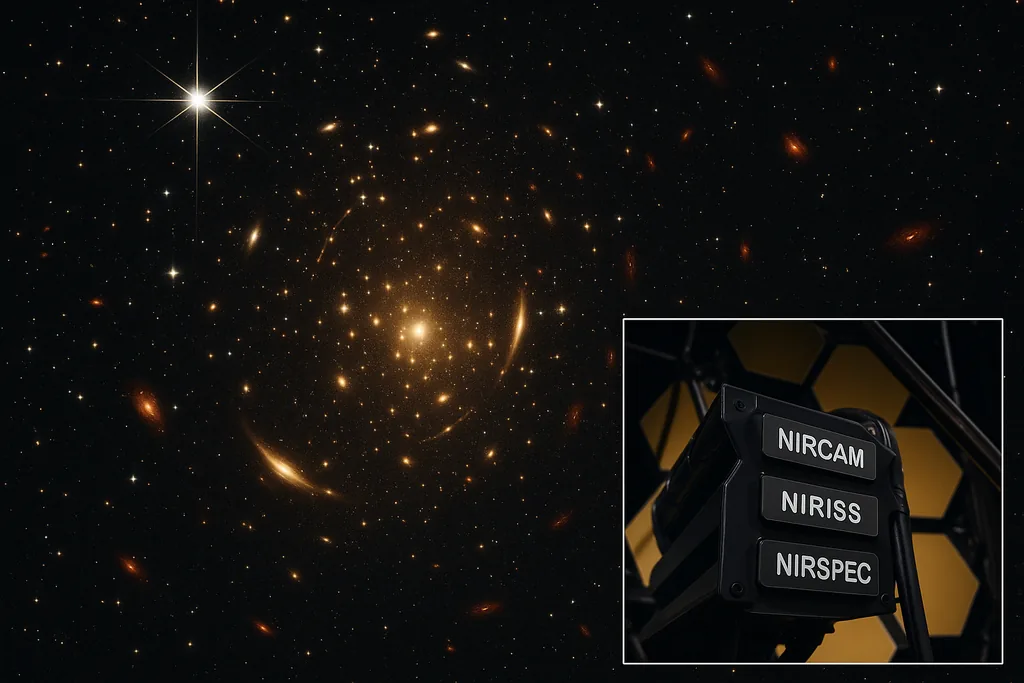
Stunning infrared portrait from Webb
On 24 January 2026 the James Webb Space Telescope (JWST) released a striking new image of MACS J1149.5+2223, a massive galaxy cluster about five billion light‑years away in the constellation Leo. The photograph, highlighted as a Picture of the Month by the survey team, shows long, luminous arcs and multiply imaged background galaxies produced by the cluster's powerful gravitational lensing. Compared with earlier Hubble observations, JWST's infrared sensitivity and resolution reveal fine structure inside those magnified galaxies — spiral arms, bright star‑forming knots and dust lanes — while exposing a population of faint, red sources that likely lie at very high redshift.
A "celebrity" cluster with a history
MACS J1149 earned its nickname through decades of study. It was one of the targets of the Hubble Frontier Fields program, and became famous when a lensed supernova reappeared in multiple images — a dramatic demonstration of general relativity and the time‑delay effect in strong lensing. That legacy made the cluster a natural follow‑up target for JWST, which now revisits the same field with instruments optimised for the infrared. The new JWST data do not simply add pixels; they expand the scientific value of this field by pushing the observable frontier for background galaxies and by improving the fidelity of mass‑mapping in the cluster itself.
Gravitational lensing as a precision probe
Those refinements matter. Better lens models reduce uncertainties when astronomers translate magnified light into intrinsic properties such as luminosity, size and star formation rate. They also let teams trace the distribution of dark matter at smaller scales, testing predictions of competing dark‑matter models. Yet model-building is still delicate: degeneracies in lens reconstructions and the need for spectroscopic redshifts to pin down distances remain limiting factors, so JWST's imaging must be combined with spectroscopy and multiwavelength data to deliver robust mass estimates.
The infrared advantage: seeing the early Universe
JWST operates primarily in the infrared, which is crucial for observing the early Universe. As cosmic expansion stretches light from the first generations of galaxies, ultraviolet and visible emission shift into JWST's wavelength range. Infrared observations therefore light up galaxies that Hubble could only hint at or miss entirely. In MACS J1149's field, JWST detects numerous faint red sources whose colours indicate high redshift and dusty star formation. Many of these objects are only visible because the cluster's lensing magnifies them — a natural telescope that, combined with JWST's sensitivity, exposes galaxies from within the first billion years after the Big Bang.
Infrared wavelengths also pierce dust more effectively than optical light, revealing star formation that would otherwise be obscured. That capability is central to current scientific questions: which galaxies produced the ionising photons that ended the cosmic 'dark ages' during reionisation, and how early did supermassive black holes grow? JWST's images of MACS J1149 already include candidate galaxies from the epoch of reionisation and at least one background object whose inferred central black hole mass appears surprisingly large for its age — a result that, if confirmed, will challenge conventional growth models.
CANUCS and coordinated spectroscopy
The newly released image comes from the Canadian NIRISS Unbiased Cluster Survey (CANUCS), a JWST programme that combines deep imaging with follow‑up spectroscopy. CANUCS uses NIRCam for high‑resolution imaging and NIRISS and NIRSpec for slitless and slit spectroscopy respectively. Spectra are essential because imaging colours alone cannot determine precise distances. Spectroscopic redshifts reveal how much the Universe has expanded since the light left each galaxy, and they identify emission lines that diagnose star formation, metallicity and the presence of active black holes.
CANUCS intentionally targets low‑mass, faint galaxies at high redshift because these are promising contributors to reionisation but have been historically under‑studied. Pairing spectroscopy with JWST's imaging not only secures distances, it also strengthens lens models: each spectroscopically confirmed multiple image becomes an anchor in the mass reconstruction. The result is an iterative cycle where better maps improve the interpretation of background galaxies, and better spectroscopic samples improve the maps.
Multiwavelength context and the role of other observatories
Although JWST provides unprecedented infrared detail, full understanding of MACS J1149 requires other wavelengths. X‑ray observations from the Chandra X‑ray Observatory trace the hot intracluster gas and reveal where baryonic mass concentrates; radio data from arrays such as the Very Large Array show jets and non‑thermal emission that can signal active nuclei. Composite images that combine X‑ray, optical and radio layers with JWST's infrared view give a multi‑component picture of the cluster: galaxies, hot gas, relativistic plasma and the dark matter halo inferred from lensing all map onto a single physical system.
Such multiwavelength synergy is not merely cosmetic. Differences between where mass (from lensing), hot gas (from X‑rays) and galaxies (in optical/IR) sit can tell astronomers about the cluster's assembly history and about interactions between baryons and dark matter. For example, offsets between dark matter peaks and X‑ray peaks can constrain dark matter's collisional properties — an approach made famous by other merging clusters — and JWST's lensing constraints add precision to those tests.
What to expect next
The JWST image of MACS J1149 is an invitation to deeper follow‑up. CANUCS will continue to gather spectroscopy and expand the sample of confirmed high‑redshift galaxies behind the cluster. Modelers will incorporate the new structural details into lens reconstructions and reanalyse previously claimed objects such as unusually massive early black holes. At the same time, observers will combine JWST data with Chandra, radio arrays and archival Hubble images to produce integrated maps of baryons and dark matter.
In the medium term, clusters like MACS J1149 will continue to act as natural telescopes for JWST and subsequent facilities, amplifying the faintest galaxies and sharpening our view of the reionisation era. The new Webb portrait is therefore both a milestone and a tool: a beautiful image that also tightens the observational grip on some of the deepest questions in cosmology, from the behaviour of dark matter to the rise of the first galaxies and black holes.
Sources
- James Webb Space Telescope / NASA, ESA & CSA (JWST observations and CANUCS programme)
- Space Telescope Science Institute (Hubble Frontier Fields legacy)
- Chandra X‑ray Center / Smithsonian Astrophysical Observatory (X‑ray observations)
- National Radio Astronomy Observatory (Very Large Array radio data)
- National Research Council Canada (image contributions: C. Willott)
- INAF — Osservatorio Astronomico di Roma (image contributions: R. Tripodi)




Comments
No comments yet. Be the first!