
Decoding Sub-Neptunes: Why Atmospheric Escape May Rule Out Ocean Worlds
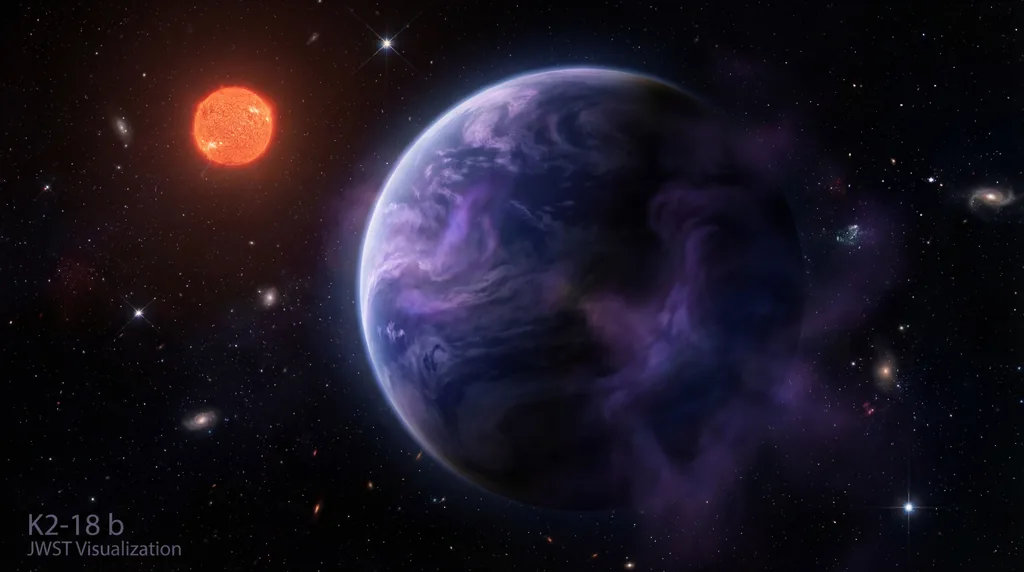
For years, the exoplanet K2-18 b has captivated both the scientific community and the public as a premier candidate for a "Hycean" world—a hypothetical class of planets featuring global liquid oceans beneath a hydrogen-rich atmosphere. This alluring vision of a habitable "water world" in the deep cosmos has driven significant observational efforts. However, new research utilizing a novel "timescale argument" for atmospheric escape suggests that many of these sub-Neptunes, including K2-18 b, may actually be gas giants in disguise. The study indicates that these planets likely lack a solid or liquid surface entirely, possessing instead massive, deep envelopes of hydrogen and helium that rule out the possibility of life-sustaining oceans.
The research, led by James E. Owen, James Kirk, and James G. Rogers, addresses one of the most persistent mysteries in exoplanetary science: the "sub-Neptune identity crisis." Astronomers have long noted a "radius valley" in the distribution of exoplanets, a gap that separates smaller, rocky "super-Earths" from larger, gas-shrouded "sub-Neptunes." While the composition of super-Earths is relatively understood, sub-Neptunes—planets with radii between two and four times that of Earth—remain an enigma. Are they "water worlds" comprised of high-molecular-weight volatiles like H2O, or are they "mini-Neptunes" consisting of a rocky core surrounded by a voluminous, low-density hydrogen-helium (H/He) envelope? Distinguishing between these two scenarios is critical for determining the habitability of the most common type of planet in the galaxy.
The Timescale Argument: A New Analytical Tool
To resolve this ambiguity, Owen and his colleagues developed a technique that utilizes observations of escaping gases from a planet's upper atmosphere. The methodology is built upon a fundamental "timescale argument." If a planet is currently observed to be losing hydrogen or helium at a specific rate, it must possess a reservoir of these gases large enough to have sustained that escape over the planet's entire multi-billion-year lifetime. By calculating the minimum mass of the reservoir required to support the observed mass-loss rate, researchers can place an upper limit on the atmosphere's mean molecular weight.
In simpler terms, if a planet is "leaking" hydrogen rapidly today, it must have started with a massive supply of it. If the atmosphere were primarily composed of heavier molecules like water vapor (which would give it a high mean molecular weight), the observed rate of hydrogen escape would be physically unsustainable over geological timescales. Therefore, a high rate of escaping light gas is a "smoking gun" for a low-molecular-weight, hydrogen-dominated envelope. This method provides a powerful check against transit spectroscopy, which can sometimes be deceptive due to the presence of high-altitude clouds or hazes.
Under Fire: Re-evaluating K2-18 b and TOI-776
The researchers applied this technique to several archetypal sub-Neptunes, most notably TOI-776 b, TOI-776 c, and the famous K2-18 b. In the case of the TOI-776 system, observations from the James Webb Space Telescope (JWST) showed relatively featureless, or "flat," transit spectra. In isolation, a flat spectrum can be interpreted in two ways: either the atmosphere is rich in heavy molecules like water (which compresses the atmosphere and mutes spectral features), or it is a hydrogen-rich atmosphere where high-altitude aerosols (clouds) block the light. By combining the JWST data with the escape rate constraints, the team ruled out the high-molecular-weight scenario for TOI-776 c. The escape rates necessitate a large H/He reservoir, confirming it is a low-density gas giant with clouds, rather than an ocean world.
The most striking results, however, concern K2-18 b. This planet has been the subject of intense debate since JWST detected methane and carbon dioxide in its atmosphere, which some researchers interpreted as evidence of a Hycean world. However, K2-18 b has also shown signs of a tentative escaping hydrogen exosphere. If this detection of escaping gas is robust, the timescale argument becomes devastating for the Hycean hypothesis. The team’s analysis infers a hydrogen-rich envelope mass fraction of log f_env = -1.67 ± 0.78. This result is inconsistent with the Hycean model at a approximately 4σ (sigma) level of statistical significance, suggesting that K2-18 b is almost certainly a mini-Neptune with no liquid surface.
The Role of the James Webb Space Telescope
The success of this research highlights the evolving role of the James Webb Space Telescope. While JWST is often celebrated for its ability to "sniff" the chemical makeup of atmospheres through spectroscopy, this study demonstrates that its high-precision observations of escaping gas exospheres are equally vital. Identifying the presence of escaping hydrogen or helium allows astronomers to look "under the hood" of a planet's atmosphere in a way that static spectroscopy cannot.
One of the primary challenges in exoplanet characterization is the "degeneracy" of spectral data. A "flat" spectrum is often an ambiguous signal. Is the atmosphere thin and heavy, or is it thick, light, and cloudy? By measuring the rate at which gas is fleeing the planet's gravity, researchers can break this degeneracy. Ongoing escape acts as a diagnostic for the total gas content of the planet. For the sub-Neptunes studied, the "smoking gun" of high escape rates points consistently toward gas-giant classifications, suggesting that many worlds previously thought to be watery are instead shrouded in impenetrable layers of primordial gas.
Implications for the Search for Life
The implications for the search for life are profound. If the majority of sub-Neptunes are indeed mini-Neptunes rather than Hycean worlds, the "habitable zone" for these planets may be much narrower—or non-existent. A planet without a solid or liquid surface cannot host the geochemical cycles necessary for life as we know it. This research suggests that the scientific community may need to pivot its focus back toward truly rocky planets—those that fall on the smaller side of the radius valley—when searching for biosignatures.
However, the researchers caution that while their findings are statistically significant, they depend on the robustness of the escaping gas detections. In the case of K2-18 b, the detection of the hydrogen exosphere remains tentative. The paper emphasizes the need for further observational follow-up to confirm these escape rates. If confirmed, the dream of K2-18 b as an inhabited ocean world may come to an end, replaced by the reality of a turbulent, gas-rich giant.
Future Directions
Looking forward, the "timescale argument" developed by Owen, Kirk, and Rogers provides a roadmap for future exoplanetary surveys. As JWST continues its mission and as next-generation telescopes like the Extremely Large Telescope (ELT) come online, measuring mass-loss rates will become a standard requirement for planet characterization. By building a larger database of planets with known escape rates, astronomers can begin to map out the true composition of the sub-Neptune population with unprecedented clarity.
The study concludes that the internal composition of sub-Neptunes remains one of the most significant "unresolved questions" in the field. However, by treating these planets as dynamic systems that evolve over time—rather than static objects—scientists are finally finding the tools to peel back the clouds and reveal the true nature of these distant worlds. Whether K2-18 b is a gas giant or an ocean world, the answer will fundamentally reshape our understanding of where life might exist in the universe.




Comments
No comments yet. Be the first!