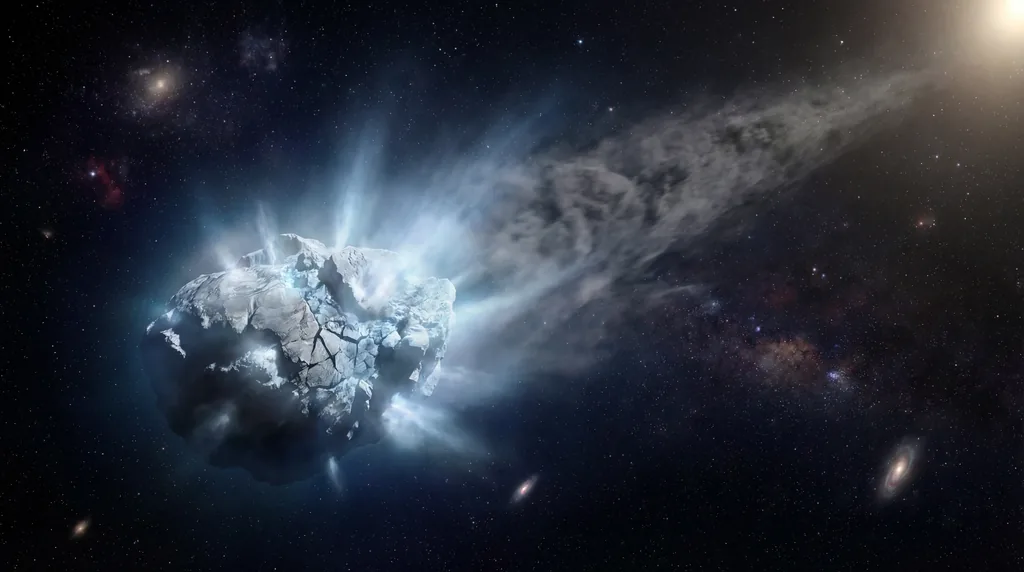

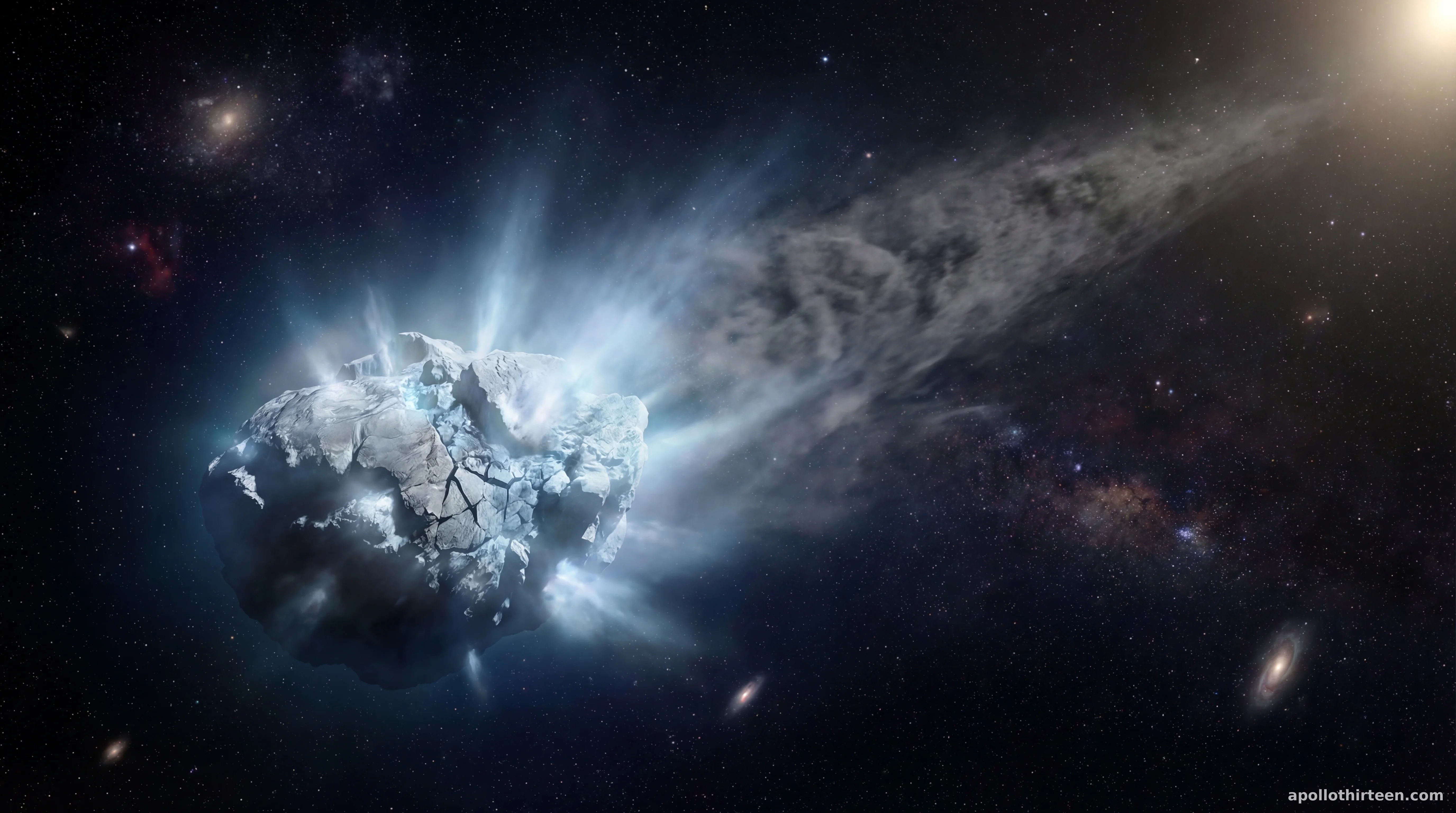
3I/ATLAS: The Third Interstellar Visitor Reveals 'Hyperactive' Water Production
The arrival of an interstellar object (ISO) within our solar system offers a rare, high-stakes opportunity to study the building blocks of distant planetary systems without leaving our own cosmic backyard. The latest such visitor, 3I/ATLAS, has provided astronomers with a wealth of data that challenges previous assumptions regarding the composition of these nomadic bodies. While the first interstellar object, 1I/‘Oumuamua, appeared as a dry, rocky shard, and the second, 2I/Borisov, behaved more like a typical comet, 3I/ATLAS has revealed itself to be "hyperactive." New research using space-based observations indicates that 3I/ATLAS is releasing water at a scale that suggests a remarkably different evolutionary history than its predecessors.
A study led by Hanjie Tan and Jian-Yang Li of the Planetary Environmental and Astrobiological Research Laboratory (PEARL) at Sun Yat-sen University, alongside Xiaoran Yan of the Institute of Applied Physics ”Nello Carrara” (IFAC–CNR), has characterized the water production of 3I/ATLAS during its critical perihelion passage. Because the object’s trajectory took it extremely close to the Sun, ground-based telescopes were unable to observe it due to solar glare. To bypass this limitation, the researchers turned to the Solar Wind ANisotropies (SWAN) instrument aboard the SOHO (Solar and Heliospheric Observatory) spacecraft, which monitors Lyman-alpha emissions from neutral hydrogen atoms—the byproduct of water molecules dissociated by solar radiation.
Characterizing the Hyperactive Nature of 3I/ATLAS
The core finding of the research, published in a recent draft for the American Astronomical Society, is a peak post-perihelion water production rate ($Q_{\mathrm{H_2O}}$) of approximately $4 \times 10^{28}$ molecules per second. To put this in perspective, the researchers calculated that this requires a minimum "active fraction" of roughly 30% of the object's surface, assuming a maximum nucleus radius of 2.8 kilometers. In cometary science, an active fraction of this magnitude is considered "hyperactive," as most solar system comets only sublimate from a small percentage of their surface area.
This level of activity draws a striking parallel to Comet 103P/Hartley 2, a well-known hyperactive comet within our own solar system. Tan and colleagues suggest that the high production rate is likely not coming solely from the nucleus surface, but rather from a "distributed source" of icy grains. As 3I/ATLAS approached the Sun, it appears to have shed a cloud of small, icy particles that sublimated in unison, creating a larger effective surface area for water release than the solid nucleus could provide on its own. This suggests that 3I/ATLAS may be a fragment of a much larger, volatile-rich planetesimal from its home system.
The Dynamics of Perihelion Asymmetry
One of the most significant contributions of this study is the documentation of a "perihelion asymmetry" in the object's behavior. By comparing their post-perihelion measurements with previous pre-perihelion data, the team discovered that 3I/ATLAS did not brighten and dim at the same rate. On its inbound journey toward the Sun, the water production rose sharply, scaling at $r_h^{-5.9 \pm 0.8}$ (where $r_h$ is the heliocentric distance). However, as it moved away from the Sun (outbound), the decline was much shallower, scaling at $r_h^{-3.3 \pm 0.3}$.
This asymmetry provides a fingerprint of the object’s thermal evolution. The steep inbound rise likely marked the transition when 3I/ATLAS crossed the "water-ice sublimation line" at roughly 2 to 3 au, causing a sudden awakening of dormant volatiles. The shallower decline post-perihelion suggests that the thermal energy absorbed during its closest approach continued to drive activity even as the object retreated into the colder reaches of the solar system. The researchers used 3D Monte Carlo modeling to confirm that this behavior was driven by solar insolation acting on a stable, active area, rather than a one-time outburst or a fragmentation event.
A Stable Messenger from the Galaxy
Despite the intense heat of perihelion, 3I/ATLAS displayed remarkable structural stability. Unlike 2I/Borisov, which showed signs of an optical outburst and a rapid decline in water production near the Sun, 3I/ATLAS maintained a steady output. According to the research team, there were "no signs of outbursts or rapid depletion of water production" during the observation window of November to December 2025. This stability suggests a homogeneous composition, where volatiles are distributed evenly throughout the matrix of the nucleus rather than trapped in isolated pockets.
The dynamical age of 3I/ATLAS further adds to its mystery. With a high hyperbolic excess velocity ($v_{\infty} \approx 58$ km/s), the object is estimated to be between 3 and 11 billion years old. This age implies it was formed during the early history of the Galaxy, potentially predating the birth of our own Sun. Its "pristine" nature—having spent billions of years in the deep cold of interstellar space—makes its sudden, hyperactive response to solar heat a vital data point for understanding planetesimal formation in other star systems.
Comparing the Three Interstellar Visitors
The discovery and characterization of 3I/ATLAS allow for a fascinating comparative study of the three known interstellar objects:
- 1I/‘Oumuamua: Seemingly inactive, with no detectable coma, leading to theories ranging from a nitrogen-ice fragment to a rocky shard.
- 2I/Borisov: Highly volatile-rich with a high CO/H2O ratio, but prone to fragmentation and outbursts near the Sun.
- 3I/ATLAS: Characterized by "hyperactive" water production and a stable, grain-dominated coma, mirroring some of the most active comets in our own system.
This diversity suggests that the "standard" interstellar object does not exist. Instead, the Milky Way appears to be populated by a wide variety of small bodies, reflecting the diverse chemical and thermal environments of the protoplanetary disks in which they formed.
Implications for the Future of Cometary Science
The study by Tan, Yan, and Li underscores the indispensable role of space-based assets like SOHO in modern astronomy. Without the SWAN instrument, the most active phase of 3I/ATLAS would have been a "black box" to researchers. As the astronomical community prepares for future missions—such as the European Space Agency’s (ESA) Comet Interceptor, which aims to wait in space for a pristine comet or ISO to enter the system—the data from 3I/ATLAS provides a roadmap for what to expect.
Looking ahead, the stability and water-rich nature of 3I/ATLAS offer hope that future interstellar visitors might be more than just fleeting shadows. If objects like 3I/ATLAS are common, they could serve as "galactic delivery systems," carrying water and organic molecules across the vast distances between stars. For now, 3I/ATLAS continues its journey back into the interstellar void, leaving behind a trail of data that has significantly expanded our understanding of the galaxy's wandering travelers.




Comments
No comments yet. Be the first!