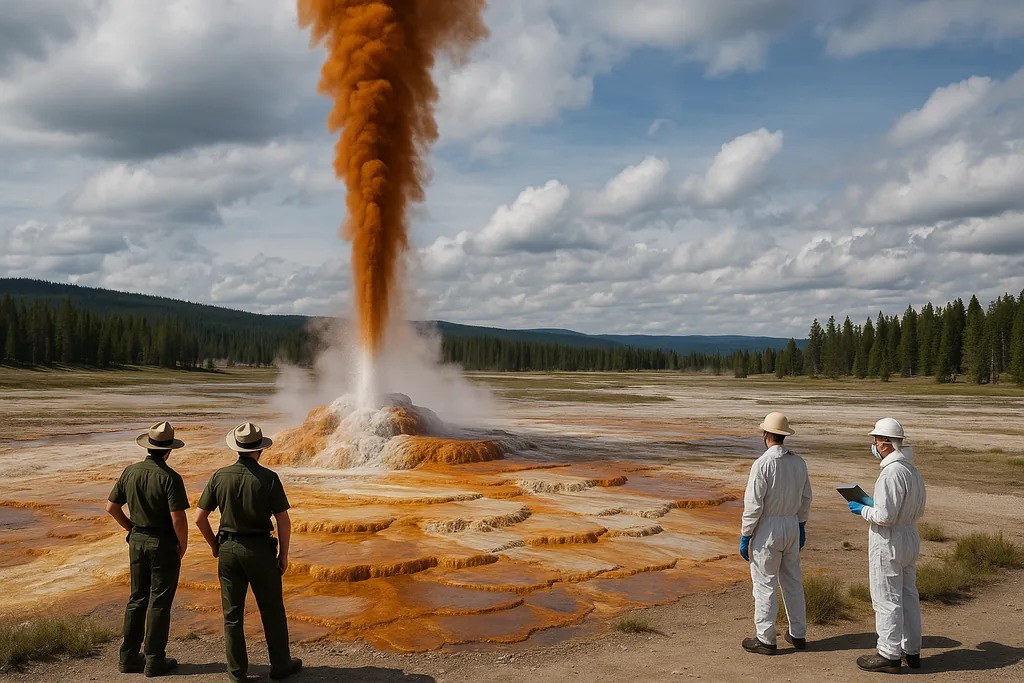
A backyard spectacle: the world’s largest acid geyser
On March 3, 2026, a striking hydrothermal display drew park visitors and researchers when what scientists are calling the world’s largest acid geyser erupted within a well-traveled geothermal area. The eruption produced a high, rust-colored plume and sheets of boiling, acidic liquid that stained nearby terraces and soaked the air with a sharp, chemical tang. Photographs and on-site reports circulated quickly, prompting park managers to close surrounding trails and to ask people to keep a wide berth while geochemists and the United States Geological Survey (USGS) mobilised monitoring teams.
The label “world’s largest acid geyser” reflects both the intensity and the scale of the discharge: observers noted unusually large volumes of acidic fluid and mineral-laden spray compared with ordinary hydrothermal vents. Scientists cautioned that the phrase is descriptive rather than formal—researchers will need time to measure flow rates, chemistry and subsurface controls before definitively ranking the feature. Still, the event is already unusual enough to interest volcanologists, chemists and microbial ecologists alike because acidic eruptions are rarer and chemically more complex than the familiar clear-water geysers most people associate with places like Yellowstone.
How the world’s largest acid geyser erupts
In practical terms, eruption begins when heat drives boiling in a restricted conduit. Gas bubbles nucleate and grow until the overpressure clears a pathway, producing a violent venting of steam, liquid and dissolved solutes. Because acidic fluids dissolve rock more readily, the subsurface plumbing of an acid geyser can enlarge over time or change morphology quickly—opening new vents or collapsing old ones. Those dynamic feedbacks are part of why the recent eruption surprised observers: small changes in gas flux or permeability can convert a quiet acid spring into a forceful, geyser-like event.
Acid versus water: chemistry and physics
Compared with ordinary water geysers, acid geysers are chemically aggressive and physically different in ways that matter for hazard and habitability. The acidity (often with pH values well below neutral) dissolves silicate and carbonate minerals, releasing iron, aluminum and sulphate into solution; when those fluids reach the surface and cool, they precipitate colorful sulfate minerals, iron oxides and other encrustations that give vents dramatic hues—reds, oranges and whites. The dissolved metals and low pH also make these fluids toxic to many plants and animals, and corrosive to metal and concrete structures.
Physically, acid geysers can erupt with different rhythms. In some systems the eruption is gas-dominated—bursts of volcanic CO2, H2S or steam drive the column—whereas in others chemical reactions in the rock (for example, oxidation of sulfides) sustain pressure and fluid production. Those processes alter how forceful the discharge is, how frequently it repeats, and how long a given vent remains active. For scientists, these coupled chemical and hydrodynamic processes are an opportunity to study geochemistry and subsurface flow in real time.
Safety, monitoring and what to expect next
Park officials and scientists have emphasised caution. Acid geyser eruptions release corrosive liquids and acidic aerosols that can irritate skin, eyes and lungs, and the fluids often carry dissolved heavy metals that pose environmental and human-health risks. Visitors should stay behind barriers, follow closures, and avoid touching or breathing near vents. Field crews working close to the feature use respirators, acid-resistant clothing and corrosion-resistant instruments, and they limit exposure times.
From a monitoring standpoint, the eruption has triggered rapid sampling and instrument deployment. Teams will measure temperature, pH, major-ion chemistry, and gas composition, and they will install seismometers and pressure sensors to track subsurface changes. Those data will help determine whether the eruption is a transient response to a gas pulse or part of a longer-term reorganization of the hydrothermal system. Authorities will also test downstream runoff for metal concentrations and acidity so managers can mitigate impacts to soil and water.
Why researchers care: ecology, hazards and planetary analogues
Beyond immediate hazards, the event matters because acid geysers set up extreme chemical gradients that host specialized microbial communities—organisms that thrive at low pH and high metal concentrations. Scientists studying extremophiles are keen to sample the new vent and its deposits because those microbes can tell us how life survives in chemical extremes and inform searches for potential biosignatures on other worlds.
There are also practical implications. Acidic hydrothermal discharge can accelerate corrosion of park infrastructure and damage vegetation and aquatic habitats; understanding the geyser’s chemistry will help managers protect trails and water sources. On a broader scale, the eruption gives volcanologists and hydrogeologists an opportunity to link gas flux, subsurface reactions and surface expression in a setting far easier to observe than deep volcanic conduits. That knowledge improves hazard assessments for geothermal areas and may refine models that predict when hydrothermal systems transition from passive springs to eruptive geysers.
Could acid geysers be natural—or are they lab curiosities?
Acid geysers are natural phenomena. While laboratory experiments can and do recreate acid vents at small scales to study reaction rates and flow, the large-scale eruptions that produce columns of acidic fluid and mineral sprays arise in the field where heat, groundwater and volcanic gases coincide. Well-known acidic environments include hydrothermal fields in volcanic regions—some of which deposit vivid sulfate and iron minerals—and extreme sites such as Dallol in Ethiopia or the Rio Tinto basin in Spain that illustrate how acid-rich waters shape landscapes over time. The recent event is a reminder that such systems can be both grand and active close to populated areas.
Practical safety tips for observers
If you see or hear about an acid geyser eruption, keep these precautions in mind. First, obey park closures and signage: those restrictions protect you from corrosive fluids and unstable ground. Second, avoid inhaling steam or aerosols from the vent; even dilute acidic mists can inflame eyes and airways. Third, resist touching discolored rocks or water—acidic runoff often carries heavy metals and can burn skin or ruin clothing and equipment. Finally, for citizen scientists, photograph from a distance and report observations to park managers rather than attempting to collect samples without permits and protective gear.
The March 3 eruption of the world’s largest acid geyser will be studied for months. Teams from the National Park Service and the USGS plan ongoing monitoring and public updates as they assemble chemistry, flow and seismic data. For now, the spectacle has reminded visitors that geothermal landscapes continue to surprise: familiar places can host unfamiliar chemistry, and those extremes reveal both hazards and opportunities to learn about Earth’s inner workings.
Sources
- Nautilus (report on the world’s largest acid geyser)
- Yellowstone National Park (National Park Service geothermal monitoring)
- United States Geological Survey (USGS hydrothermal and volcanic monitoring)




Comments
No comments yet. Be the first!