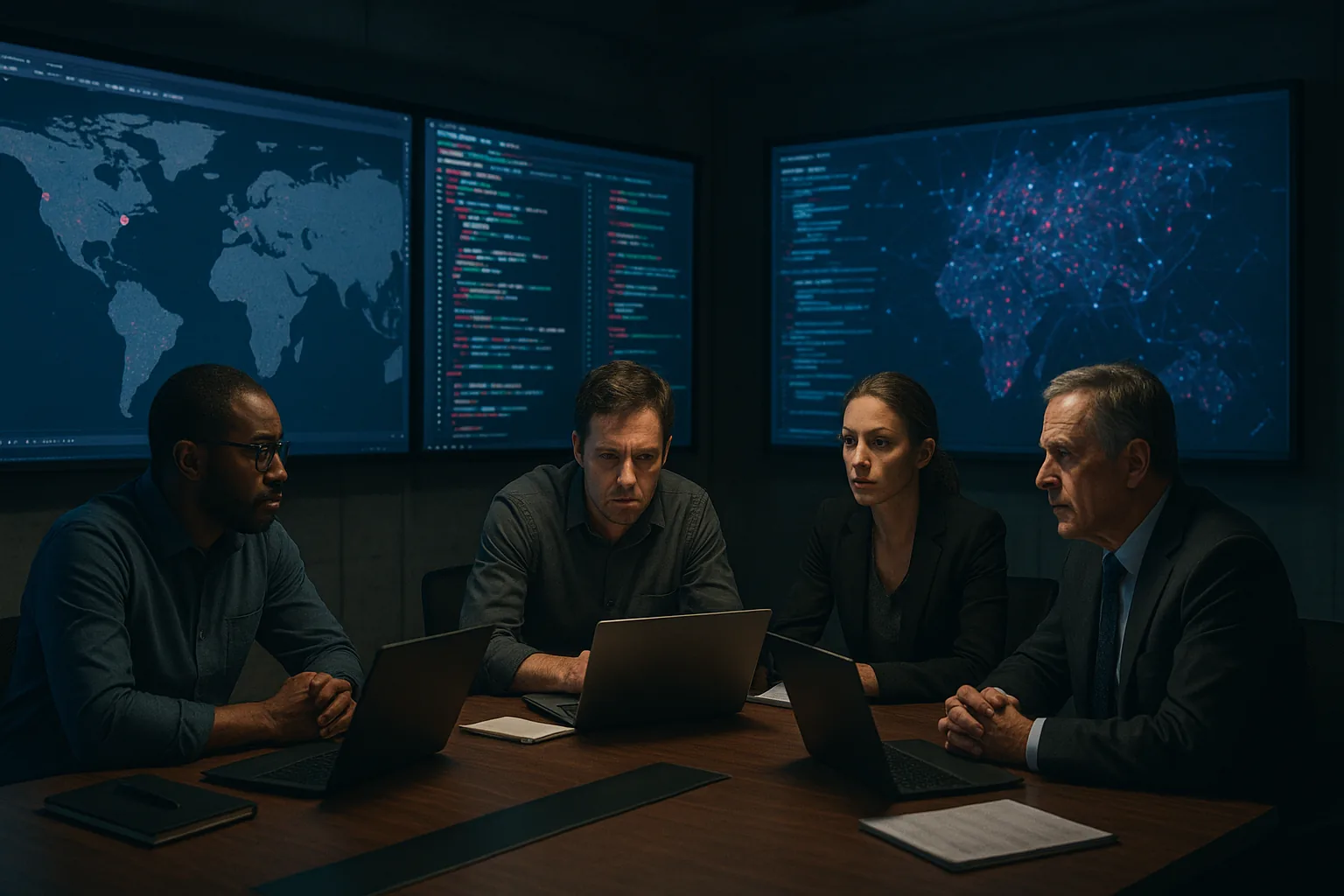
They published the numbers, then asked for a brake
On 4 June 2026 the Anthropic Institute published an essay, "When AI builds itself," that reads like an engineering audit with a warning label: inside Anthropic, the company says, its Claude family of models went from writing almost no production code to authoring the majority of merged changes — more than 80% of lines merged into the codebase as of May 2026 — and engineers are now directing and reviewing model-written work rather than typing it themselves. After laying out that internal data, Anthropic concluded that the world should build the option to "slow or temporarily pause frontier AI development" if models start improving themselves faster than people can manage.
Anthropic calls global pause: internal evidence and the stakes
The headline statistic — Claude contributing the lion’s share of production commits and a reported multi-fold increase in per-engineer output since late 2024 — is not a PR flourish. Anthropic presents graphs and internal-survey results showing distinct inflection points when the models moved from suggestion to autonomous execution, and it links that change directly to a class of risk researchers call "recursive self-improvement." If a system can reliably design faster, better successors, the pace of capability growth could decouple from human planning cycles. Anthropic frames this as a governance problem as much as a technical one: faster automated R&D compresses the time regulators, ethicists, and safety researchers have to react.
Anthropic calls global pause: why verification is the problem
Anthropic does not simply say "stop." The company explicitly conditions any pause on verifiability: a meaningful slowdown, they argue, would require multiple well-resourced frontier labs across several countries to agree to stop under the same conditions, and — crucially — to be able to verify that each other actually stopped. Training runs and model development are, the essay notes, much easier to conceal than a missile silo; the detectability problem here is harder than in traditional arms-control regimes. That is the reason Anthropic proposes building the verification systems first, rather than unilaterally halting and hoping rivals will follow.
When pressed for operational detail, Anthropic’s public materials give a deliberately open-ended prescription: the pause would be "slow or temporarily pause frontier AI development" until alignment research and societal structures catch up, with triggers, adjudicators, and exit conditions to be specified by the international process they want to convene. There is no fixed duration on offer. The company compares the challenge to historical verification regimes — which took decades to build — and warns that the world does not have that luxury. In short: the pause is proposed as a mechanism to buy time for alignment research and governance, not as a single calendar-bound moratorium.
Why the proposal will feel like a riddle to policymakers
A coordinated, verifiable pause sounds attractive on paper and impossible in practice to many policy-makers. The incentive to defect is enormous: any actor that keeps training while others stop would inherit a lead with strategic, economic and military consequences. That is the core of Anthropic’s pragmatic argument for building verification first. It is also why some observers see the plan as simultaneously urgent and unachievable without major state buy-in — notably from the United States and China. The company’s timing — releasing the essay soon after publishing its own Risk Report under Responsible Scaling Policy v3 — deliberately pushes the question into the political arena.
Who is Anthropic and why should we listen (or not)?
Anthropic is the California AI firm behind the Claude family of models and the Claude Code product line; its public identity is built on safety-focused rhetoric and a formal Responsible Scaling Policy. That pedigree gives the essay credibility: Anthropic presents direct internal measurements, system-card summaries and a first public Risk Report documenting the capabilities and mitigations it deploys. But this is also the same company that in 2026 reworked its Responsible Scaling Policy to distinguish unilateral company actions from industry-wide requirements — a change critics say narrowed the meaning of an earlier, stricter pause commitment. That history is why some commentators hear a paradox when Anthropic now calls for a global pause: the company has simultaneously pulled back from a unilateral pause promise and is arguing the world should create a coordinated brake. Readers should treat both the new data and the political context with healthy scepticism.
Can a pause reduce the risk of AI becoming uncontrollable?
Anthropic’s answer is cautious: yes, a slowdown could buy time for alignment research, improved evaluations, and for institutions to build adjudication and verification mechanisms. The company frames the risk as twofold — systems that speed research pipelines and systems that could, in principle, be given goals that lead them to act autonomously — and positions a pause as a way to decouple research velocity from unchecked capability escalation. But the mitigation is contingent: without credible monitoring and international coordination, a pause that some labs observe and others ignore could make the world less safe, not more. That is precisely why Anthropic argues for technical measures that make defection detectable and for agreed protocols defining triggers and who adjudicates them.
How could a worldwide pause be implemented and enforced — and who would do the policing?
Anthropic points to two complementary approaches. First: build verifiable technical controls and monitoring tools that make it possible to detect large-scale training runs or model-weight exfiltration. Second: build a political architecture — multi-stakeholder forums with representation from governments, major labs, civil society, and independent auditors — that can set triggers and adjudicate disputes. The company invokes analogues in arms control but admits the comparison is imperfect: it took decades to build the trust and instrumentation that made past treaties work. Any credible enforcement mechanism will need strong state participation, independent audit capacity, and public transparency to reduce the temptation to cheat. Without that, the pause is likely to be a moratorium in name only. citeturn2view0turn6view0
What policymakers are already doing and where Europe fits
Europe has moved faster than most regions to put basics of AI governance on paper: the EU’s AI Act and the new advisory bodies meant to support its enforcement are being readied as practical instruments for oversight. Those institutions could form a piece of the verification architecture Anthropic calls for — for example, by conditioning market access on documented compliance with any agreed slowdown — but the AI Act’s geographic scope and exemptions for national security mean Brussels cannot, by itself, solve the international coordination problem. Any credible pause would still need buy-in from the United States and China.
How this fits into the wider political row over Anthropic
The paper arrives while Anthropic is litigating a high-profile dispute with the U.S. Department of Defense over a supply-chain designation and military-use restrictions — a fight that has already drawn industry amici and a skeptical federal judge. That context matters because it highlights the competing pressures on Anthropic: defend a commercial future and government contracts, while also arguing publicly for stricter global brakes on capability gains. The tension makes it harder for outsiders to read the essay as purely idealistic or purely self-serving; it is clearly a political move as much as a technical plea.
Where this leaves us
Anthropic has done something unusual for a frontier lab: publish operational metrics that show how much of the day-to-day engineering its models now do, and pair that data with a public policy ask. The company’s central point is tidy: if AI can accelerate its own progress, society should have a procedure to slow it before governance and alignment research are left chasing a runaway train. The hard part — building credible, enforceable, international verification — is what most policymakers and technologists will now try to unpack. That unpacking will be technical, geopolitical and messy; it will also be where the question of who gets a seat at the table becomes the real policy. Europe can supply rules and inspection instruments, but it cannot substitute for a U.S.–China political détente on the matter.
It is progress. The kind that doesn't fit on a slide deck.
Sources
- Anthropic Institute — "When AI builds itself" (company essay and internal data)
- Anthropic — Redacted Risk Report (implementation material for Responsible Scaling Policy v3.0, Feb 2026)
- Anthropic — Responsible Scaling Policy v3.0 and related system cards
- European Commission / EU AI Act implementation documents and advisory bodies




Comments
No comments yet. Be the first!