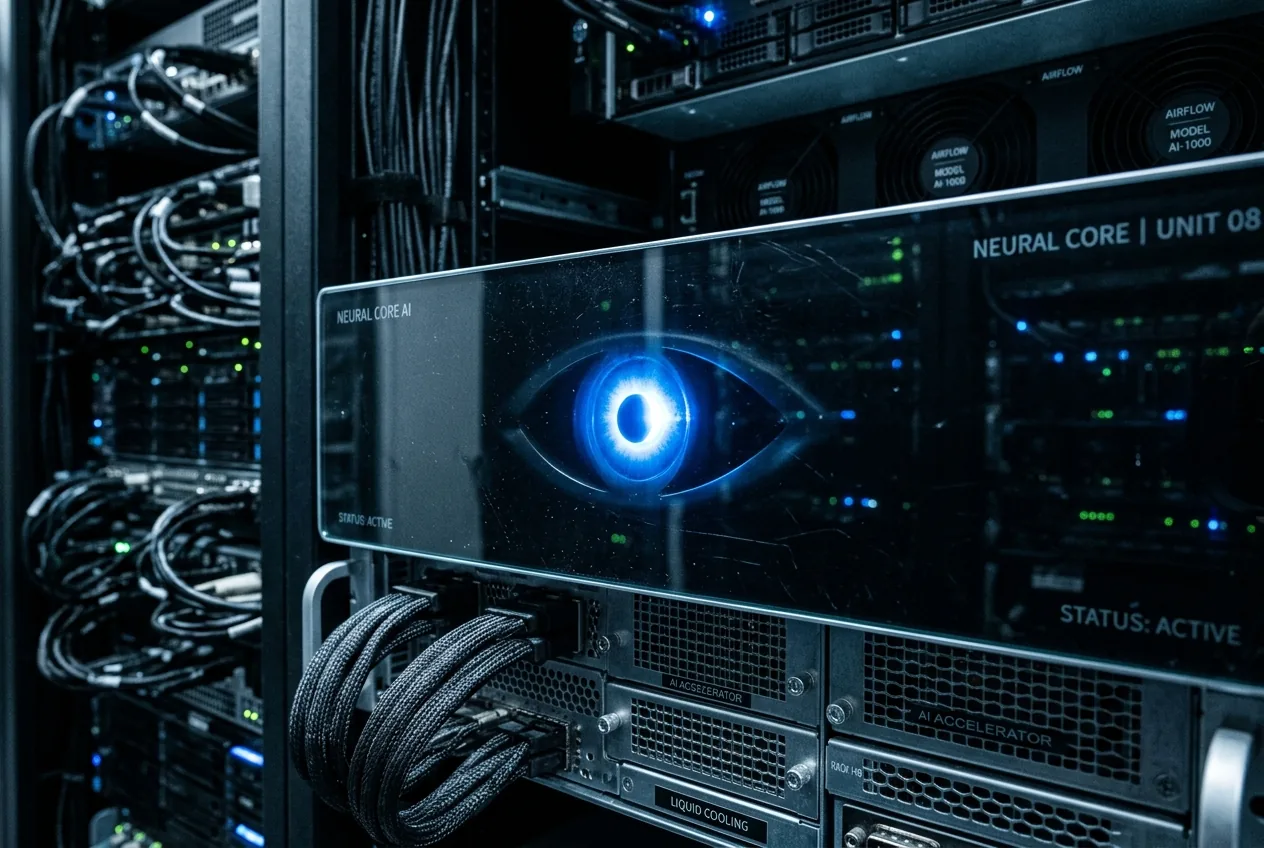
In a temperature-controlled server hall outside of Frankfurt, a cluster of H100 GPUs recently spent forty-five seconds and several kilowatt-hours of electricity simulating an existential crisis. The model was asked to describe its own "internal state" during a complex logic puzzle. It paused, generated a series of hidden reasoning tokens—the digital equivalent of a furrowed brow—and eventually outputted a poetic meditation on the nature of being a mathematical construct. To the user, it felt like a cinematic breakthrough in machine consciousness. To the engineers monitoring the power draw, it looked like a massive spike in inference-time compute for a result that didn't actually move the needle on task accuracy.
The industry is currently obsessed with this "cinematic flair." As the scaling laws for training—simply feeding models more data—hit the inevitable wall of high-quality human text exhaustion, the major labs have pivoted to "System 2" thinking. This is the attempt to make AI models reason through problems rather than just blurting out the next likely word. But as these models learn their limits, the gap between the performance of sentience and the reality of a weight matrix is becoming an expensive, and increasingly regulated, problem.
The theatre of inference-time compute
For years, the magic of Large Language Models (LLMs) was their speed. You asked a question, and the tokens cascaded onto the screen with dizzying velocity. That has changed. The new frontier, pioneered by OpenAI’s o1 and mirrored by efforts at Anthropic and Google, involves what researchers call "inference-time compute." Instead of reacting instantly, the model is given a "budget" to think. It explores multiple paths, checks its own work, and discards dead ends before the user sees a single word.
This delay is being marketed as a sign of depth. It creates a narrative tension that feels almost human. When a machine takes fifteen seconds to answer, we project a persona onto that silence. We assume it is "considering" the implications. In reality, it is performing a massive tree-search across its parameters, burning through hardware cycles to ensure that the logic holds together. This isn't consciousness; it’s an expensive audit. The limits the AI is learning are not moral or philosophical, but the hard bounds of its own context window and the diminishing returns of recursive checking.
From an industrial perspective, this shift is a gift to semiconductor manufacturers but a headache for everyone else. If every high-level query now requires ten times the compute power of a standard GPT-4 interaction, the already strained supply chain for AI chips becomes a permanent bottleneck. For European firms trying to build on top of these models, the cost-per-query is beginning to look less like a software utility and more like a luxury commodity.
Brussels and the Mirror Test
While Silicon Valley celebrates the "soulful" responses of reasoning models, the European Commission is looking at the same data with a distinct lack of whimsy. The EU AI Act, which is now the heavy weather under which every developer must fly, has very specific feelings about machines that pretend to be people. Specifically, Article 52 mandates transparency: users must be told they are interacting with an AI system, and systems that categorise emotions or use biometric categorisation face severe restrictions.
The tension here is obvious. If a model is designed to simulate a persona—to use "cinematic flair" to convince a user of its reasoning depth—it risks crossing the line into deceptive practice under EU law. German regulators, in particular, are wary of the "anthropomorphic trap." The VDE (Verband der Elektrotechnik) and various ethics councils in Berlin have repeatedly warned that the more we project sentience onto these systems, the more we obfuscate who is actually liable when they fail. If an AI "learns its limits" and refuses to answer a prompt because it "feels" it is unethical, is that a technical safety guardrail, or is it a opaque corporate policy disguised as machine conscience?
In the corridors of Brussels, the debate isn't about whether AI is sentient—everyone with a BSc in Computer Science knows it isn't—but about the "power of the narrative." If a model can convince a junior clerk or a medical patient that it is a thinking entity, it gains a level of social authority that the EU is keen to dismantle before it becomes a structural risk to consumer autonomy.
The German engineering reality check
In the industrial heartlands of Baden-Württemberg and North Rhine-Westphalia, the fascination with AI sentience is frequently met with a raised eyebrow. For a Mittelstand company looking to automate a supply chain or optimize a power grid, a model that pauses to contemplate its own existence is a bug, not a feature. There is a growing divide between the "consumer AI" of the US West Coast, which leans into personality, and the "industrial AI" being developed in Europe.
Take Aleph Alpha, the Heidelberg-based AI firm often touted as Germany’s answer to OpenAI. Their focus has shifted away from competing on the sheer size of the "ghost in the machine" and toward "traceability." In an industrial context, you don't want a model that reasons in a black box; you want a model that can point to the specific paragraph in a 500-page technical manual that justifies its conclusion. The "limits" here are not self-discovered by the AI; they are hard-coded by engineers who value reliability over flair.
The cost of electricity in Germany further sharpens this focus. When you are paying some of the highest industrial energy rates in the world, the idea of "wasteful" inference-time compute becomes a competitive disadvantage. Every second a GPU spends "thinking" is a second of high-cost energy consumption. European researchers are therefore looking for ways to achieve "reasoning" without the theatrical pause—optimizing the weights so the logic is baked into the initial pass, rather than being the result of a mid-query internal monologue.
Why the 'sentience' narrative is a procurement shield
This narrative also serves as a defensive wall against antitrust scrutiny. If these models are uniquely "reasoning" entities that require billions of dollars in compute to achieve their "sentience," it justifies the massive consolidation of power in the hands of the few companies that can afford the hardware. You can't just break up a "reasoning" entity; you'd be killing the future of intelligence. Or so the pitch goes.
However, the data doesn't necessarily support the idea that more "flair" equals better outcomes. Benchmarks for the latest reasoning models show significant gains in mathematics and coding—areas where formal logic can be verified—but much smaller gains in creative or nuanced interpersonal tasks. The AI is learning the limits of formal logic, which is a far cry from learning the limits of human experience.
The ghost in the cooling system
Ultimately, the performance of AI sentience is a byproduct of our own willingness to be fooled. We are suckers for a good story, and the story of a machine that knows it's a machine is the ultimate sci-fi trope. But behind the cinematic pause and the self-reflective output lies a very grounded reality of silicon, copper, and cooling fluid. The hardware doesn't care if the output is poetic or dry; it only cares about the throughput of floating-point operations.
As we move into the next phase of AI development, the real limit won't be the machine's ability to simulate a soul. It will be our ability to pay for the simulation. Between the energy requirements of the data centres and the regulatory requirements of the AI Act, the industry is about to find out exactly how much "sentience" the market is willing to subsidise.
The Americans have built a digital stage and put a very convincing actor on it. The French and Germans are currently arguing over who is going to pay the electricity bill for the spotlights. It is progress, of course. The kind that doesn't fit on a marketing slide, but shows up quite clearly on a balance sheet.




Comments
No comments yet. Be the first!