If SpaceX decides not to buy the AI coding startup Cursor later this year, it will pay its parent company, Anysphere, a $10 billion “partnership fee.” In the sober world of aerospace procurement and industrial contracts, a ten-figure penalty for doing nothing is usually called a disaster; in the current Silicon Valley AI arms race, it is simply the price of keeping a target within your gravity well. The deal, announced Tuesday, gives Elon Musk’s rocket-and-satellite empire a formal option to acquire the world’s most popular AI-integrated code editor for $60 billion, a move that effectively merges the infrastructure of space with the software that builds it.
The financial alchemy of a space conglomerate
The internal balance sheet of the new SpaceX-xAI-X conglomerate reveals a stark divergence in performance that this acquisition is likely intended to smooth over. Last year, Starlink emerged as the group’s reliable cash engine, posting an operating profit of $4.42 billion—more than double its 2024 performance. However, those profits are currently being incinerated by xAI. Musk’s artificial intelligence lab reported a staggering $6.4 billion loss in 2025, a victim of the exorbitant costs of H100 GPU clusters and the talent war currently raging across the Bay Area. At $60 billion, Cursor is being valued at nearly double its $29 billion valuation from just last November, a premium that serves as a loud signal to the market that SpaceX is no longer just a transportation company.
Under the proposed deal structure, SpaceX is using its Starlink revenue to subsidize the expansion of its AI ambitions. This kind of cross-subsidization is a classic Musk maneuver, but it carries significant risk for public market investors who will soon be asked to buy into the IPO. The inclusion of special voting shares ensures that Musk retains absolute control over the entity, even as the financial picture becomes increasingly opaque. For European investors, who typically demand clearer separation between infrastructure and speculative software ventures, the SpaceX conglomerate looks less like a tech company and more like a 21st-century version of the East India Company—a sovereign corporate entity with its own foreign policy and its own internal economy.
Thermodynamics and the dream of the orbital data center
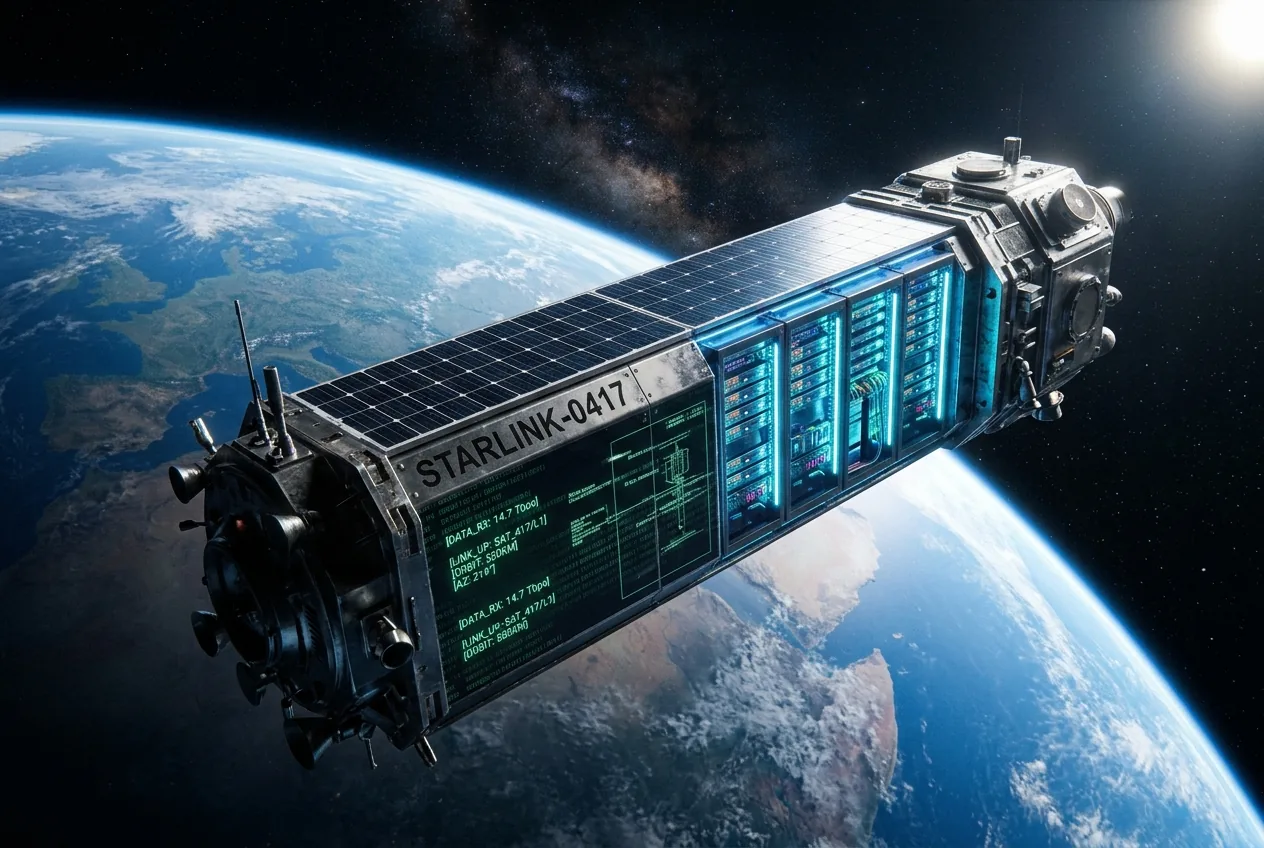
Beyond the financial engineering, there is a technical justification for the deal that leans on the physics of large-scale computing. Musk has recently begun pitching the idea of “data centers in space,” arguing that satellites powered by unshielded solar energy and cooled by the ambient vacuum of orbit will eventually be cheaper than terrestrial facilities. While this sounds like science fiction, the procurement of Cursor suggests an immediate application: the automation of the satellite fleet itself. With tens of thousands of Starlink satellites in low Earth orbit, the manual maintenance of flight software is becoming an impossibility. Cursor’s “Composer” model, which allows engineers to describe complex software systems and have them generated in real-time, is the missing link in autonomous constellation management.
The geopolitical irony in the code base
This highlights a reality that many in the AI industry are hesitant to admit: the supply chain of intelligence is as globalized and messy as the supply chain for semiconductors. Even as the U.S. and the EU tighten export controls on high-end chips, the models themselves are leaking across borders through open-source repositories and collaborative research. For SpaceX, owning Cursor means owning the interface that thousands of Western engineers use to write sensitive code, regardless of where the underlying model weights were originally trained. It is a pragmatic, if politically risky, admission that in the race for AI dominance, speed is more important than ideological purity.
Europe’s regulatory vacuum and the talent drain
For the European Union, the SpaceX-Cursor deal is a sobering reminder of the widening gap in industrial policy. While the EU has focused on the AI Act and antitrust investigations into the “Magnificent Seven,” it has failed to produce a venture capable of the kind of aggressive vertical integration Musk is currently demonstrating. Companies like Mistral in France or Aleph Alpha in Germany are often touted as European champions, but their valuations and compute budgets are rounding errors compared to the $10 billion SpaceX is willing to pay just for the right to partner with a startup. The deal underscores a shift in the global order: the real competition is no longer between nations, but between integrated ecosystems that control everything from the silicon and the energy to the satellite and the software editor.
Brussels will likely look at the $10 billion partnership fee and see a disguised subsidy or a predatory acquisition designed to stifle competition in the nascent AI-coding market. But the reality is that the European regulatory framework is currently ill-equipped to handle a company that operates in orbit. If the compute power moves to space, whose jurisdiction does the data fall under? If a German engineer uses a Cursor interface hosted on a Starlink satellite to write code for a BMW factory, the data sovereignty questions become a jurisdictional nightmare. By the time the European Commission completes a study on the matter, the infrastructure will likely already be in place, and the talent will have followed the capital to Hawthorne.
SpaceX’s bid for Cursor is not just an acquisition; it is a declaration that the era of the specialist space company is over. The $1.75 trillion valuation Musk is seeking depends on the world believing that rockets are merely the delivery mechanism for a much larger, more pervasive intelligence network. Whether the thermodynamics of space-based AI actually make sense is almost secondary to the momentum of the capital. The deal is progress—the kind that doesn't fit on a slide deck, and the kind that leaves terrestrial regulators staring at a sky they no longer control.




Comments
No comments yet. Be the first!