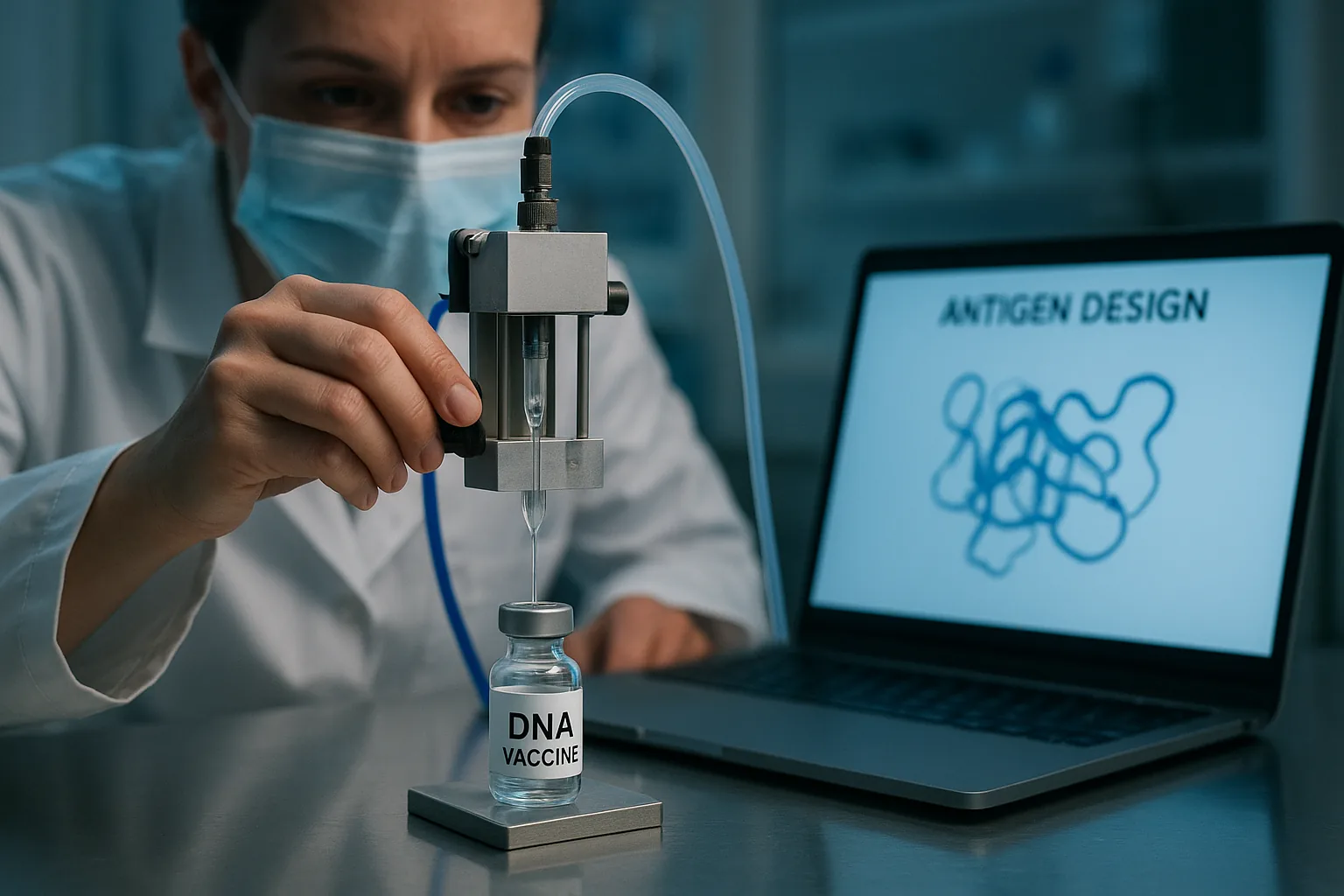
Thirty-nine volunteers, a micro‑jet and a claim: Cambridge calls it a "world-first" vaccine designed artificial
The details matter because this is not a tweak to an old recipe. The Cambridge group used viral genetic data from many coronaviruses, fed that into a machine‑learning pipeline, and asked the algorithm to output a compact antigen that targets features shared across the family — bits the virus cannot easily change. The vaccine itself was delivered as DNA using a needle‑free microfluidic jet into the skin, a delivery choice the team says speeds up manufacture and sidesteps some supply‑chain bottlenecks of conventional syringes.
'world-first' vaccine designed artificial: what Cambridge actually tested
The phase I work described in the Journal of Infection enrolled under 50 people; the public reporting focuses on 39 trial recipients across Cambridge and Southampton. The platform here is a DNA construct encoding the AI‑designed antigen, delivered by a high‑pressure, hair‑thin liquid jet that forces the genetic blueprint into skin cells. That method is different from the mRNA lipid nanoparticle approach used widely during the COVID pandemic.
Cambridge calls the focal molecule a "super‑antigen" because it bundles together multiple conserved pieces of the coronavirus family into a single target. In animal studies the construct stimulated a broad response against several coronaviruses; in humans the primary outcome was safety and tolerability. Immunogenicity was measurable but described as modest — a phrase scientists use deliberately, meaning the signals are present but not yet at levels most would call strongly protective.
Crucially, the team has already opened a larger phase II programme expected to recruit a few hundred participants. That next step will examine how well the vaccine trains the human immune system in a more diverse set of people and whether antibody or T‑cell responses increase with dose or different delivery approaches.
How the AI found a 'super‑antigen' (and why that is not the same as a finished vaccine)
At its simplest, the Cambridge system is a pattern‑finder. The researchers assembled public and surveillance viral sequence databases, then used machine learning to identify regions that are both common across many coronaviruses and biologically constrained — parts the virus needs to keep working and therefore cannot change easily. The algorithm then stitched these conserved motifs into a single artificial antigen that the immune system can recognise.
This is not a magic wand. Conserved regions are sometimes poor targets because the immune system ignores them, or because they sit in a part of a protein that is hard for antibodies to reach. That is why practical vaccine design still needs human judgement: which conserved sites to present, whether to stabilise their shape, whether an adjuvant is required and which delivery platform will make human immune systems pay attention. AI speeds the search and proposes candidates; wet‑lab immunology still decides which candidates to test.
Think of the algorithm as an experienced scout pointing out the load‑bearing walls in a row of houses. It saves weeks or months of lab work, but engineers still have to decide how to bolt the scaffold to the house so it won’t fall down in a storm.
'world-first' vaccine designed artificial: safety, trials and what "modest" immune response means
Can AI actually speed vaccine development — and does it change the industrial equation?
Yes, in two distinct ways. First, AI reduces the search space. Instead of months of iterative lab work to pick candidate antigens, a well‑trained model can propose promising designs in hours or days. That helps get to first‑in‑human testing faster. Second, AI can explore combinations (mosaics) that humans would not have intuitively tried, potentially finding antigen shapes that trigger broader immunity.
But speed at the design stage does not always translate to speed at scale. Manufacturing DNA constructs or validating a new delivery device still requires facilities, raw materials and regulatory approvals. Europe in particular has a patchwork of production sites and procurement authorities; rapid deployment would demand coordinated contracts and stockpiling strategies. In short: AI can cut the upstream calendar, but downstream bottlenecks — factories, regulatory clearances, cold chains — still determine how quickly a vaccine reaches a population.
European policy and industry: why a Cambridge triumph matters for EU preparedness
From Cologne to Cambridge, the industrial reality is familiar: innovative labs exist, but turning an experimental vaccine into millions of doses is a supply‑chain problem. The Cambridge work will be interesting to EU health agencies and funding bodies because platforms that aim to protect entire viral families change procurement calculus. A single broad vaccine could reduce the need for yearly reformulations and complex procurement cycles across 27 national health systems.
That said, European regulatory pathways differ from the UK’s. The Medicines and Healthcare products Regulatory Agency (MHRA) oversaw the early UK work; any pan‑EU use would involve the European Medicines Agency and national immunisation committees. Horizon funding, joint procurement frameworks and public‑private manufacturing partnerships will be the levers Brussels will need to pull if it wants to convert an academic milestone into continental readiness.
What to watch next
Several concrete signals will decide how far this goes. Phase II immunogenicity data: do antibody titres and T‑cell responses rise in a larger, more varied cohort? Manufacturing plans: is there a scalable process for the DNA construct and the microfluidic delivery device? And transparency: will the team publish the AI design pipeline and training data so independent groups can validate and extend the work?
Technically, other groups are already trying similar ideas for influenza and haemorrhagic fevers; Cambridge says teams are moving on those fronts. If multiple independent groups converge on the same conserved targets, that will be stronger evidence the approach is robust rather than an isolated success.
For now, the achievement is notable primarily because it tests a new toolchain — machine learning plus rapid delivery platforms — in humans. The results so far are promising on safety and informative on immunology. They are not yet a replacement for the tried‑and‑tested routes that produced the COVID vaccines people relied on during the pandemic.
Europe has the immunologists and biotech hubs. It still needs to decide which capital will underwrite the doses and which regulator will get blamed when the first rollout hiccup happens.
Sources
- Journal of Infection (phase I trial paper)
- University of Cambridge (Lab of Viral Zoonotics)
- DIOSynVax (industry partner)
- University of Southampton (clinical trial site)
- Oxford Vaccine Group (external expert commentary)
- National Institute for Health and Care Research (NIHR) statements




Comments
No comments yet. Be the first!