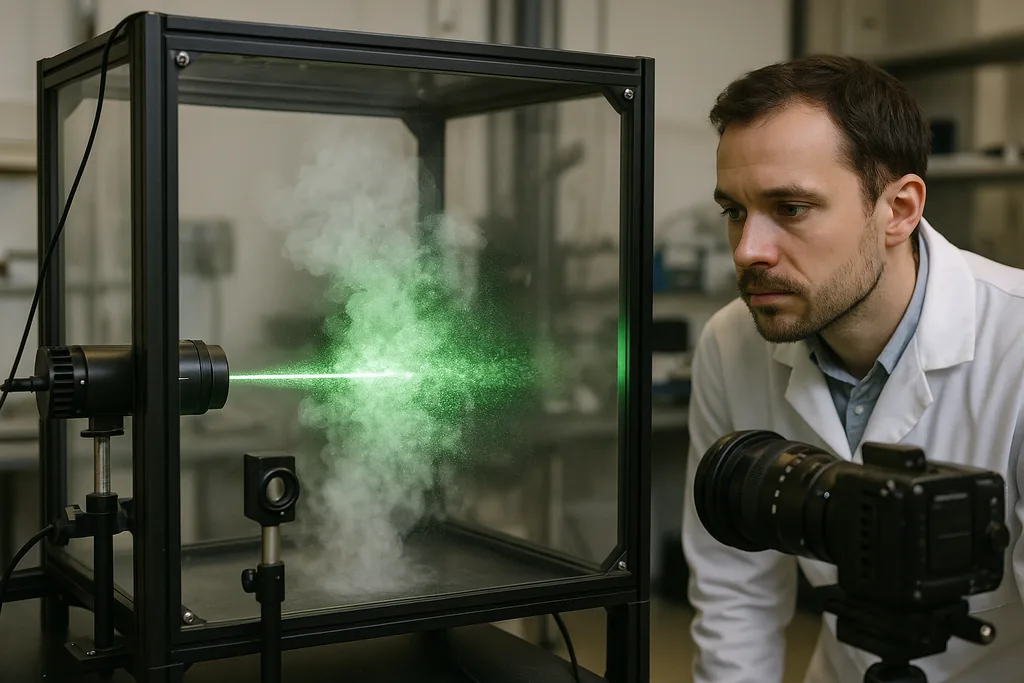
Laser‑lit clouds in a Warwick lab and a 100‑year puzzle
In a cavernous engineering lab at the University of Warwick this week, a laser sheet sliced through a cloud of generated aerosols and turned a faint, chaotic plume into a ribbon of light. It is the sort of scene that has become familiar to anyone studying how tiny bits of matter move through air — but what the researchers are doing there goes to a deeper, older problem: scientists tracked particles floating through the air for decades using an approximation that assumed those particles were perfect spheres. That century‑old assumption, embedded in the Cunningham correction factor since 1910, has limited the accuracy of models for everything from wildfire smoke drift to the fate of microplastics and airborne pathogens. Now a team led by Duncan Lockerby at Warwick has published a mathematical upgrade — a correction tensor — designed to restore realism to how non‑spherical particles are modelled.
How scientists tracked particles floating — from Cunningham to tensors
When airflow is slow and particles are microscopic, drag behaves differently than for macroscopic objects. Ebenezer Cunningham’s early 20th‑century correction accounted for the fact that air at molecular scales does not behave like a continuous fluid around very small spheres; Millikan later refined that work. But both versions treat particles as if they were spherical. Real airborne material — dust, pollen, fragments of microplastic, soot aggregates and many viral carriers — is irregular. That geometric mismatch alters the drag, the torque, and the way particles rotate and tumble as they move.
Lockerby and colleagues revisited the mathematics and derived a correction tensor: a matrix‑like object that encodes directional dependencies of drag and slip across the particle’s surface. In plain language, a tensor lets the model say that a jagged flake feels different resistance when it presents a flat face versus a narrow edge to a flow. The new tensor lifts the spherical assumption and produces directional drag coefficients that change with shape, orientation and the gas’s molecular regime. The result is a more general mathematical bridge between microphysics and the bulk motion tracked in models and observations.
How scientists tracked particles floating in the lab and field
Tracking tiny particles is a technical exercise in matching measurement technique to particle size and environment. In controlled laboratory work like Warwick’s, researchers generate aerosols with defined size and composition and observe them in chambers illuminated by lasers. Optical methods — laser scattering, high‑speed imaging and particle image velocimetry — reveal trajectories and rotations of individual particles; instruments such as aerodynamic particle sizers and condensation counters count and size them. In the field, lidar and radar systems map plumes of particulate matter at larger scales while in situ samplers and air monitors record concentrations of PM2.5 and coarser fractions.
All of these approaches need accurate drag laws to translate raw trajectories and counts into physical quantities: residence time in the atmosphere, deposition rates on surfaces, or the dispersion of a smoke plume downwind. When the drag model assumes sphericity, results can be biased — for example predicting too rapid settling for flat flakes or misestimating how long small aggregates remain buoyant in turbulent air.
The mathematics that models shape and slip
Tiny particles operate across regimes where the continuum approximation of fluids breaks down. Engineers speak of the Knudsen number, a ratio that compares the mean free path of gas molecules to particle size. At higher Knudsen numbers — meaning the particle is comparable in scale to molecular motions — the so‑called slip effects become important and classical Stokes drag underestimates the true forces. The Cunningham correction applied a scalar multiplier to Stokes drag for spheres; Lockerby’s correction tensor generalises that multiplier into directional components and couples it to orientation and shape descriptors.
That change may sound abstract, but it alters computed particle accelerations and rotations in a way that can cascade into very different predictions for transport. In simple terms: irregular particles can present surfaces that either shield or expose more area to flow; they can spin and align with streamlines; and they can interact with turbulent eddies differently than spheres. The tensor formalism captures that anisotropy in a compact, testable way.
Why this matters for health, climate and smoke forecasting
Small airborne particles have outsized impacts. PM2.5 and nanoparticles penetrate deep into lungs and can enter the bloodstream; soot and wildfire smoke affect visibility, climate radiative forcing and public health; microplastic fragments are a persistent pollutant across ecosystems. Models are used to predict exposure, to warn populations downwind of wildfires, and to design mitigation strategies. But if the physical drag used by those models misrepresents how long particles stay aloft or where they deposit, public‑health advisories and policy decisions are based on incomplete physics.
Bringing math back to the wind: turbulence, currents and chaotic motion
No new drag law removes the influence of air currents and turbulence, but it improves how those forces couple to particle shape. In moving air, turbulence produces a spectrum of eddies that buffet particles at many scales; small particles experience both Brownian motion and stochastic kicks from turbulent structures. Irregular shapes add rotational degrees of freedom: a particle may tumble into a low‑drag attitude or catch on a vortex and remain suspended longer.
Accurate tracking requires combining high‑resolution flow measurements with appropriate particle dynamics. In the lab, laser sheets and tracked aerosols resolve these interactions directly; in the field, ensemble statistics and probabilistic transport models are the tools of choice. The tensor gives those models better microphysical inputs so the statistical behaviour emerging from turbulent flow is anchored to realistic single‑particle dynamics.
From mathematical proof to experimental verification
Lockerby’s team plans to test the tensor using a new aerosol generation system at Warwick’s School of Engineering. The aim is to produce controlled, non‑spherical particles and measure their motion in a variety of flow and pressure conditions so the tensor’s predictions can be validated against direct observation. That experimental step is essential: mathematical generality becomes useful only when it reduces predictive error in real, messy air.
Validation will involve the same optical imaging and particle counting techniques used to track aerosols today, but with careful characterization of particle shapes and orientations. If the tensor reduces model bias across multiple particle classes — from soot aggregates to jagged mineral dust — it will be a rare example of a century‑old approximation being replaced by a concise framework that works across a wide set of real‑world cases.
What solving the mystery changes for applied science and policy
Better microphysics feeds better forecasts and better policy. Air‑quality managers, public‑health officials and climate scientists rely on dispersion models to prioritise interventions and issue warnings. If those models begin to reflect how non‑spherical particles behave, the timing and geography of advisories — who to tell to stay indoors during a smoke event, how to design filtration systems, how to estimate population exposure — will be grounded in stronger physics.
In addition, laboratory outcomes could inform engineering design: inhalation toxicology experiments, filtration testing and the design of industrial emission controls can all adopt refined drag laws to produce more transferable results. The payoff is a chain that runs from sharpened mathematics through lab tests to tangible improvements in modeling tools used every day by regulators and researchers.
Sources
- Journal of Fluid Mechanics (research paper on the correction tensor for particle drag)
- University of Warwick — School of Engineering (Lockerby research and press materials)
- Proceedings of the Royal Society A (Ebenezer Cunningham’s 1910 paper)




Comments
No comments yet. Be the first!