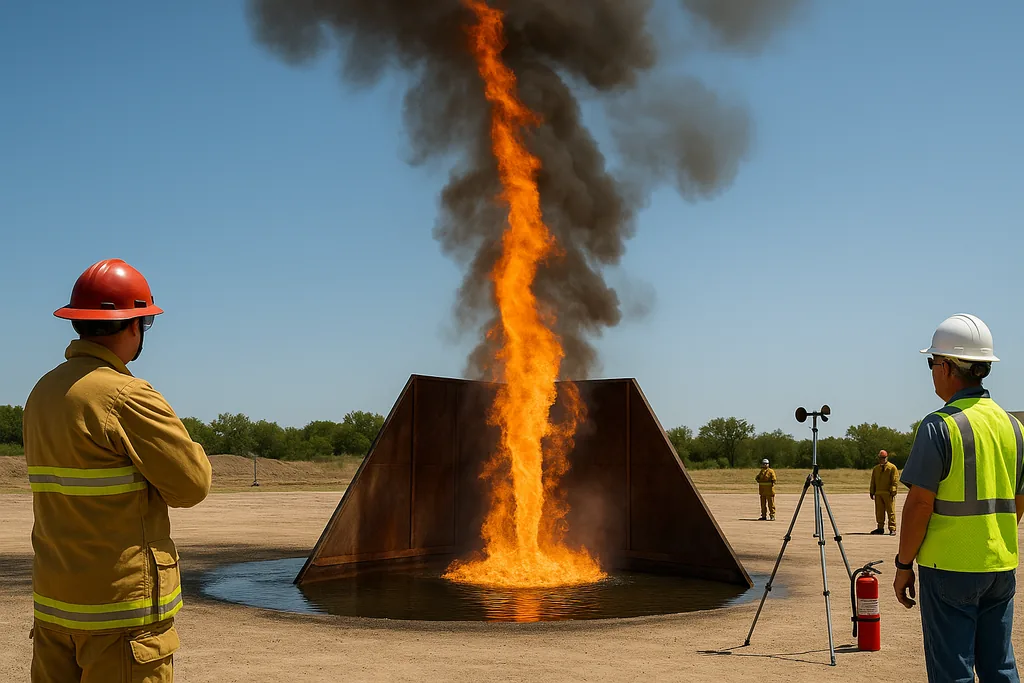
A 17‑foot vortex and a surprising result
How scientists could soon use fire tornadoes
At its simplest, the idea is not science fiction: engineers force a flame to spin so it draws oxygen from the surroundings more efficiently. The vortex concentrates air into the combustion zone, producing a hotter, more complete burn — effectively a temporary, mobile incinerator for floating hydrocarbons. That higher combustion efficiency is why the Texas A&M–UC Berkeley team measured both faster consumption and substantially lower particulate emissions than uncontrolled pool fires. The experiment scaled the phenomenon beyond laboratory rigs into a practical setting, using a 1.5‑metre crude pool and a 4.8‑metre tall rig to show the physics still works at human‑relevant sizes.
Practically, researchers envision mobile barrier structures or frames that could be deployed over an ignited slick at sea, converting the usual messy, smouldering pool into a stable, oxygen‑rich whirl. Because in‑situ burning is already an operational option for responders, proponents see the fire‑whirl approach as an enhancement rather than a wholly new step: responders would still aggregate and ignite oil where necessary, but could then manipulate airflow to produce the spinning column that accelerates combustion and reduces smoke.
Why scientists could soon use them instead of in‑situ pools
The headline advantages are operational speed and emissions. Time is the single most important variable after a spill: oil spreads quickly and threatens coasts, marshes and wildlife. The Texas A&M team reported roughly double the burn rate and up to 95 percent fuel consumption in the whirl tests, figures that — if replicated at sea — would shorten the window in which oil reaches sensitive habitats. Equally important for coastal communities and responders, the vortex destroyed many of the soot‑forming particles that usually form thick black plumes, cutting particulate output by about 40 percent in the experiments.
Taming the ‘Goldilocks’ zone
Fire whirls are powerful but delicate. The experiments make plain that efficiency depends on a narrow band of conditions: airflow, wind strength, slick thickness and the geometry of the barriers all matter. Too much ambient wind and the column collapses; too little directed airflow and it reverts to a conventional pool fire. If the oil layer is too deep the whirl can extinguish prematurely. The team described this as a Goldilocks zone — everything must be just right for the whirl to stay aloft and burn cleanly.
That sensitivity is the main engineering challenge. Translating a controlled field test into open‑ocean operations means managing wave motion, gusting winds and changing slick geometry. Engineers will need robust, rapidly deployable frames, methods to stabilise them over waves, and real‑time sensors and control systems to tune airflow. The rig used at Brayton is a proof of concept, not a final design for a ship‑borne kit.
How researchers generate a fire whirl
That operational sequence mirrors existing in‑situ burning practice — responders already aggregate and ignite oil intentionally — but adds a second phase of active airflow management. The innovation is not in lighting a slick but in engineering the airflows around it so the fire behaves like an efficient turbocharged incinerator.
What fire tornadoes can and cannot clean
It is crucial to be precise about the method’s reach. Fire whirls act on combustible hydrocarbons: crude oil, diesel and similar liquid fuels that readily vaporise and burn. They are not a general ocean‑cleanup technology for plastics, microplastics or most chemical pollutants. Floating plastic items may melt, fragment or give off toxic gases when burned, and many plastics contain additives that create hazardous emissions. In other words, this is a potential remediation tool for oil spills specifically — not a way to sweep up the ocean’s plastic problem.
For responders, that distinction matters. The technique could shorten the time a slick poses a biological threat and reduce the formation of tar mats, but it does not remove non‑combustible debris and may not be appropriate where burning would create other unacceptable emissions near populated coasts.
Safety, environmental and regulatory risks
Even if fire whirls emit less soot, they still burn hydrocarbons and release combustion products. There will be air‑quality impacts, local deposition of combustion residues and risks to nearby vessels, responders and wildlife. The columns themselves are intense, high‑temperature phenomena that require exclusion zones and specialised firefighting training. On the regulatory side, any operational use would need air‑emissions permitting, environmental impact analysis and interagency coordination with maritime authorities — a nontrivial bar in many jurisdictions.
Researchers and funders acknowledge these risks. The next stage is broader field trials, independent monitoring of emissions, and modelling of plume transport so regulators can assess human‑health and ecosystem impacts. Only after those steps, plus demonstration of reliable control in realistic weather and sea states, could operational deployment be considered.
Where this research matters beyond oil spills
Beyond immediate response, studying fire whirls feeds basic science in fluid dynamics and combustion. The experiments illuminate how rotation, entrainment and temperature interact in turbulent flames — knowledge that can inform cleaner industrial burners, incinerators and even models of extreme wildfire behaviour. Fire scientists say understanding vortexed flames could improve prediction of dangerous whirlwinds in wildfires and suggest new tactics for managing intense burning on land.
But the societal question remains practical: can controlled fire whirls be made safe, reliable and acceptable to regulators and coastal communities? The answer is still uncertain; the Texas A&M work is a striking first step, not a finished technology.
Next steps and what to watch
The timeline ahead is clear in its stages: more field campaigns, systematic emissions and ecological impact assessments, engineering of deployable platforms, and regulatory engagement. Researchers will also test a wider range of crude types, slick thicknesses and sea conditions to map where the method works and where it fails. If those studies reproduce the initial benefits at sea, we could see pilot deployments inside a few years under tight experimental permits; if not, the method will remain an interesting lab‑to‑field lesson in combustion physics.
For communities and policymakers, the important takeaway is measured optimism: the physics is promising and the first large‑scale data are positive, but operational use will require hard work on safety, engineering and environmental oversight.
Sources
- Fuel (research paper: Large‑scale field experiments on enhancing In‑Situ burning with fire whirls)
- Texas A&M University College of Engineering (research team and press materials)
- University of California, Berkeley (research collaboration)
- Bureau of Safety and Environmental Enforcement (research support)
- TEEX Brayton Fire Training Field (experimental site)




Comments
No comments yet. Be the first!