Look low and early: a rare 'planetary parade' will sweep the sky on Feb. 28
On the evening of Saturday, Feb. 28, a rare 'planetary parade' will arrange half a dozen worlds along the ecliptic so they appear together in a single arc above the horizon. The show is brief: depending on your latitude and local twilight, the visible grouping will usually last only 30–90 minutes after sunset before some planets sink back toward the sun. That narrow window is why skywatching guides and astronomers are urging people to pick their viewing spot and time carefully if they want to see every object in the line-up.
Why the rare 'planetary parade' will happen
Planetary parades are not cosmic coincidences so much as the geometry of the solar system made visible. The planets orbit the Sun in nearly the same flat plane — the ecliptic — so from Earth we usually see them projected along a similar line in the sky. Occasionally, several of those orbits place multiple planets on the same side of the Sun and roughly the same region of celestial longitude, producing the appearance of a parade or arc.
That alignment is an apparent one: the planets are still at very different distances from Earth and are not physically close to one another. What makes these events appealing is observational — they give people the unusual opportunity to compare bright planets and, with binoculars or a small telescope, the dimmer outer worlds in one glance. Astronomers treat such groupings as useful reminders to check timing, equipment and sky conditions before the window closes.
When the rare 'planetary parade' will be visible
If you want to be precise, use a sky app or an online rise/set calculator to get the local times for sunset and the planets' altitudes on Feb. 28. Those tools will also tell you when the brightest members dip below your local horizon, which is important because the parade can disappear quickly if a low-lying planet sets or twilight brightens the sky.
Which planets will be visible in the arc
On similar multi-planet events in recent months, four inner and giant planets — Mercury, Venus, Jupiter and Saturn — are common naked-eye participants, while the ice giants Uranus and Neptune often join the arc but require optical aid. Expect the same pattern here: the brightest planets in the parade will be visible unaided under suburban skies, while Uranus and Neptune will likely need binoculars or a small telescope and darker skies to show up as faint disks or star-like points.
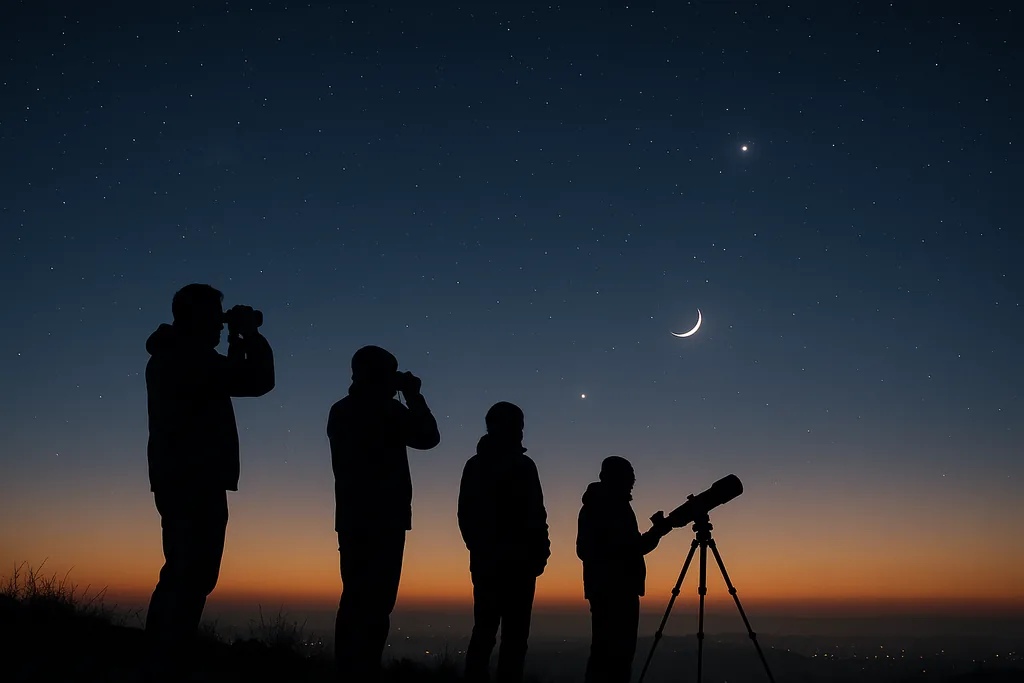
Use the thin crescent Moon, if it is present near the line, as a calendar-style signpost to help identify the planets. Observers are cautioned not to expect the planets to look stacked like beads on a string; through the naked eye they will appear as bright points spread along an arc whose curvature reflects the ecliptic’s path across your sky.
How to observe the planetary parade from your location
If you want to see Uranus or Neptune, bring a steady pair of 10x50 binoculars or a small telescope; a finderscope or a star-chart app will help you point to the correct patch of sky. For the bright planets, binoculars improve the view and may reveal moons around Jupiter or the fuzzy, extended appearance of Saturn; a modest amateur telescope will pick out cloud bands, Jovian moons and Saturn’s rings. Whatever you do, check local sunrise and sunset times and be careful with optical equipment: never use binoculars or a telescope while the Sun is above the horizon.
Practical viewing tips and safety
The best time to view the parade is during civil or nautical twilight when the sky is dark enough for stars and planets to appear but before the faintest objects drop below the horizon. That means being out early and prepared: dress for the temperature, bring red-light torches to preserve night vision, and pack a blanket. Because the window is small, aim to be in place at least 20 minutes before the expected start time.
Remember that atmospheric conditions matter. Low clouds, haze and city light scatter will wash out the dimmer planets first. If your forecast calls for poor transparency, you’ll still be able to pick out the brightest members of the parade, but Uranus and Neptune are easily lost in light-polluted skies. Finally, if you use a telescope, allow the optics to reach ambient temperature before observing — that minimizes image drift caused by thermal currents.
Observers in the Northern Hemisphere will usually look along the southern or southwestern horizon to see the planets arcing across the evening sky, while Southern Hemisphere viewers will often look north or northwestern skies to see the same ecliptic arc. The relative height of each planet above your horizon shifts with latitude: planets appear higher for locations nearer the equator and sit lower when you travel poleward. That affects how long each object will remain visible after sunset.
What a planetary parade is—and what it is not
In popular use, "planetary parade" is a handy label for any time several planets appear together in the sky. Astronomers more precisely call the events conjunctions or groupings along the ecliptic, but the effect is the same from an observer’s point of view: a chance to line up bright worlds in a single photograph or sweep of the eye. It’s not a long-term or physical alignment of the planets’ orbits in three dimensions — just an angle-dependent view from inside the solar system.
Don’t be surprised if photos shared on social media look more dramatic than the naked-eye view; many online images are composites or long-exposure photographs that make faint companions and tails far more visible than they appear to the human eye. Still, a real-time, unaided view of multiple planets stretching across the sky remains an unusual and memorable spectacle.
Quick checklist for Feb. 28
- Pick a site with a clear view toward the ecliptic, 30–90 minutes after local sunset.
- Bring binoculars (10x50) for a better view and a small telescope if you want to try for Uranus and Neptune.
- Use a sky app or planetarium program to get local rise/set times and the planets’ approximate bearings.
- Protect your night vision with a red torch, dress warmly, and allow time for equipment and eyes to adapt.
Whether you treat this as a photo opportunity, a family activity, or a quiet moment under the sky, the Feb. 28 grouping is a reminder that the solar system’s geometry can turn routine motions into rare, observable patterns. With a little planning and a short window of good weather, you can see several planets lined up in a single sweep of the heavens.
Sources
- NASA (space agency skywatching guidance and ephemerides)
- NOAA Space Weather Prediction Center (space weather forecasts)
- European Space Agency (ESA) planetary and near-Earth object information
- International Meteor Organization (IMO)
- American Meteor Society (AMS)
- International Astronomical Union (IAU)




Comments
No comments yet. Be the first!