A quiet algebraic upheaval in Morgantown
What the old law actually said (and where it broke)
How the equations change
Cassak and colleagues started from the kinetic description of matter — the phase‑space density that depends on position and velocity — and derived, from first principles, the energetic contribution associated with every higher‑order moment of that distribution. In plain language: beyond the usual energy tied to heating and expansion, there are energetic bookkeeping items associated with skewed velocity distributions, anisotropic temperatures, beams and other departures from equilibrium. The authors show how to express the rate at which those higher moments change as a power density term that can be added to the energy balance. Particle‑in‑cell simulations of magnetic reconnection — a common plasma process that converts magnetic energy into particle energy — demonstrate that this extra term can be locally significant. Thus the First Law's structure is preserved but enriched: you still conserve energy, you simply add terms that account for ordered, non‑thermal forms of energy that matter when equilibrium is absent.
From a pencil‑and‑paper idea to a measurable power density
Following the PRL result, the same group and collaborators developed a concrete diagnostic tool to measure this non‑equilibrium contribution. They gave it the practical name HORNET (a higher‑order non‑equilibrium term): an "effective power density" that quantifies how fast a local volume of plasma is moving toward or away from local thermodynamic equilibrium. Simulations applying HORNET to magnetic reconnection and kinetic turbulence show that it can reach a sizable fraction of the familiar power densities (tens of percent in some regions), which means it cannot be ignored when trying to close an energy budget in kinetic plasma environments. The HORNET development turned the conceptual rewrite into something experimenters and observers can compute and compare with measurements.
Laboratory work and space measurements
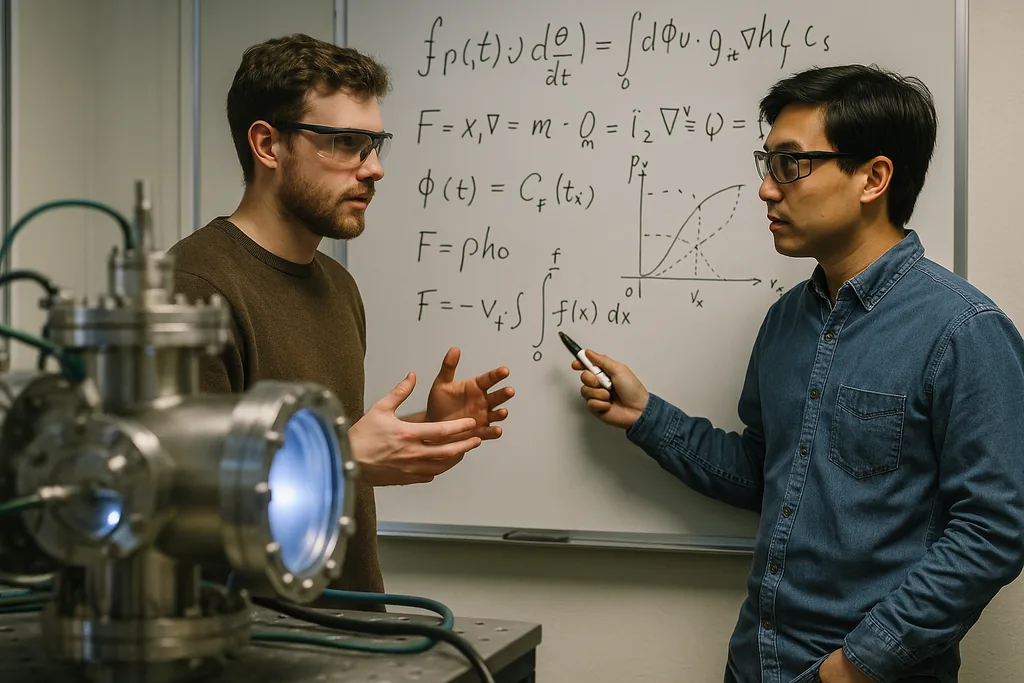
The West Virginia University team emphasizes that this is not just theoretical bookkeeping. Their group operates PHASMA, an experiment designed to make space‑relevant measurements of energy conversion in nonequilibrium plasmas; the generalized First Law and HORNET provide explicit predictions for what PHASMA and space probes should see. The same framework helps interpret kinetic processes in the magnetospheres of planets, solar wind turbulence, reconnection sites in the solar corona, and laboratory devices where collisions are too rare to quickly restore equilibrium. If HORNET‑like terms appear in spacecraft data and laboratory measurements where previously they were missing, that will be direct evidence that the extended accounting matters in nature.
Why this isn’t a law‑breaking headline
Popular headlines that claim the First Law has been "rewritten" or "broken" are misleading if read out of context. The conservation of energy — that total energy cannot be created or destroyed — remains inviolate. What has changed is the identification of energy reservoirs and the precise form of the terms you must add to the traditional thermodynamic bookkeeping when the system does not admit a temperature field. This is a generalisation of thermodynamic bookkeeping, not a negation of conservation. That distinction matters for both teaching and public understanding.
Connections to quantum thermodynamics and small systems
The Cassak–Barbhuiya line of work sits alongside other recent efforts to revisit the foundations of thermodynamics when its implicit assumptions fail. In quantum regimes, researchers have developed gauge‑invariant formulations of work and heat that rethink what the First Law means when you can track microscopic degrees of freedom and quantum coherences. Those approaches similarly broaden the meaning of heat and work rather than discard conservation itself. Taken together, the classical kinetic generalisation and the quantum gauge approaches mark a period in which thermodynamics is being extended and unified across regimes where fluctuations, coherence and non‑equilibrium structure are important.
Practical consequences and limits
- Space weather and satellites: better energetic accounting in reconnection and shocks can improve models of particle acceleration that affect satellite electronics and radiation environments.
- Laboratory plasmas and fusion: in devices where collisions are insufficient to thermalize distributions quickly, knowing how non‑thermal energy flows could inform heating strategies and diagnostics.
- Semiconductor processing: low‑temperature plasmas used to etch chips are often out of equilibrium; more complete energy accounting could refine models for process control.
- Nanoscale and quantum devices: the conceptual parallels with gauge‑invariant quantum thermodynamics suggest new ways to think about work and heat in highly controlled small systems.
At the same time, there are caveats. The extra terms are derived from kinetic theory and involve quantities that are harder to measure than macroscopic pressure or temperature. Their practical usefulness will depend on the availability of velocity‑resolved measurements or sufficiently precise simulations, and on whether those terms materially change predictions for observables in particular systems.
What scientists will watch for next
Researchers will be looking for three things: (1) direct laboratory measurements where HORNET terms close an energy budget that previously had a deficit; (2) spacecraft or astrophysical observations where including higher‑order terms improves agreement with particle acceleration and heating signatures; and (3) conceptual bridges between the kinetic generalisation and quantum thermodynamic frameworks so that one consistent language describes energy accounting from electrons in a reconnection exhaust to qubits in a cryostat. Each of those steps will move the idea from a compelling theoretical advance to a routine tool in the physicist’s toolbox.
For now, the most useful way to think about the story is this: the First Law has not been toppled; it has been sharpened. Physicists found energy hiding in the detailed shape of particle velocity distributions, and they have written down how to include that energy in conservation statements. Beyond the equations, the work is an example of how long‑standing principles can be extended without being discarded — and how improved diagnostics and simulations let us see energy flows we could not measure before.
Sources
- Physical Review Letters (Paul A. Cassak et al., "Quantifying Energy Conversion in Higher‑Order Phase Space Density Moments in Plasmas").
- West Virginia University (Department of Physics & Astronomy / PHASMA experiment press materials).
- arXiv (M. Hasan Barbhuiya et al., "Higher‑order nonequilibrium term: Effective power density quantifying evolution towards or away from local thermodynamic equilibrium").
- Entropy (MDPI) (Lucas C. Céleri & Łukasz Rudnicki, "Gauge‑Invariant Quantum Thermodynamics: Consequences for the First Law").




Comments
No comments yet. Be the first!