Scientists find clues suggesting life where Mars was once wet
On Feb. 4, 2026, a team published a reanalysis that reignited debate about whether Mars once hosted life: scientists find clues suggesting past life on Mars after reexamining long‑chain organic molecules detected years ago by NASA's Curiosity rover. That finding sits alongside dramatic chemistry from NASA's Perseverance rover — leopard‑spotted mudstones and bleached, clay‑rich fragments — that together paint a picture of wetter, more chemically active ancient environments. Taken together, the new studies do not prove life, but they raise the odds that Mars once had the right ingredients and the right reactions in the right places for microbial life to emerge or persist.
Scientists find clues suggesting: Curiosity's long‑chain organics
That does not equate to a smoking‑gun proof of biology. Long‑chain alkanes can form abiotically under some conditions. But the radiation modelling constrains the problem: if those molecules arrived in the quantities implied by Curiosity's measurements, there are fewer plausible nonbiological pathways left to explain them. The study authors explicitly call for caution, noting unknown chemistry could still be at play. Nonetheless, the result narrows alternative explanations and elevates these organic signatures as priority targets for future, higher‑precision analysis.
Scientists find clues suggesting: Perseverance's redox minerals and bleached rocks
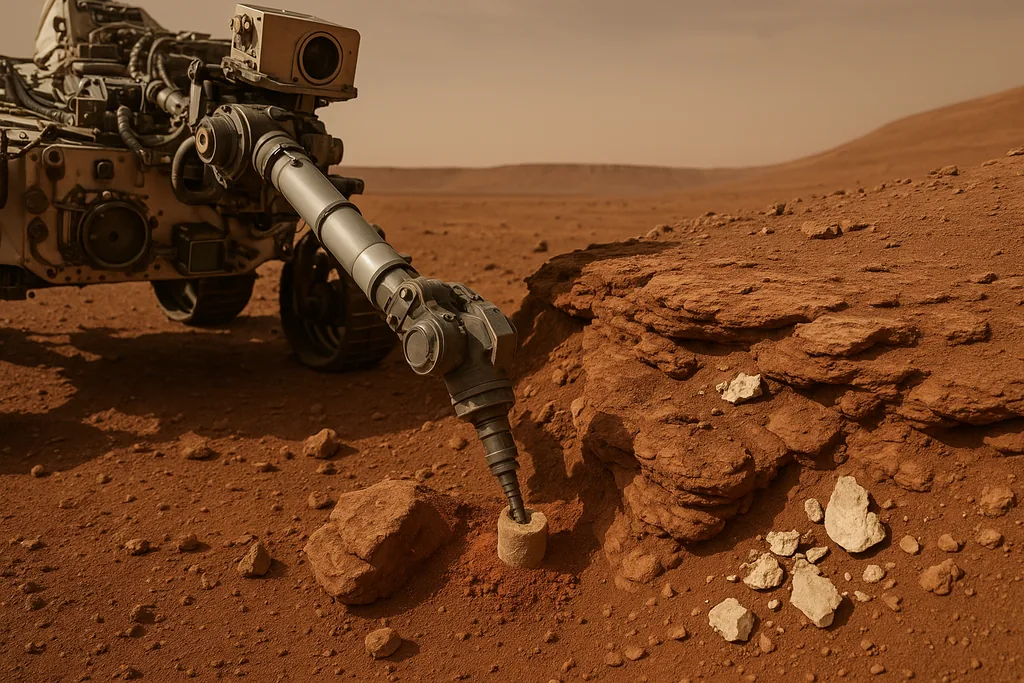
Separately, Perseverance has been drilling into Jezero Crater and its rim, returning a stream of discoveries that point to ancient lakes, rivers and rain. In September 2025 a high‑profile study reported on a rock nicknamed Cheyava Falls, where the rover found tiny greenish nodules and ringed "leopard spots" made of iron phosphates and iron sulfides. The pattern of minerals — vivianite rims and greigite interiors — is precisely the kind of mineral assemblage that on Earth forms as the result of redox reactions driven by microbes consuming organic matter and passing electrons to iron. That study, published in Nature, described the chemistry as "consistent with" biological activity because the specific redox sequence is a hallmark of life at ambient temperatures in sedimentary settings.
Meanwhile, another team published an analysis of widespread bleached, clay‑rich kaolinite fragments in a December study in Communications Earth & Environment. Those white, leached rocks are most plausibly produced by prolonged rainfall and humid weathering over millions of years — conditions that strongly increase the habitability potential of a region. If vast stretches of Jezero and its surroundings were subjected to sustained water activity, then nutrient cycling, ponding and the kinds of chemical energy gradients used by microbes on Earth would have been possible.
How scientists infer ancient habitability from chemistry
Interpreting Martian rock chemistry requires stitching together many lines of evidence. Instruments on the rovers measure mineralogy, elemental abundances and organic compounds in rock cores only millimetres wide. Scientists then model how those signals change over time under radiation, oxidation and heat. When models show that the observed minerals would be unlikely to form without specific redox reactions or without the sustained presence of liquid water, researchers flag those as candidate biosignatures.
What would prove past life — and why sample return matters
Scientists are explicit that none of the current results cross the threshold to a definitive life detection. Proving life requires multiple, independent lines of evidence that are inconsistent with known abiotic chemistry. That typically means microscopic fossil structures, isotopic ratios that point to biological fractionation, complex organic distributions that map to metabolic pathways, or combinations of mineral and chemical signatures that cannot be reproduced by nonbiological processes at plausible temperatures and pressures.
Rover instruments are superb but limited: they do incredible in‑situ work, but Earth laboratories carry far more sensitive methods and can perform destructive analyses that no rover can. That's why NASA's Mars sample‑return program — the plan to bring carefully selected cores from Perseverance back to Earth — is central to answering whether Mars hosted life. The Nature and Astrobiology papers both end by calling for returned samples and for complementary missions, such as deeper drilling by the European Space Agency's Rosalind Franklin rover and planned Chinese sample‑return efforts around the end of the decade.
Alternative explanations and scientific caution
That skepticism is not a weakness — it is the standard that preserves scientific credibility. Findings that once looked like curiosities in isolation gain power when different instruments, sites, and teams converge on compatible interpretations. The current moment is precisely that: Curiosity's reanalysis tightens constraints on organics; Perseverance's chemistry shows wet, redox‑active sediments; and global mapping reveals clay‑rich zones consistent with persistent water. Together they shrink the space in which purely abiotic stories can comfortably live.
The practical implications for future missions and astrobiology
If Mars did host microbial ecosystems, it would transform our understanding of how life begins and how common it might be in the universe. A second genesis on Mars — even one that followed a different chemistry from Earth's life — would suggest life is not a freak accident. Practically, the new findings will shape target selection for returned samples, refine drilling and caching strategies, and prioritise sites where organic material was both abundant and well preserved.
The answer to whether Mars once harboured life remains open, but the scientific community is converging on a clearer map of where the best evidence might lie. For now, the safest headline is this: scientists find clues suggesting past life on Mars, and those clues make the coming sample returns and deeper exploration some of the most consequential missions in planetary science.
Sources
- Astrobiology (research paper on Curiosity long‑chain organics)
- Nature (research paper on Perseverance Cheyava Falls mineralogy)
- Communications Earth & Environment (study on bleached kaolinite rocks)
- NASA / Jet Propulsion Laboratory (Perseverance and Curiosity mission data)
- Purdue University (planetary science team analysis)
- Stony Brook University (geochemistry and astrobiology contributions)
- Max Planck Institute for Solar System Research (independent expert commentary)
- European Space Agency (Rosalind Franklin rover planning)




Comments
No comments yet. Be the first!