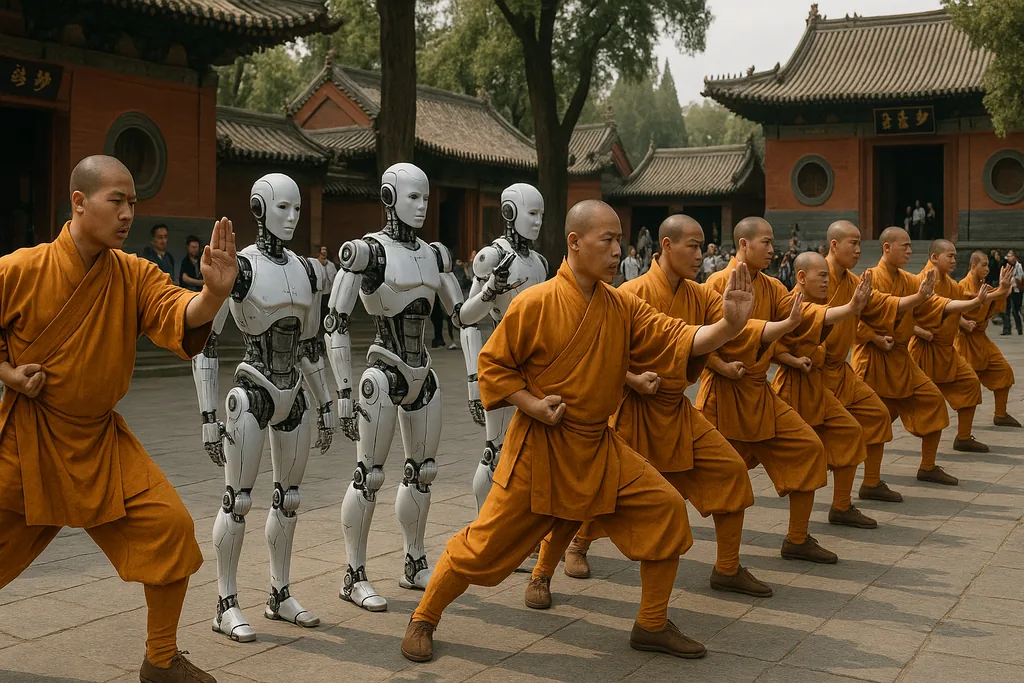
china's shaolin temple, humanoid robots in the courtyard
On Feb 6, 2026 short video clips began circulating online showing an unexpected scene in the stone courtyards of the Shaolin Temple in Henan: life‑size humanoid machines moving in time with saffron‑robed monks. By Feb 9 the footage had been widely shared and picked up by outlets reporting that the robots — identified in some posts as machines from Shanghai firm AgiBot — were practising basic Kung Fu drills and choreographed routines alongside the temple’s practitioners. The images are striking: wooden temple roofs framing chrome and plastic limbs, monks and machines mirroring the same stances as cameras tracked the display.
The episode is a public demonstration rather than a new syllabus for novices. Local broadcasters and social posts describing the event make clear the visit was a cultural and technological exchange: Shaolin monks took part in the showcase while technicians and company staff handled the robots. That distinction matters for how the appearance of machines inside a sacred, centuries‑old training ground is being interpreted.
china's shaolin temple, humanoid motion‑learning technologies
The rolls and kicks on display are possible because of decades of incremental progress in embodied AI and humanoid engineering. Companies like AgiBot build platforms that combine actuators, sensors, and on‑board controllers with software for imitation learning and trajectory planning. In practical terms that means the robots can watch a human movement — via motion capture, depth cameras or direct programming — and reproduce it by mapping recorded joint trajectories onto their actuators. Reinforcement learning and model‑based control help stabilise balance during dynamic moves; perception stacks let the machines align timing and posture when they are placed beside people.
These technologies power what viewers saw: robots following choreographed sequences, matching tempo and pose rather than improvising combat. The demonstration highlights two technical strengths — repeatability and safe testing in public spaces — and two persistent limitations: robots still struggle with unpredictable contact, fine tactile work, and the subtle balance corrections a human martial artist makes instinctively. In short, the machines can imitate forms impressively, but current hardware and software place clear ceilings on what they can learn compared with a seasoned monk.
Monks, machines and cultural exchange
Why bring humanoids into Shaolin's training halls? Organisers and commentators framed the event as a technology showcase and cultural dialogue rather than an attempt to mechanise spiritual practice. For Shaolin, participation offers a way to make the temple’s heritage visible to a global audience and to engage with contemporary curiosities about AI. For robotics companies, the location provides a richly symbolic and technically honest testbed: martial arts require full‑body coordination, repetitive drilling and precise timing, so they are useful for evaluating motion control and human‑robot synchrony in realistic settings.
The public reaction has been mixed. Some viewers praised the spectacle as a novel fusion of tradition and innovation; others worried about the optics of machines in a sacred place, or feared that technology might one day displace human practitioners. That anxiety is understandable but premature: the videos and accompanying reporting make clear the temple’s involvement was cooperative and limited to a staged demonstration, not a wholesale program to replace human training with robots.
What robots can — and can’t — learn from Kung Fu training
Can humanoid robots learn Kung Fu at Shaolin Temple? The short answer from the footage is: to a degree. Humanoid platforms can learn sequences of moves, adopt stances, and reproduce choreography. Imitation learning and offline trajectory planning allow them to mimic the external form of Kung Fu. They can be taught to time punches, maintain stances and execute kicks in a constrained environment.
What they cannot yet learn is the embodied context that underpins traditional martial arts. Shaolin training integrates breath control, meditation, adaptability under stress, pain‑tolerance, reflexes developed over years of practice, and an ethical framework embedded in Buddhist teaching. Those interior, experiential aspects are not simply data you can copy; they are lived qualities. Technically, robots lack the proprioceptive finesse, robust contact‑rich manipulation and long‑horizon adaptability of a human body conditioned by years of training. They also lack subjective experience and the cultural sense that gives practices like Shaolin Kung Fu their deeper meaning.
Technologies behind the movements and how they work in practice
Under the hood of the display are several distinct technologies. Actuators and joint controllers provide the mechanical range of motion; inertial measurement units and force sensors inform balance and contact detection. Perception systems — stereo or depth cameras, sometimes complemented by motion‑capture markers — let the robot track a human demonstrator or align itself within a formation. On the software side, there are two common approaches: direct playback, where human movement data is mapped to the robot’s joints, and learning‑based methods that build a policy from demonstrations and then refine it with simulated or real‑world practice using reinforcement learning. Hybrid methods that combine model‑based control for safety and learning for flexibility are increasingly popular.
In a staged training session like Shaolin’s, organisers will prioritise safety and visual fidelity: movements are slowed, contact is avoided, and technicians retain low‑level control. That makes for compelling footage but also hides the work still needed for robust, autonomous performance in unpredictable settings.
Broader implications: spectacle, research and ethics
The episode at Shaolin sits at the intersection of research practice, public spectacle and cultural diplomacy. For roboticists, performing in a real temple delivers useful data on human‑robot synchrony and public interactions with humanoids. For cultural custodians, it is a way to make classical practice visible and to steer how that visibility is presented. For the public, it prompts reflections about authenticity and the appropriate boundaries for technology in religious or heritage sites.
There are legitimate ethical questions. How should institutions decide whether to allow technology into sacred spaces? Who controls the narrative when private companies stage demonstrations at cultural landmarks? And how do we avoid tokenising heritage for marketing while still exploring productive collaborations? These conversations are as important as the technical work itself and will shape how similar events are staged in the future.
In the immediate term, the footage from Feb 6–9, 2026 is best read as a high‑profile experiment: an engineered, camera‑friendly meeting of old and new that showcases what humanoids can imitate and how human tradition can help test emerging robotics. The spectacle will almost certainly encourage more demos, and perhaps research partnerships, but it is unlikely to change the core of Shaolin practice anytime soon — the temple’s spiritual training and the long apprenticeship required to become a martial artist remain resolutely human crafts.
Sources
- Shaolin Temple (Henan Monastery)
- AgiBot (Shanghai robotics company)




Comments
No comments yet. Be the first!