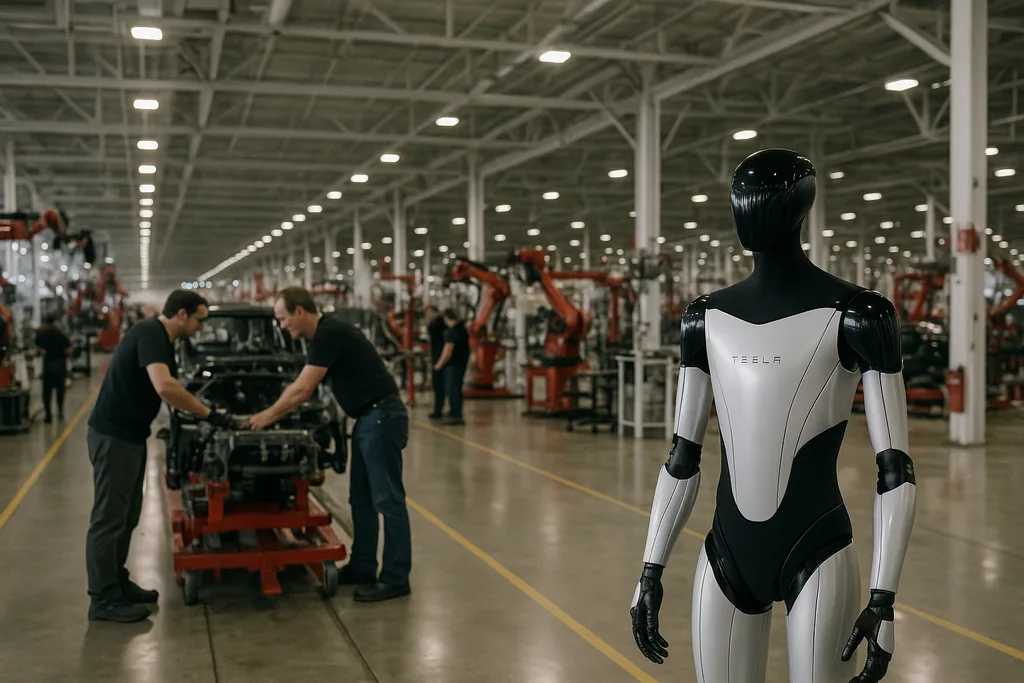
On 19 January 2026 Elon Musk renewed a familiar, extravagant thesis: if Tesla stops being primarily an automaker and becomes a robotics and AI company built around the Optimus humanoid and autonomously driven fleets, its valuation could climb to roughly $25 trillion. The comment, picked up in a translation of recent interviews and company statements, is the latest public version of a scenario Musk and some bullish investors have been sketching for more than a year — an outcome that would eclipse every listed company on earth by multiples.
How Musk arrives at the $25 trillion number
Musk's arithmetic combines several ambitious assumptions: Optimus will be mass-produced at enormous scale, autonomous Robotaxi fleets will convert cars from one‑time sales into recurring-service assets, and Tesla's stack of batteries, AI software and manufacturing will produce outsized margins. In prior public appearances he has floated scenarios in which billions of humanoids are conceivable demand, and where dramatic cost reductions — sometimes as low as a few thousand dollars per unit in extreme hypothetical cases — could make annual revenue from robots measure in the tens of trillions of dollars.
Those projections are not purely rhetorical: they are tied to company strategy. Tesla's Master Plan updates have reframed cars as a beachhead for AI, energy and robotics ecosystems. Musk and the board have also embedded robotics and autonomous driving targets into executive pay plans and public roadmaps. The logic is simple: turning products into platform services (robotaxis, robotics-as-a-service, recurring software subscriptions) raises revenue multiple and, therefore, valuation.
Engineering gaps and production reality
The gap between theory and factory floor is large. Reporting from late 2025 and early 2026 documented a series of production shortfalls and technical constraints. Tesla missed earlier targets to produce thousands of Optimus units in 2025; public estimates report only a few hundred prototypes and development units reached the factory floor, many still depending on remote operation rather than fully autonomous behaviours. Demonstrations have highlighted remaining problems with balance, smooth locomotion and the dexterity of hands — exactly the subsystems that determine whether a humanoid can perform real-world, useful tasks at scale.
Scaling humanoids requires reliable, compact actuators, high-volume precision manufacturing for hands and sensors, resilient software for perception and control, and an industrial supply chain that today mostly serves other markets. Tesla has announced plans to convert or expand Gigafactory capacity for robots and to accelerate development of a third-generation Optimus, but shifting a car factory to robot-volume assembly at the levels needed for Musk’s math would be a novel industrial feat.
AI, compute and the economics of scale
Behind the robotics vision is AI. Musk has repeatedly described AI progress as a "supersonic tsunami" and public companies affiliated with him — including xAI — are aggressively buying compute. The training and inference costs for general-purpose robotic brains are substantial: large language- or vision-model‑class capabilities, continuous learning from deployed units, and low‑latency control loops all need chips, data centres and software engineering at scale.
Financial and industry signals show that leaders expect compute to be a gating factor: third‑party reports and filings indicate multi‑billion dollar commitments to GPU purchases and data‑centre capacity for Musk’s AI efforts. But even with abundant compute, the software problem for physical robots — generalisation, safety, and long‑tail interactions in varied environments — has a different cadence and risk profile than cloud models trained on text and images.
Market, regulatory and labour implications
Even if the engineering problems are solved, markets and regulators will shape the attainable business. Robotaxis face safety verification, city permits, insurance frameworks and consumer acceptance. Humanoid platforms used in care homes, factories or surgery would require certification workflows and domain‑specific validation; those sectors are conservative by necessity. Musk has suggested early Optimus applications in hazardous environments and 24‑hour care, which are plausible niches, but converting those niches into the mass-market volumes underpinning a $25 trillion valuation is another matter.
There is also a labour and social dimension: widespread physical automation raises questions about employment, regulatory protections, and how societies reallocate value if human labour is broadly substitutable. Musk has acknowledged the philosophical and societal questions, even as he frames the transformation as a productivity revolution.
What investors and suppliers should watch
For investors, two practical axes matter. First: milestones. Near-term production numbers, documented autonomy in real-world environments, and sustainable unit economics for robot deployment are concrete checkpoints. Second: margins from recurring services. Valuations that assume $10s of trillions implicitly posit extraordinarily high software and services attach rates and low capital intensity per unit — assumptions that must be validated by early service revenue trajectories.
For suppliers and the broader industrial ecosystem, Tesla's ambitions create opportunity and risk. Companies making precision motors, tactile sensors, power electronics and advanced batteries could win large contracts if Tesla meets volume goals. But those same suppliers are exposed to demand volatility and overheated expectations: previous robot-related supply-chain rallies have produced sharp price and revenue swings when Tesla’s shipping cadence lagged earlier forecasts.
Balancing bravado with bottlenecks
For now, the story is in two parts: a clear strategic pivot at the company level, and a long, uncertain engineering and commercial road ahead. Optimus may yet be part of a future where robots meaningfully expand productivity; whether it becomes the engine behind a multi‑trillion‑dollar valuation will depend on scaling that promise into verified products, repeatable manufacturing, and safe, regulated deployments.
Sources
- Tesla, Inc. — quarterly financial reporting and investor materials (Q3 2025 disclosures)
- Nevada Department of Motor Vehicles — public filings on autonomous vehicle testing approvals
- xAI and related corporate financing materials regarding compute and chip purchases




Comments
No comments yet. Be the first!