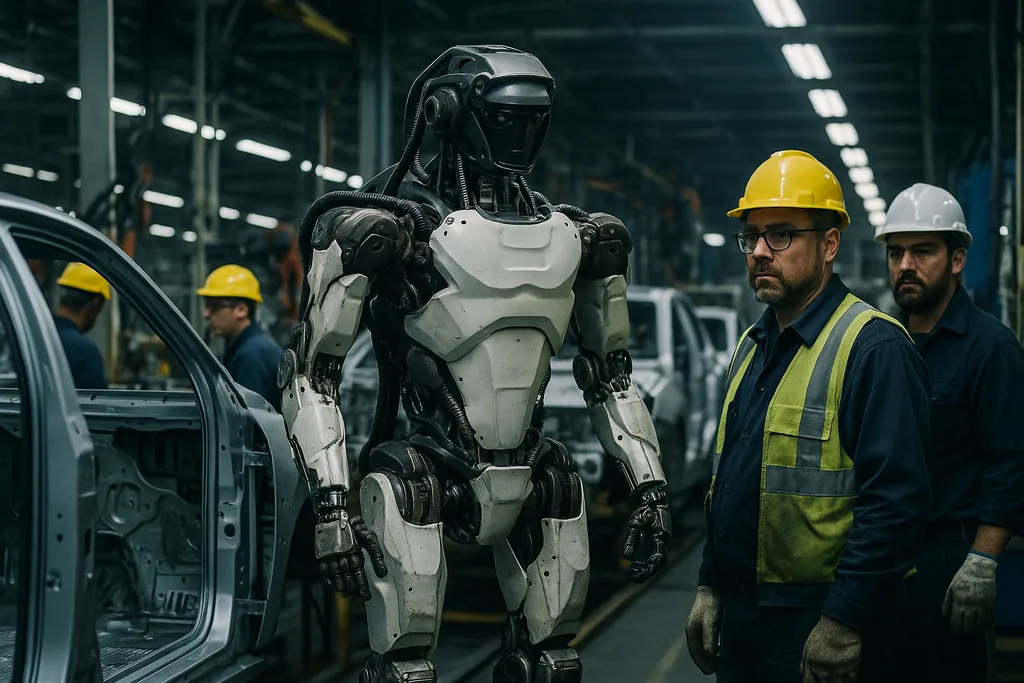
Factory floors meet a new kind of coworker
On Jan. 5, 2026, Hyundai Motor Group put a humanoid robot called Atlas on display at CES in Las Vegas. Three weeks later, when the company said it plans to deploy Atlas at its Georgia assembly plant beginning in 2028 and to scale production toward an annual run rate of 30,000 units, the announcement landed like an industrial provocation: the Hyundai Motor branch of the Korean Metal Workers’ Union responded that it would not allow robots into production sites without union consent.
Immediate flashpoint
The union’s blunt posture — “we will not allow any robots to enter production sites without our permission,” as it put it in an internal newsletter — turns a corporate automation plan into a national debate about jobs, bargaining rights and what counts as legitimate technological progress. Hyundai has provided a technical sales pitch: Boston Dynamics, the US subsidiary through which the Atlas model was developed, says Atlas can learn many tasks quickly and can handle heavy lifts of up to about 50 kilograms at reach. Management frames humanoid robots as a way to cut costs, raise throughput and remove humans from dangerous work. Unions and many workers hear a different message: the first step toward large-scale displacement.
Robot density and the South Korean context
Industry actors in Korea have been incrementally expanding automation in high-risk operations for years. Shipbuilders are piloting collaborative welding systems and plan to expand automation aggressively; steelmakers and offshore firms already use quadruped and wheeled inspection robots to enter hazardous zones. The Atlas announcement crystallises unease precisely because it represents a qualitative step — humanoid machines designed to operate where people normally work — rather than incremental machine tooling.
Union leverage and legal mechanics
The union response is not only rhetorical. South Korea’s collective bargaining framework gives organized labor a formal seat in discussions about work environment changes, and the Hyundai Motor local has signalled it expects negotiation and consent before any reconfiguration of production lines. That creates a legal and industrial-relations brake on unilateral rollouts: companies can deploy technology, but doing so in major assembly processes without at least negotiating with workforce representatives risks strikes, injunctions, and long-term damage to labor-management relations.
Lee Byoung-hoon, a professor emeritus of sociology and a noted labor relations scholar, told reporters that the introduction of humanoid robots is a “monumental change” and an opportunity to model cooperative bargaining, rather than a pretext for unilateral job cuts. His point underscores a wider dynamic: automation decisions are now negotiated political outcomes as much as engineering projects.
Where robots are easiest — and hardest — to displace people
Technical claims about Atlas and similar systems emphasise speed of learning and dexterous handling. Developers present humanoids as flexible, programmable labour that can be deployed across diverse tasks without the bespoke tooling that traditional industrial robots require. That flexibility is attractive to manufacturers that produce many variants on the same line.
But flexibility comes with caveats. Tasks that require fine-grained judgment, tacit knowledge passed down among line workers, or real-time improvisation remain difficult to automate reliably. Human–robot collaboration in welding booths or blast-furnace inspection (areas where Korean firms have already introduced robots) often focuses on shifting the riskiest elements to machines while preserving skilled human oversight. In other words, the most likely near-term deployments will concentrate on hazardous or repetitive sub-tasks; wholesale replacement across an entire assembly process is a more contested and technically demanding prospect.
Social anxieties and the politics of automation
For companies, the calculus is different: automation promises resilience against labor shortages, lower unit costs, and an industrial edge in an economy that depends on high-volume, high-precision manufacturing. For government, the balance is delicate: fostering advanced robotics strengthens national competitiveness, yet the state also faces pressure to manage transition risks through retraining programs, social safety nets and industrial policy.
Industrial precedents in Korea
Korean industry already offers practical precedents for a negotiated approach. Some firms have phased in robot partners for inspection and maintenance roles; others pursue full automation of highly repetitive tasks with explicit timelines for workforce transition. The Hayek-ish claim that technology automatically creates new jobs is not wrong in the long arc of economic history, but it is not an immediate salve for workers whose livelihoods and communities depend on the rhythm of factory employment.
Within that complexity, the Atlas case is important because Hyundai has publicly signalled both a timetable — pilots at the Georgia facility in 2028 — and a scale target: to be able to mass-produce tens of thousands of humanoid robots for use across assembly processes. That combination of timetable and scale raises the stakes for negotiation because it suggests an irreversible shift in the capital structure of production if management proceeds without agreement.
Paths forward: bargaining, pilots and public policy
There are plausible, less adversarial paths forward. One option is tightly defined pilot programs: limited, time-bound trials of humanoid robots in clearly hazardous or ergonomically harmful jobs, coupled with worker monitors and transparent performance metrics. Another is explicit job-safety nets written into collective bargaining agreements — guarantees of no net job loss for a set period, retraining funds, or redeployment commitments — that turn automation into a negotiated productivity dividend rather than a unilateral cost-cutting measure.
What to watch next
Two concrete calendars to note: Hyundai’s public unveiling of Atlas on Jan. 5, 2026, and the company’s stated plan to begin deployment at its Georgia plant from 2028. Between those dates the most consequential developments will likely be negotiation outcomes at Hyundai, pilot program designs, and whether the company and the union agree to a timetable that includes retraining and redeployment clauses.
If management and labor reach a cooperative framework, the Atlas episode could become a model for how advanced robotics are introduced safely and fairly. If they do not, the case could harden into an industrial confrontation that delays robot adoption and polarises public debate about automation’s winners and losers.
Either way, the Atlas announcement puts a spotlight on an increasingly inescapable question for advanced industrial economies: who decides how work is reshaped when machines move out of cages and onto the factory floor?
Sources
- International Federation of Robotics (robot density data)
- Chung‑Ang University (labor relations expert commentary)
- Korean Metal Workers’ Union (collective bargaining statements)




Comments
No comments yet. Be the first!