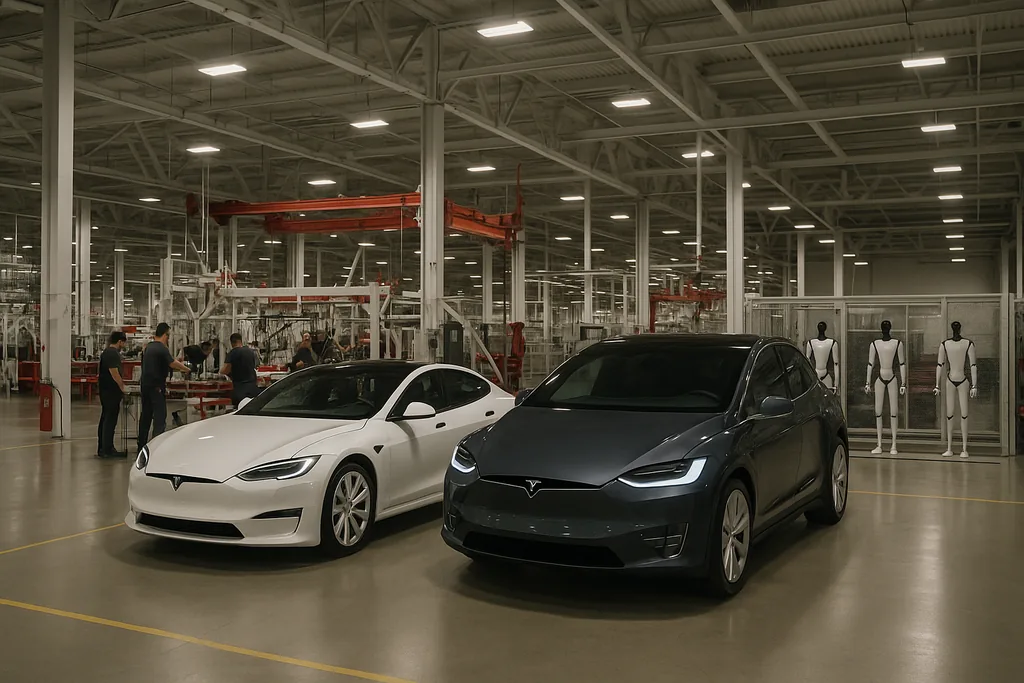
Tesla's bold move: farewell marks a turning point
On 20 February 2026 Tesla confirmed what industry watchers had been expecting: the company will discontinue the flagship Model S sedan and Model X SUV in Q2 2026 as it reallocates factory capacity to mass-produce the Optimus humanoid robot. This week’s announcement—echoing remarks made during the Q4 2025 earnings call—frames tesla's bold move: farewell not as a retreat from cars but as a strategic pivot toward robotics, autonomy and higher-volume manufacturing. For a company that helped make electric luxury desirable, the decision is both practical and symbolic: low-volume halo cars give way to a bet on humanoid machines the company calls the future of labour and value creation.
tesla's bold move: farewell reshapes the product line
Instead, Tesla will concentrate on higher-volume, higher-margin models such as the Model 3 and Model Y while repurposing assembly lines—particularly at Fremont—to support Optimus production. The company frames the move as modern portfolio management: pruning niche lines to free capital, engineers and manufacturing capacity for a product Elon Musk argues could eventually create far greater scale. Importantly, this does not mean Tesla is abandoning automobiles wholesale; the company will continue mainstream vehicle production even as it withdraws from the S/X segment.
The practical result for buyers and the market is twofold: a narrower new-car lineup from Tesla and a potential scarcity premium on discontinued models. Collectors and enthusiasts may see rising resale values for well-preserved S and X examples, while mainstream buyers lose one of the last remaining luxury EV options from Tesla's catalogue.
tesla's bold move: farewell and the rise of Optimus
What does Optimus promise? Demonstrations so far have shown humanoid movement, basic manipulation and choreographed routines; public comments from Tesla have suggested the robots could be applied to factory floors, logistics and home assistance. The company projects a path from demonstration units to scaled, lower-cost production, arguing that the same strengths that scaled EV manufacturing—battery engineering, sensors, AI and a global supply chain—are transferable to humanoid robotics.
That transfer is not assured. Robotics involves new reliability, safety and usability hurdles. Hardware durability, human-safe control systems, software validation and the economics of an unproven product at scale are all open questions that will determine if Optimus becomes a viable mass product or an expensive experiment.
Manufacturing, workforce and supply-chain implications
Retooling Fremont and other facilities is at the heart of Tesla’s near-term plan. The company says it will adapt assembly lines and reassign workers to Optimus production, a process that requires new tooling, test rigs and supplier agreements. For suppliers of bespoke S/X components—luxury seats, trim pieces and unique body panels—the decision will reduce demand, forcing renegotiation or reallocation of parts capacity toward robotics components such as actuators, sensors and compute modules.
From a supply-chain perspective, the shift could reorient demand from traditional automotive parts to electronic and mechatronic subsystems. That plays to trends Tesla has already pursued—tight vertical integration on batteries, software-defined features and a reliance on high-end compute—but scaling a humanoid robot order book demands reliable, low-cost actuators and long-term servicing networks that currently do not exist at the same scale as EV service operations.
For workers, Tesla faces a retraining and redeployment challenge. Assembly-line teams used to stamping and panel fitting will need skills for testing robotic joints, firmware flashing and safety verification. The transition will also test labour relations and regional economic dependencies, particularly in areas where large S/X production runs provided high-value employment.
What existing owners will see and what to expect
Tesla has assured existing Model S and Model X owners that warranties, service and over-the-air software updates will continue. That commitment aims to limit customer backlash and preserve brand reputation. Full Self-Driving (FSD) users should expect ongoing software maintenance, though future feature rollouts may prioritize fleet and robot development where company resources are redirected.
Owners contemplating resale face uncertainty: discontinuation typically tightens supply in the used market, which can support higher prices for collector-grade examples. Conversely, the aftermarket for specialized S/X parts could thin, complicating long-term restoration costs. Tesla’s service commitment will be a key variable in how the secondary market values these vehicles in the coming years.
Market reactions, rival strategies and regulatory questions
Investors and analysts have a split view. Some see Optimus as a potential route to much larger margins if Tesla can scale robots to commodity prices; others warn the company is moving from a core competency—automotive volume production—into an uncertain market with different economics and safety regimes. Competitors in the luxury EV space may seize the moment to target S/X shoppers, while robotics startups and industrial suppliers will watch closely for Tesla’s supplier demands and technical choices.
Regulators will also pay attention. Humanoid robots raise safety, liability and employment policy issues that differ from vehicle regulation. Certification pathways, workplace safety approvals and consumer-use rules for robots are less mature than for cars, and any serious incidents could trigger stricter oversight that slows deployment.
Timing, realism and the roadmap ahead
Tesla’s public timetable has been ambitious: company statements have floated rapid rollouts and high unit targets in the next two years. Optimistic timelines—from demonstration to mass deployment and widespread adoption—face real technical and logistical hurdles. Building a reliable, affordable humanoid at scale requires not just hardware maturity but also robust software, validated safety systems and a commercial ecosystem of applications that justify buyers’ investment.
Will Tesla stop making all cars? No. The company is not abandoning vehicle production; it is discontinuing specific low-volume luxury lines to concentrate resources. Production of core volume models will continue while the company experiments with robotics and autonomous services. Whether Optimus will change Tesla’s identity from automaker to robotics-first company depends on performance, cost and market traction over the next several years.
For policymakers, suppliers and owners the next 12–24 months will be revealing: the speed of Fremont’s retooling, early Optimus production numbers and the balance between continued vehicle sales and robotics investment are the metrics that will show whether tesla's bold move: farewell is prescient or premature. Either way, the announcement marks a clear statement of intent from a company that has repeatedly redefined its priorities—and the industries it operates in—over the past decade.
Sources
- Tesla — Q4 2025 earnings call and company statements on Optimus
- World Economic Forum — Davos 2026 remarks
- Tesla manufacturing and Fremont production retooling plans (company materials)




Comments
No comments yet. Be the first!