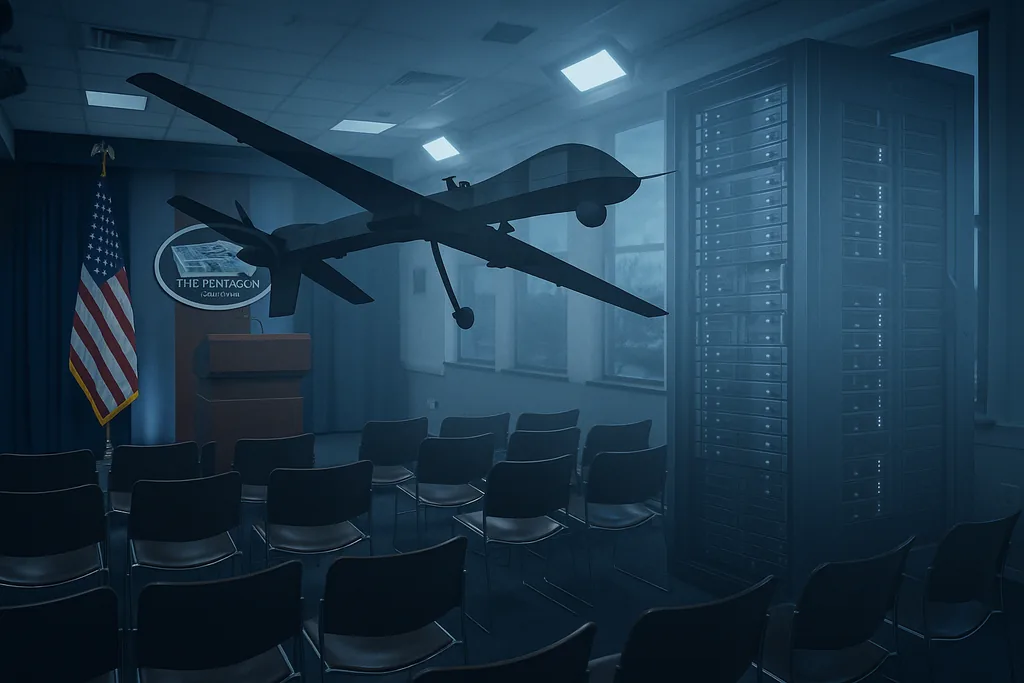
Less than a week after the Pentagon pushed new contract language that would let the military use commercial models for “any lawful use,” including domestic mass surveillance and autonomous lethality, Anthropic said no. The company’s CEO publicly refused the Department of Defense demand, triggering an escalation that saw the defense secretary threaten a supply‑chain blacklist and the president order federal agencies to stop using Anthropic services. The phrase at the center of the clash — AI vs. the Pentagon: killer robots, — now frames a national debate about what private companies can lawfully and ethically refuse when government buyers ask for unconstrained access to powerful models.
AI vs. the Pentagon: killer robots, and the "any lawful use" demand
The immediate fight is contractual but the implications are far broader. In January the Pentagon circulated updated terms that would let it use AI products for “any lawful use,” language Pentagon officials say is intended to avoid piecemeal restrictions across many different programs. For Anthropic, the sticking points were explicit: no mass domestic surveillance of Americans and no fully autonomous lethal weapons without a human in the loop. Those were presented by the company as company‑level red lines grounded in safety and reliability concerns.
AI vs. the Pentagon: killer robots, mass surveillance and corporate red lines
Anthropic’s stance—refusing a universal license for “any lawful use”—is notable because many rivals reportedly accepted the Pentagon language. That divergence has turned similar commercial decisions into de facto policy choices: a company that says yes effectively broadens the set of uses the military can pursue with minimal further negotiation; a company that says no forces the government to find other providers or build capability itself. Tech workers, civil‑liberties groups and investors are watching whether these corporate red lines hold when faced with the financial and political power of national security buyers.
Technical and ethical stakes of autonomous weapons
When reporters, engineers and ethicists use shorthand like “killer robots,” they are referring to systems that can select and apply lethal force without meaningful human control. The technical problems are stubborn: perception errors, adversarial false positives, contextual misunderstanding and unpredictable software failures can all produce catastrophic outcomes in combat. AI models are statistical pattern matchers trained on data; they are not moral agents or reliable decision makers in high‑stakes, ambiguous environments.
The ethical risks go well beyond technical errors. Autonomous lethality raises questions of accountability (who is responsible when a machine kills?), escalation (how do adversaries respond to automated targeting?), and discrimination (machine systems may replicate or amplify biases that misidentify civilians as combatants). Many ethicists also warn about lowering the political threshold for entering conflict if decision loops are accelerated by automation. For these reasons some policy makers and advocates press for strict limits or bans on systems that operate without human control, while others argue for carefully constrained R&D and strong human‑in‑the‑loop requirements until systems are demonstrably safe.
Contract law, supply‑chain risk, and how the Pentagon regulates AI‑enabled surveillance
The Pentagon regulates use of commercial technologies primarily through contracting language, approvals and acquisition policy — not through an overarching statute that specifically addresses AI use cases. When the department asks contractors to accept “any lawful use,” it is leveraging contract terms to secure broad authority; that language is intended to avoid repeating negotiations across many task orders and programs. But it also raises constitutional and statutory questions when “lawful” could include domestic surveillance tied to law enforcement or intelligence uses.
Labeling a vendor a “supply‑chain risk” is an administrative tool with concrete consequences: it can prompt federal agencies and large defense contractors to transition away from a supplier and may chill third‑party integrations. The Pentagon’s threat to use the Defense Production Act or similar authorities underscores that acquisition law can be a lever to compel compliance, but those levers are politically charged and can provoke litigation. Who sets the red lines, therefore, becomes contested territory — a mix of company policy, internal government memos, congressional oversight and, at times, judicial review.
Are killer robots a real threat? International rules and current limits
The risk that autonomous systems will be used for lethal force is not hypothetical: militaries are actively pursuing automation in sensing, targeting and strike systems. That said, the world has not yet converged on a binding international ban on fully autonomous lethal weapons. The United Nations’ Convention on Certain Conventional Weapons has hosted years of discussions about lethal autonomous weapons systems, but these talks have so far produced no treaty banning such systems. NGOs, some states and coalitions of tech companies push for strong international limits; other states resist treaty constraints, seeking operational freedom.
At the national level, policy mixes remain fragmented: some countries favor strict human‑in‑the‑loop rules, others emphasize capability and deterrence. The absence of a universal treaty means much of the governance today is shaped by export controls, purchase decisions, and corporate policies. That fragmentation is exactly what makes vendor red lines and private contracts consequential — they fill a regulatory vacuum but can be reversed under pressure.
What happens next and why it matters
The immediate next steps will be legal and political. Anthropic signaled it would litigate any designation that impairs its business; the Pentagon can press contractors and prime vendors to minimize dependence on a noncompliant supplier. Congress may hold hearings, and several public‑interest groups will seek oversight. Practically, federal programs that already use Anthropic’s models will need transition plans if agencies comply with an order to cease use — a messy, expensive and potentially disruptive process.
Beyond the courtroom and the budget line items, the episode forces a broader question: should commercial AI vendors be allowed to contractually limit how governments use their technology when national security clients argue operational necessity? The answer will shape future wars, domestic policing, and the architecture of public‑private security partnerships. If market power and reputational pressure are now the principal brakes on dangerous uses, their durability in the face of urgent defense demands will determine whether democratic societies can set meaningful guardrails around AI.
The clash between Anthropic and the Pentagon is therefore not only a dispute over one company’s terms and one government’s procurement priorities; it is a live case study in how policy, technology and ethics collide when frontier systems meet state power. How companies, courts and legislatures resolve it will affect whether the next generation of military AI is constrained by human judgment and democratic oversight — or by contract clauses and backroom exemptions.
Sources
- US Department of Defense (public statements and acquisition memos)
- Anthropic (company press statements)
- White House (public statements and executive direction)
- United Nations — Convention on Certain Conventional Weapons (CCW) meeting reports and summaries




Comments
No comments yet. Be the first!