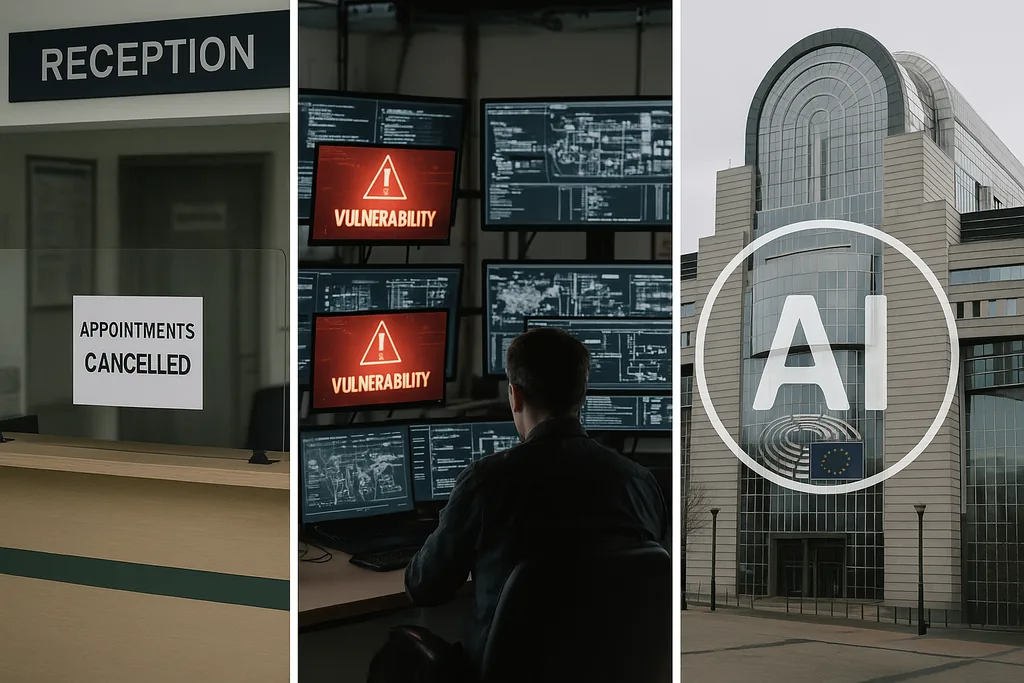
Ransomware shuts US clinics — clinical impact
This week brought a stark reminder of how quickly cybercrime translates into real-world disruption: a ransomware attack on the University of Mississippi Medical Center forced the immediate closure of outpatient clinics across the state, cancelling appointments, imaging and elective procedures and blocking access to the Epic electronic health record system. The centre moved to manual downtime processes to keep hospital and emergency services running, but the interruption to routine care and the logistical scramble to reschedule patients illustrated the human cost of an attack that targets clinical IT. In practical terms, ransomware does more than encrypt files — it freezes scheduling systems, diagnostic workflows and supply chains, and it diverts clinical staff away from patient care into administrative triage and recovery.
How does ransomware affect US clinics and patient care? The immediate effects are cancelled outpatient visits and delayed diagnostics; the medium-term effects can include lost or corrupted clinical records, delayed surgeries, and degraded patient trust. Facility managers also face hard choices about whether to pay ransoms to restore critical systems, an option that carries legal and ethical risks and does not guarantee recovery of all data. To reduce the chance of such shutdowns, healthcare providers need a combination of technical controls and operational preparedness: immutable, tested backups; network segmentation that isolates electronic medical records from ancillary systems; strict access controls and multifactor authentication for clinicians; endpoint detection and response tools; and regular tabletop exercises that rehearse recovery under realistic constraints.
Smaller clinics and community providers are particularly exposed because they often lack dedicated security operations teams and can be dependent on third‑party vendors for EHR hosting and IT management. That dependency raises two important defensive actions: first, organisations must demand clear security SLAs and breach-notification clauses from vendors; second, health systems should maintain the ability to operate critical clinical functions offline — from consent forms to medication reconciliation — for short periods without digital systems. Those steps do not eliminate risk, but they make ransomware-induced clinic closures far less likely to translate into interrupted or dangerous patient care.
ICS vulnerabilities surge
At the same time the healthcare sector was fighting a ransomware incident, researchers released worrying data for operators of industrial systems: 2025 set a new high with 508 ICS advisories from CISA covering some 2,155 distinct vulnerabilities, and an average CVSS severity score above 8.0. The Forescout analysis shows 82% of advisories were classed as high or critical, and many vendors published vulnerabilities directly without a corresponding CISA advisory, creating visibility gaps for defenders. For industrial environments — utilities, factories, transport networks — those numbers are especially alarming because many control systems are long-lived, use legacy protocols, and were never designed to be internet‑connected.
Why are ICS (Industrial Control System) vulnerabilities surging and what can be done about them? Several structural causes converge: aging hardware with limited update paths; increased IT/OT convergence that exposes previously isolated controllers; inconsistent vendor disclosure practices; and the rapid discovery of device‑level flaws as security scrutiny intensifies. The mitigation toolbox combines classic IT hygiene adapted for OT — strict network segmentation, allow‑lists for device communications, phased patching plans that respect operational constraints, and compensating controls such as application layer gateways and read‑only mirroring for sensitive processes. Visibility is also vital: asset discovery and continuous monitoring tailored to OT protocols let teams prioritise remediation by actual risk rather than vendor reputation alone.
Operationally, organisations should map attack paths that cross IT and OT boundaries and run exercises that simulate an OT compromise: what happens to safety interlocks, production schedules and third‑party remote access? Governments and industry bodies can help by standardising disclosure practices so that vendor advisories feed into national vulnerability databases promptly and consistently. Without those changes, the growing volume and severity of ICS flaws will continue to translate into larger, more dangerous outage scenarios when threat actors — opportunistic or state‑linked — exploit them.
European Parliament's AI restrictions and industrial caution
This week the European Parliament disabled built‑in AI features on issued devices and tightened controls after IT staff flagged that some AI functions sent user data to external cloud providers for processing. The step is part of a wider European sensitivity: legislatures and regulators are balancing the productivity gains of generative AI against the risk that confidential legislative drafts, constituent data or proprietary research could be exfiltrated or used to train third‑party models. Separately, HackerOne moved to clarify policy language after bug hunters asked whether submitted vulnerability reports might be used to train generative AI models — a change that underlines how governance questions are rippling through both public institutions and private security platforms.
What does the European Parliament's AI ban entail and which technologies are restricted? The immediate measures focus on disabling cloud-based assistant features and blocking unvetted third‑party model integrations on work devices; they do not represent a blanket prohibition on AI research or deployment, but they do prioritise data sovereignty and auditable processing. For businesses and developers, the practical implication is that services relying on external, opaque model providers will face tighter scrutiny in European public-sector contexts. That could nudge some organisations toward private, auditable models, on‑premises inference or stricter data‑handling agreements with providers.
How could the European AI ban impact AI innovation and deployment in Europe? The effect will be twofold. In the short term, extra compliance and procurement friction may slow rollout of cloud-based AI tools inside government and tightly regulated industries. In the medium term, however, this pressure creates a market incentive for startups and established vendors to build privacy‑preserving, verifiable AI stacks — local inference, differential privacy, model usage attestations and vendor contracts that forbid training on customer data. The policy stance could therefore accelerate a particular strand of innovation: secure, auditable AI geared to regulated customers rather than mass, opaque cloud services.
Industry moves: semiconductors, identity and the attack surface
The headlines also included a string of commercial moves and incidents that feed into the same security story. Advantest, a major supplier of automatic test equipment to the semiconductor industry, disclosed a recent ransomware intrusion and investigation after detecting an intrusion on February 15. Semiconductor suppliers and test houses are attractive targets because they sit at critical points in global supply chains: outages there can ripple to chipmakers and downstream electronics manufacturers. Meanwhile, vendors such as GitGuardian and buyers like Palo Alto Networks are pivoting to non‑human identity and AI agent governance — a sign that defenders expect the attack surface to expand as organisations deploy autonomous agents, containers and model‑based services.
Those commercial responses are sensible: security tools that inventory software, detect leaked secrets and control agent behaviour address concrete changes in attacker tradecraft and operational risk. But they are not a substitute for the basics: patch management, segmented networks, vetted vendors and rehearsed incident response remain the most effective levers to reduce the probability and impact of disruptive attacks.
Defensive checklist for healthcare and industrial operators
Organisations that face both clinical and industrial risk should treat recovery planning as a primary safety function, not a paperwork exercise. Practical steps that matter include: maintaining offline, immutable backups tested for recovery speed; enforcing zero‑trust or least‑privilege access across IT and OT; isolating critical control networks from the enterprise internet; hardening remote access mechanisms and logging every third‑party connection; and running cross‑discipline incident simulations that include clinicians, OT engineers and legal counsel. Insurance and law enforcement are useful parts of the ecosystem but should not replace technical and organisational hardening.
For policy makers, the immediate priorities are clearer disclosure channels for vendor advisories, funding for defensive OT visibility in critical sectors, and consistent rules on how AI services handle public-sector data. For businesses and hospitals, the message is operational and urgent: security investments reduce the likelihood that a single incident will become a week‑long disruption to patient care or a cascade across supply chains.
The cluster of stories this week — other news: ransomware shuts clinics, the record ICS vulnerability tallies, and EU steps to curb unchecked AI features — all point to the same conclusion: connectivity and automation bring great value, but without concerted governance and tested resilience they amplify risk. The choices organisations make now about segmentation, vendor contracts, backup discipline and auditable AI will determine whether these incidents remain occasional shocks or become the new normal.
Sources
- University of Mississippi Medical Center (UMMC statement and incident reporting)
- Forescout research on ICS vulnerabilities and CISA advisories
- Intel and Google Cloud Security joint TDX technical report
- European Parliament IT department announcements on AI features




Comments
No comments yet. Be the first!