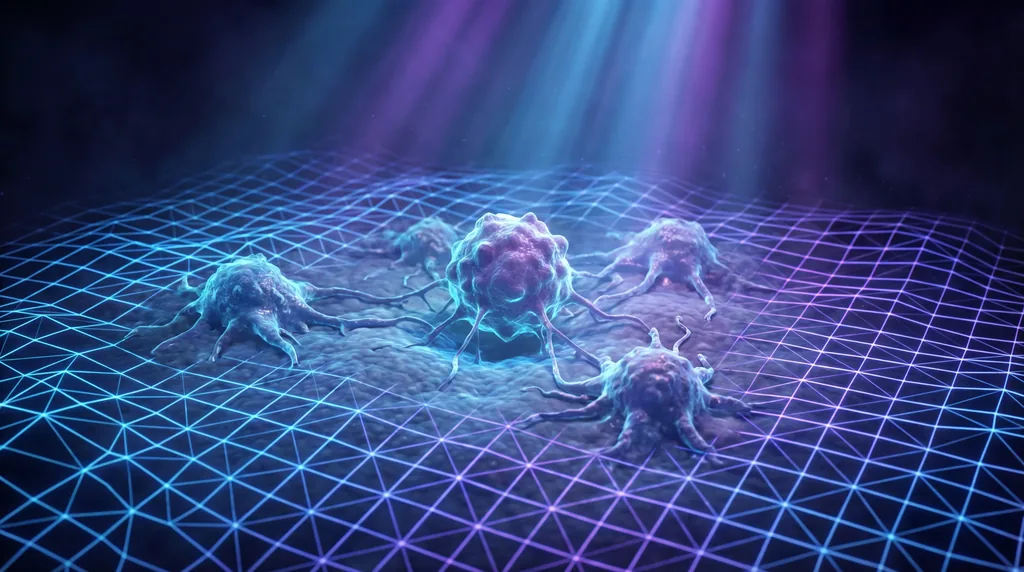

Mapping the vast landscape of the human immune system has long been limited by the immense computational power required to analyze millions of cellular interactions. SubQuad AI accelerates immuno-oncology research by mapping the immune system to identify rare cancer-fighting cells more efficiently than traditional methods. By leveraging advanced multimodal fusion and near-subquadratic retrieval, the system identifies specific immune cell phenotypes, such as those crucial for bone regeneration or tumor suppression, which were previously obscured by the massive scale of biological data.
The Computational Bottleneck in Immunotherapy
The human immune repertoire contains millions of unique receptors that must be compared to identify therapeutic matches, creating a significant data processing challenge. Traditionally, analyzing these receptors requires a "pairwise" comparison approach where every sequence is measured against every other sequence. This method scales quadratically, meaning that doubling the size of a dataset results in a fourfold increase in computational cost, eventually reaching a point where large-scale bioinformatics projects become hardware-prohibitive.
Current analytical methods often overlook minority clonotypes that are essential for fighting specific tumors because these rare cells are "drowned out" by more prevalent, non-specific immune responses. When researchers attempt to mine adaptive immune repertoires at a population scale, the dual bottlenecks of high computational cost and dataset imbalance frequently prevent the discovery of clinically important subgroups. Without a more efficient way to filter and prioritize data, the most potent cancer-fighting cells remain hidden within the noise of the broader immune system.
What is the Adaptive Receptor framework?
The Adaptive Receptor framework is an AI-driven methodology used to analyze adaptive immune receptors, such as T-cell receptors, within immuno-oncology. It utilizes a structured pipeline to process single-cell immune data, mapping receptor diversity and functionality through advanced clustering. By revealing specific immune cell subclusters, this framework supports the discovery of highly specialized cells capable of targeting complex diseases.
Researchers Zijian Zhang, Kun Liu, and Rong Fu developed SubQuad as a primary implementation of this framework to address the limitations of linear sequence analysis. The framework functions as an end-to-end pipeline that combines antigen-aware retrieval with GPU-accelerated affinity kernels. By co-designing the indexing and similarity components, the authors have created a platform that is both scalable and "bias-aware," allowing for a more nuanced understanding of how receptors interact with specific antigens in a clinical setting.
How does multimodal fusion enhance immune receptor mapping?
Multimodal fusion enhances immune receptor mapping by integrating diverse data streams, such as sequence alignments and structural embeddings, into a unified analytical model. This fusion approach allows SubQuad to weigh complementary information on a per-pair basis using a differentiable gating module. By combining these distinct data types, the system achieves a more holistic and accurate representation of receptor-antigen affinity than single-modality methods.
The role of learned multimodal fusion is critical because immune receptors are defined by more than just their primary amino acid sequence; their functional behavior is influenced by spatial geometry and chemical properties. SubQuad employs a differentiable gating module that adaptively decides which data channel—alignment-based or embedding-based—is more relevant for a specific comparison. This "antigen-aware" retrieval ensures that the system does not just find similar-looking sequences, but identifies receptors that share the same functional intent, which is a cornerstone of vaccine target prioritization.
Introducing SubQuad: A Near-Quadratic-Free Approach
SubQuad utilizes near-subquadratic retrieval to drastically reduce the number of necessary calculations by bypassing the need for exhaustive pairwise comparisons. By implementing compact MinHash prefiltering, the system sharply reduces the number of candidate pairs that require intensive evaluation. This allows the pipeline to maintain high throughput and low memory usage, even when processing massive datasets that would crash traditional bioinformatics tools.
The efficiency of the SubQuad pipeline is further enhanced by GPU-accelerated affinity kernels, which handle the remaining heavy-duty calculations with high parallelization. According to the research findings, this combination of smart filtering and hardware acceleration allows SubQuad to achieve significant gains in peak memory usage while preserving or improving recall@k metrics. Key technical features of the SubQuad architecture include:
- MinHash Prefiltering: Rapidly excludes irrelevant pairs before deep analysis.
- Subquadratic Complexity: Breaks the N-squared barrier that limits traditional scaling.
- GPU Acceleration: Leverages modern hardware to process thousands of affinities simultaneously.
- Automated Calibration: Enforces proportional representation of rare cell groups.
How does SubQuad address dataset imbalances in immune data?
SubQuad addresses dataset imbalances through fairness-constrained clustering and automated calibration routines that ensure proportional representation of rare antigen-specific subgroups. By utilizing machine learning algorithms to detect minority subclusters within populations of T cells and B cells, the system prevents common cells from overshadowing rare, potent ones. This ensures that minority clonotypes are preserved during the data-mining process.
In standard algorithms, rare cells are often treated as statistical outliers or noise, which is a major setback in cancer immunotherapy where the most effective cells might exist in tiny quantities. SubQuad’s fairness-constrained clustering acts as a corrective measure, ensuring that the "needle in the haystack" is not only found but prioritized for downstream analysis. This equity-aware objective is essential for biomarker discovery, as it allows researchers to identify unique immune signatures that are present in only a small fraction of the patient population but hold high therapeutic value.
Clinical Implications and the Future of Drug Discovery
The performance of SubQuad on large viral and tumor repertoires suggests a paradigm shift in how AI for drug discovery is applied to human health. By achieving higher cluster purity and subgroup equity, the tool provides a more reliable foundation for identifying vaccine targets and developing personalized cancer treatments. The ability to process data at this scale means that clinical researchers can analyze patient repertoires in days rather than months, significantly shortening the timeline for personalized medicine.
As the field moves toward more complex immuno-oncology challenges, the Adaptive Receptor framework established by Zhang, Liu, and Fu sets a new standard for scalability and bias-awareness. Future directions for the research involve applying SubQuad to even larger, multi-omic datasets to see how immune receptor data interacts with gene expression profiles. By providing a scalable, efficient, and fair platform for repertoire mining, SubQuad paves the way for the next generation of bioinformatics tools that can truly map the complexity of the human immune system without being hindered by computational limits.




Comments
No comments yet. Be the first!