Could the Antarctic Treaty reverse its drilling ban as melting reveals valuable minerals?

Environment
Could the Antarctic Treaty reverse its drilling ban as melting reveals valuable minerals?
Warming is exposing bedrock and sediment that contain rare earths and other strategic metals — a fact that has reignited debate over the Madrid Protocol's mining moratorium and what a post‑2048 review could mean for Antarctic policy.

Melting shorelines and a geopolitical question

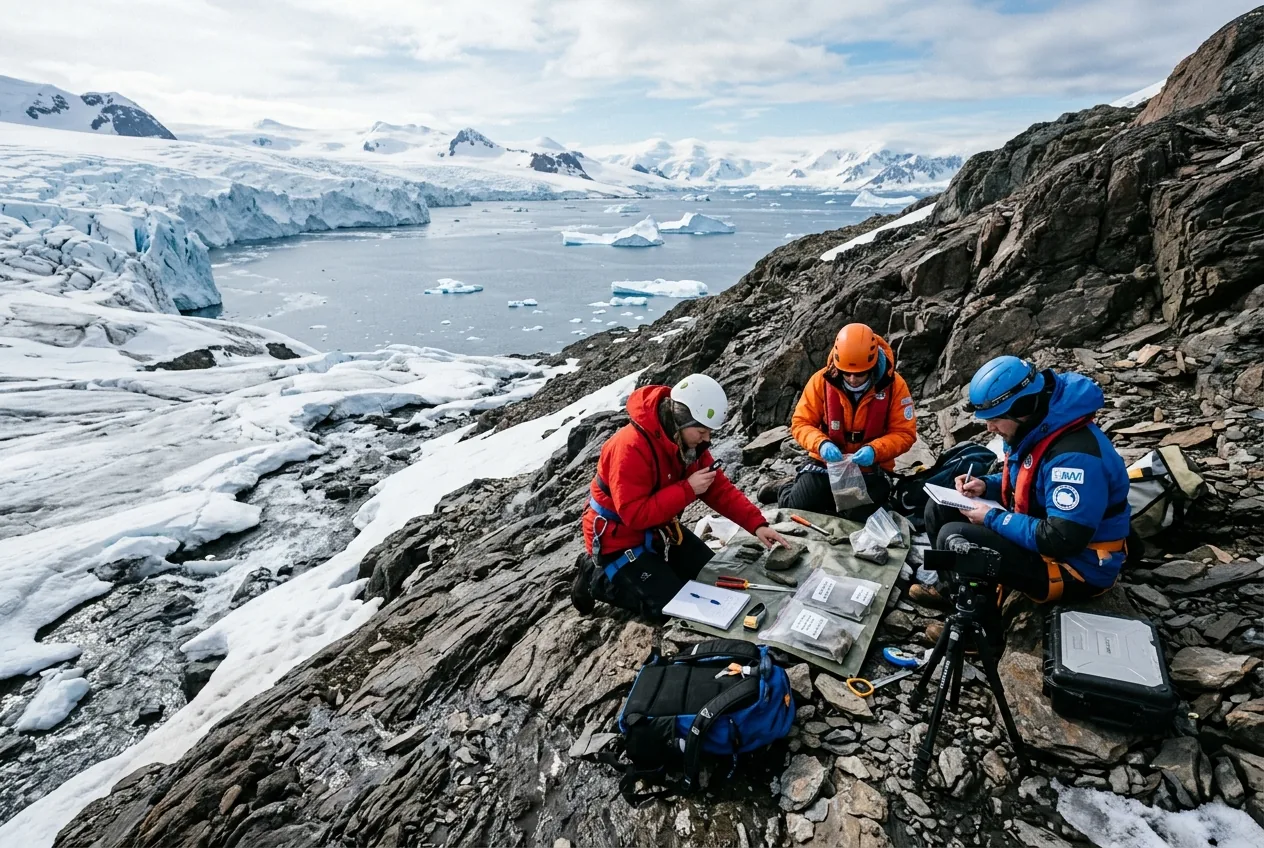
On a wind‑stung research ridge in the McMurdo Dry Valleys, a team of geochemists this year reported small but real enrichments of rare earth elements in salt‑pond sediments — a concrete, local example of how warming and surface water movement can concentrate metals in Antarctic soils. That process, replicated elsewhere at different scales, is one reason the headline phrase "valuable minerals under antarctica’s melting ice" has moved from speculative think‑pieces into policy conversations. The discovery does not mean an Antarctic gold rush is imminent, but it does bring into focus an awkward political calendar: the environmental protocol that bans commercial mining contains a 50‑year review window that parties can trigger after 2048.

Valuable minerals under Antarctica’s ice: what scientists are actually finding

Field work in places such as the McMurdo Dry Valleys has found measurable concentrations of rare earth elements in shallow regolith and salt‑pond sediments; those papers show the geochemical mechanisms by which freeze–thaw cycles and ephemeral meltwater can mobilize and re‑deposit metals. But authors and press releases alike stress that the measured concentrations to date are far below economic thresholds for commercial mining, and the deposits are highly spatially patchy and often accessible only in small, protected basins. In short: the continent hosts metal‑bearing rocks and processes that can concentrate critical minerals, but discovery of a commercially extractable deposit would require a different set of geological circumstances — large ore bodies, amenable host rock, and feasible logistics — none of which have been demonstrated at scale in refereed studies so far.

Valuable minerals under Antarctica’s melting ice and the treaty mechanics of 2048

The legal story is easier to describe than the geology. The Protocol on Environmental Protection to the Antarctic Treaty — commonly called the Madrid Protocol — explicitly prohibits mineral resource activities other than scientific research, and that prohibition remains in force. What changes in 2048 is not an automatic end to the ban but a formal possibility for review: any Consultative Party may request a review conference fifty years after the Protocol entered into force. Even if a review is called, altering the prohibition is procedurally difficult: the Protocol’s safeguards and decision thresholds mean any change would require broad consensus and additional implementing instruments, including ratification steps by many parties. That combination makes a unilateral, instant reversal highly unlikely — but not impossible if political will and technology shift dramatically.

Geology, economics and the thin line between resource and rubble

Longstanding geological reconstructions suggest that parts of Antarctica are projected continuations of mineral belts found on former Gondwana fragments, so the theoretical potential for copper, nickel, gold, platinum‑group metals, and even kimberlitic rocks that can host diamonds exists. However, geological plausibility is not the same as commercial viability: ore-grade concentrations, accessible overburden thickness, proximity to ports or ice‑free coasts, and extraction costs under extreme weather are decisive. Past reviews — including government white papers and specialist reports — have repeatedly concluded that logistical and environmental costs, plus global supply dynamics, make Antarctic mining unattractive with current technology and prices. Nevertheless, rising demand for certain critical minerals and improvements in remote‑access technologies keep the question alive in policy circles.

Who is asking for a review — motives and messages

Discussion of the 2048 window has three distinct drivers. First, environmental and conservation groups frame the Protocol as a hard‑won legal firewall and warn against creeping pressure to open the continent to industry. Second, some states and industry actors, particularly those seeking to diversify supply chains for critical minerals, have funded scientific surveys and publicly flagged interest in Antarctic geology. Third, a smaller but vocal legal and policy literature explores pathways by which a party could trigger review or even withdraw from the Protocol — an option that would be politically explosive but legally available under treaty rules. The result is a policy tug‑of‑war: conservation actors push for stronger, binding protections ahead of 2048; resource‑security actors encourage more geoscience and legal clarity so national parliaments can weigh future options.

Data gaps, research incentives and the ethics of looking

One practical contradiction is that more geological surveying — the very activity that produces the data used to argue for or against mining — necessarily increases human presence and potential environmental disturbance. Antarctic science funding is concentrated on climate, ice‑sheet dynamics, and biodiversity; relatively little long‑term funding exists for systematic, continent‑wide mineral prospecting because of legal and ethical constraints. That means policymakers must often make decisions with sparse, uneven geological data. In addition, most mineral‑focus research published in the last five years has emphasized process‑level understanding (how rare earths might concentrate in cold environments) rather than demonstrations of extractable reserves, leaving a specific evidence gap: large, mapped orebodies with measured grades and tonnages. That gap is precisely what would sway cost‑benefit calculations — and it is currently absent.

Environmental and ethical stakes beyond the shore

Drilling or mining in Antarctica would not be merely a local environmental decision. Activities on the continent interact with global systems: dust fluxes, ocean circulation, marine ecosystems and the symbolic status of Antarctica as a global commons devoted to peace and science. Environmental reviews show potential for long‑lasting habitat damage from infrastructure, pollutant release and changes to coastal systems — risks that are magnified given our limited baseline ecological knowledge in many Antarctic niches. Ethically, the argument against exploitation is unusual because there are no indigenous human claims on Antarctic land; instead the moral claim is intergenerational and planetary — preserving an environment that serves climate science, coastal stability and biodiversity. Those are precisely the kinds of public‑good benefits that are easily underpriced in short‑term commercial analyses.

Geopolitics: not just who can mine, but who can deny

If a commercially promising deposit were ever demonstrated, the contest would be as much diplomatic as technical. Antarctica’s governance rests on multilateral decisionmaking among Consultative Parties; any attempt to mine without that consensus would be a political provocation. Some analysts also flag a secondary risk: nations outside the treaty framework could attempt unilateral activity in adjacent high seas or contest jurisdiction, prompting broader maritime or resource disputes. In that sense, the value of minerals under antarctica’s melting ice is not only a question of commodity economics but of statecraft: who sets the rules for a newly accessible frontier, and how will enforcement, monitoring and environmental standards be funded and policed?

What would a reversal mean for global environmental policy?

A reversal or weakening of the Madrid Protocol’s mining prohibition would have outsized symbolic and practical consequences. Symbolically, it would signal that a century‑long norm — Antarctica as a natural reserve for science and peace — is negotiable under pressure from resource demand. Practically, it would create a template for other high‑seas and polar governance debates: seabed mining, Arctic resource claims, and transnational carbon accounting could all shift under a regime that privileges extraction under a narrow set of domestic or commercial interests. That outcome would also reframe conservation funding and enforcement needs on a global scale, because protecting fragile polar systems from industrial impacts is far more expensive than protecting managed terrestrial reserves.

The immediate reality is modest and clarifying: researchers are finding processes that concentrate metals in Antarctic sediments, and warming will continue to expose more bedrock and coastal margins. But the jump from process knowledge to a commercial extraction program is large — geologically, economically and legally. The 2048 review window is real, but it is a procedural hinge, not an automatic switch. What matters most between now and 2048 is the kind of evidence nations choose to collect, the legal safeguards they negotiate, and whether the international community agrees that some places on the planet should remain off‑limits to commodity calculus.

The genome is precise; the world it lives in is anything but — and with Antarctica, the risk is not only in the minerals beneath the ice but in the incentives that push someone to start counting them as soon as they peek out.

Sources

  • Cold Regions Science and Technology (Burton et al., 2025 paper on rare earths in McMurdo Dry Valleys)
  • Antarctic Treaty Consultative Meeting (ATCM) — Final report and Secretariat materials on the Madrid Protocol
  • Antarctic and Southern Ocean Coalition (analysis of the Antarctic Treaty review provisions)
  • Earth and Planetary Science / geoscience literature on Antarctic mineral potential
  • Wilson Center analysis of Antarctic diplomatic and legal challenges
Wendy Johnson

Wendy Johnson

Genetics and environmental science

Columbia University • New York

Readers

Readers Questions Answered

Q What valuable minerals are believed to lie beneath Antarctica's melting ice?
A
Q Could melting ice around Antarctica cause the drilling ban to be reversed?
A
Q What would a reversal of the Antarctic drilling ban mean for global environmental policy?
A
Q How do international treaties regulate mining in Antarctica and could they be changed?
A
Q What are the environmental and ethical concerns of drilling for minerals in Antarctica?
A

Have a question about this article?

Questions are reviewed before publishing. We'll answer the best ones!

Comments

No comments yet. Be the first!