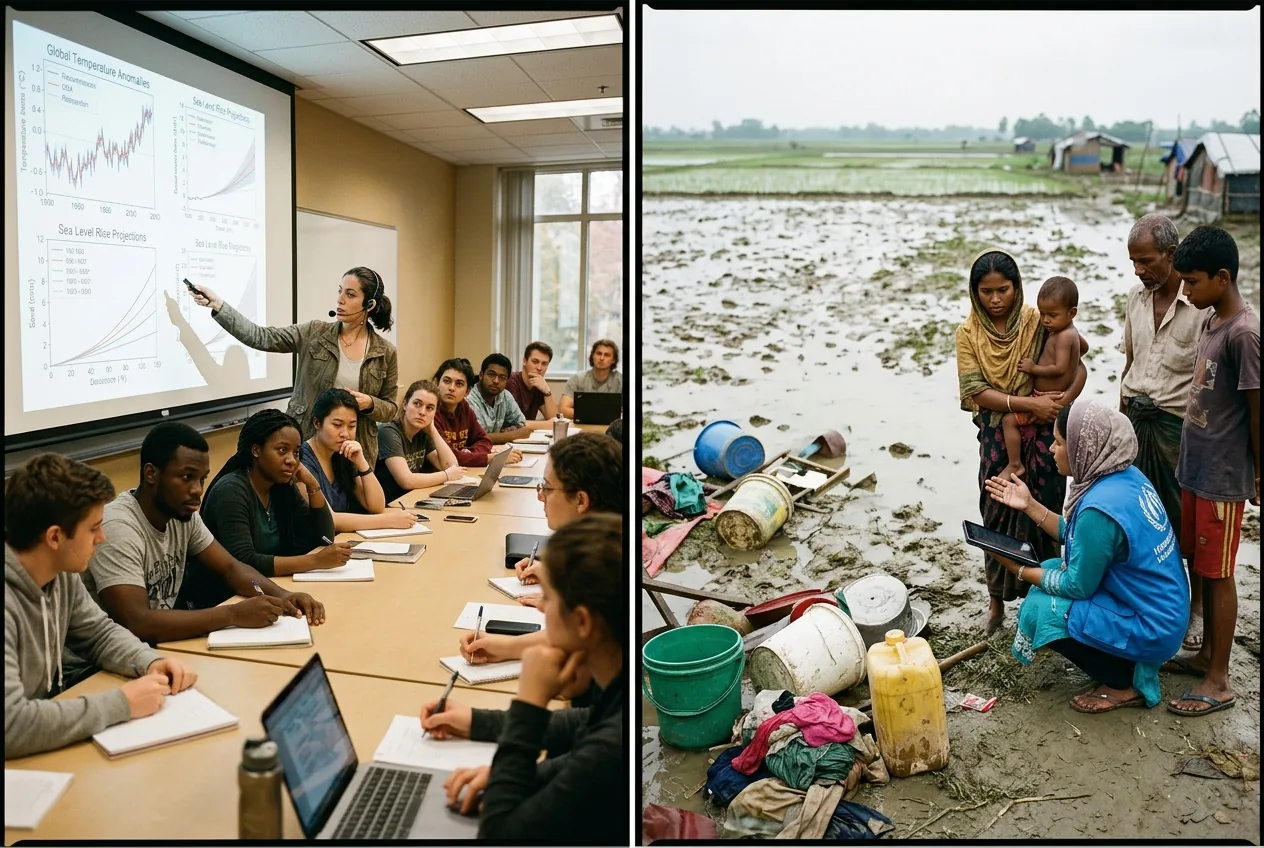
In the flood-battered districts of Khyber Pakhtunkhwa, the physical water from the 2022 and 2025 monsoons has receded, but the physiological stress response has not. Aid workers on the ground report a relentless loop of distress: parents paralysed by the fear of their children washing away, and locals unable to sleep as their brains endlessly replay the sound of rushing water. Against this acute trauma, the region has roughly one psychiatrist for every few hundred thousand people.
This localised crisis is the sharp end of a much broader global baseline. According to a 10,000-person international poll, 75 percent of young people are frightened about the climate outlook. This is no longer private rumination; it is a sprawling public-health signal hitting the 16-to-24 demographic exactly when a plastic, learning-focused brain is most vulnerable to lifelong anxiety disorders.
A Syndrome Without a Code
Clinicians are watching a new morbidity emerge. Published surveillance in journals like The Lancet and PNAS tracks a syndrome blending anticipatory worry, eco-grief, and post-traumatic stress. The symptoms manifest as insomnia, intrusive thoughts, and a kind of functional paralysis that bleeds into school concentration and decisions about eventually having children.
In Pakistan’s river plains, the gap between this biological need and medical capacity is a chasm. The current response relies on isolated community-based pilots, such as mobile psychosocial teams and telepsychiatry linking remote clinics to urban specialist hubs. They work, but they remain scattered experiments rather than national infrastructure.
Taipei’s Quiet Detachment
The psychological fallout doesn't look the same everywhere. In Taiwan, university professors note a jarring emotional detachment among their students. These young adults are highly literate about rising seas and extreme urban heat, but their daily bandwidth is consumed by exams, job hunting, and immediate economic survival.
This isn't necessarily resilience. In a political culture hyper-focused on economic development, where people assume large institutions will absorb the environmental risk, information overload simply calcifies into apathy. When there is no clear institutional avenue for meaningful action, cynicism becomes a highly effective biological shield.
The Recovery Blind Spot
There is a grim temporal rhythm to environmental trauma. Tracking data shows mental distress spikes in the two years following a climate shock, settling into a chronic baseline fuelled by lost harvests and ruined homes. Yet, disaster recovery budgets remain overwhelmingly physical.
When public funds are tight, governments pour concrete and rebuild shelters, pushing psychosocial care to the margins. It is a catastrophic policy lag. Leaving early distress untreated guarantees that reactive anxiety hardens into chronic, entrenched disorders that will eventually bankrupt underfunded public health systems.
Action as a Biological Buffer
The same generational exposure driving the crisis is also producing its own crude psychological defence. Young cohorts are inheriting environmental debts they didn't authorise, a reality amplified by an endless feed of worsening climate data.
But a substantial fraction of these youths are metabolising their panic into organised protests and community policy demands. Epidemiologically, this makes sense. Even when political outcomes stall, the sheer act of mobilisation offers a measurable psychological benefit, pulling teenagers out of paralysed isolation.
Health ministries continue to treat climate anxiety as a theoretical policy line-item, acknowledging the shifting weather while ignoring the wards. The environmental models are getting sharper by the day. The assumption that someone else is going to fund the psychological fallout is pure fiction.
Sources
- The Lancet
- Proceedings of the National Academy of Sciences (PNAS)




Comments
No comments yet. Be the first!