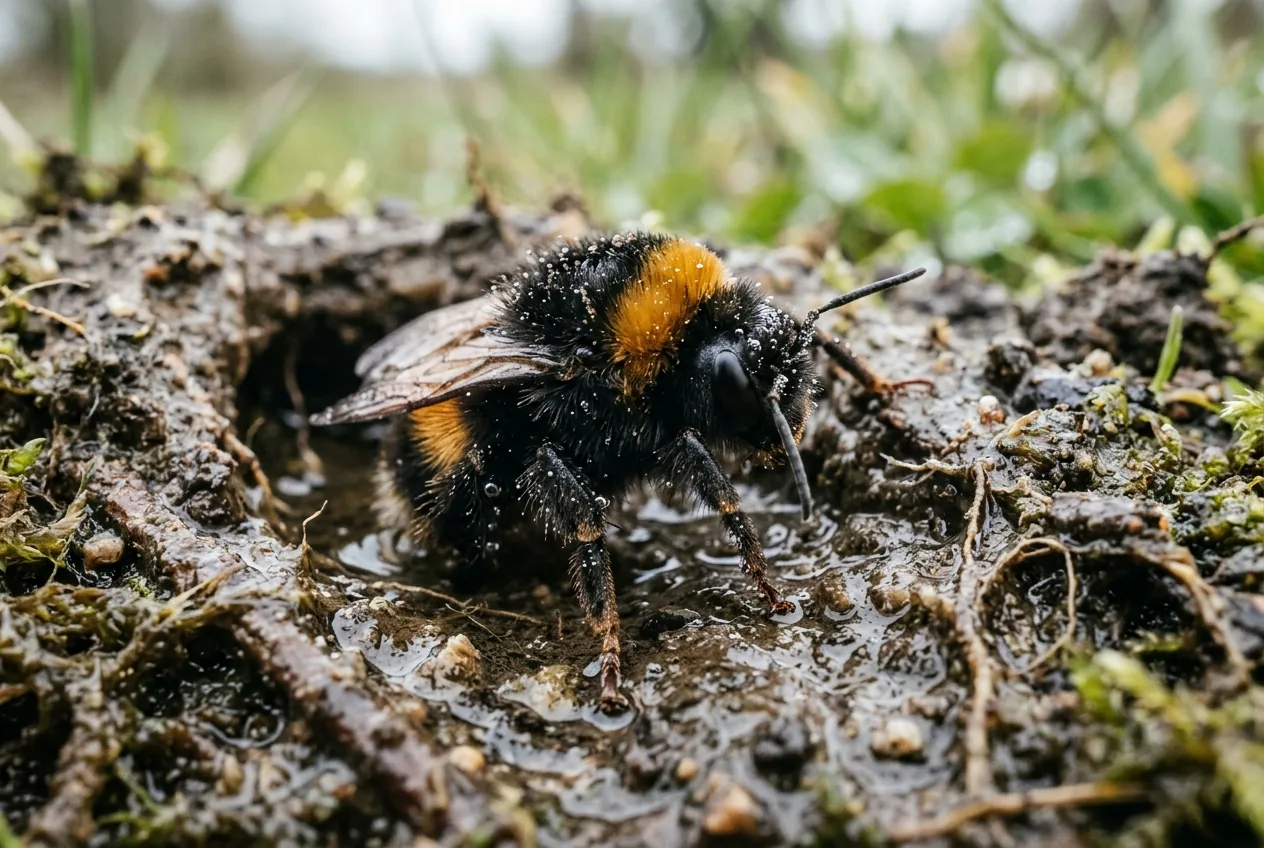
Submerge a hibernating bumblebee queen in cold water for eight straight days, and she does not die. Instead, she enters a strange physiological purgatory, steadily emitting low levels of carbon dioxide while her tissues quietly fill with lactate.
For a species where the queen is the single biological bridge between one summer and the next, this hidden aquatic endurance is a critical lifeline. Most bumblebee colonies die off in autumn, leaving only mated queens to bury themselves in shallow soil to wait out the winter. With erratic winter rain-on-snow events and sudden spring floods becoming increasingly common, a queen's ability to survive a flooded burrow dictates whether a local population will exist to pollinate the landscape come spring.
The physiological cost of a flooded burrow
The discovery, published in Proceedings of the Royal Society B, began as a laboratory accident. Researcher Sabrina Rondeau was running a pesticide experiment when condensation unexpectedly flooded several soil-filled tubes, fully submerging the diapausing queens inside. When they survived, the research pivoted to intentional, controlled flooding in cold, dark chambers designed to mimic winter burrows.
The physiological data show these insects do not simply shut down when submerged. Instead, they maintain a minimal rate of aerobic respiration while relying heavily on anaerobic pathways to survive the oxygen deficit. The resulting buildup of lactate is not free. Once removed from the water, the queens displayed a sharp spike in metabolic rate lasting up to three days, an energetic cleanup bill they must pay for surviving the flood.
Missing mechanisms and the limits of the lab
Exactly how a submerged insect manages to exchange gas underwater remains unresolved. The researchers focused on the metabolic chemical markers rather than the physical mechanism, leaving it unclear if the queens rely on trapped micro air films, altered spiracle control, or cutaneous gas diffusion.
There is also a steep drop-off between a clean laboratory flood and a natural one. Real winter soil is a complex matrix of fluctuating temperatures, shifting chemistry, and hungry microbial communities that compete for whatever oxygen remains. The study tested specific bumblebee taxa, making it a massive ecological leap to assume this trait holds uniformly across all Bombus species in varied climates.
Land use outpaces biological margins
A physiological safety margin is only useful if a queen has a burrow in the first place. This laboratory resilience intersects directly with agricultural policy and land management, where traditional overwintering microhabitats are routinely paved, deep-tilled, or compacted by heavy machinery.
Furthermore, a queen's ability to endure days of anaerobic stress and pay the subsequent metabolic cleanup bill depends entirely on her pre-winter fat reserves. If autumn foraging is curtailed by habitat loss, or if pesticide exposure disrupts her lipid accumulation before diapause, that underwater endurance may rapidly collapse.
Evolution has given the bumblebee queen an impressive buffer against a flooded world. But an insect that can hold its breath for a week still eventually needs somewhere dry to land.
Sources
- Proceedings of the Royal Society B




Comments
No comments yet. Be the first!