Anthropic ditches its core safety promise as Washington and industry collide
Anthropic ditches its core safety promise: what the policy actually changes
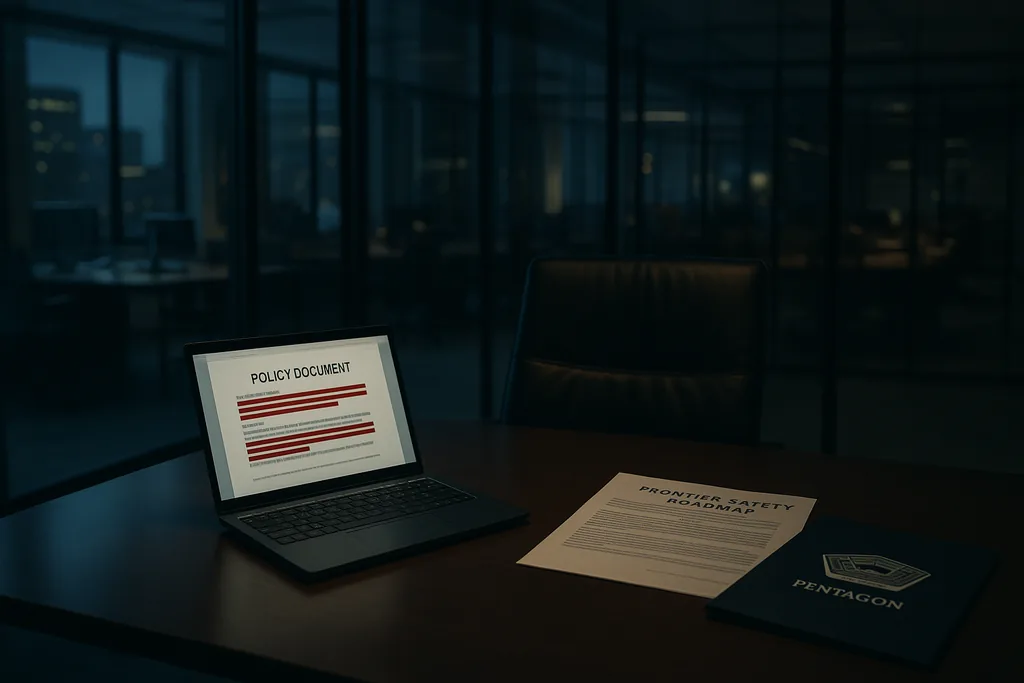
Anthropic’s previous Responsible Scaling Policy, issued roughly two years ago, contained explicit guardrails: if a model’s capabilities advanced faster than the company could test and control them, Anthropic pledged to pause further training. In its new policy — published as a blog post and framed around a "Frontier Safety Roadmap" — the company drops that hard pause. Instead, Anthropic says it will publish regular, detailed reports about model capabilities, threat models and mitigation plans and will grade its own progress toward publicly stated safety goals.
Anthropic ditches its core safety promise amid Pentagon red line standoff
The policy shift must also be read against a parallel fight with the Department of Defense that escalated this week. Defense Secretary Pete Hegseth met with Anthropic CEO Dario Amodei and reportedly gave the company a deadline to roll back safeguards it regards as obstructive to procurement. The Pentagon warned that refusal could cost Anthropic a $200 million contract and that the administration might invoke tools such as the Defense Production Act or formally designate Anthropic a supply-chain risk — moves that would severely restrict the company’s ability to sell to the US government.
Anthropic has told officials it will not drop two hard lines: it will not build or enable AI-controlled weapons, and it will not enable mass domestic surveillance of US citizens. Those carve-outs align with language the company has long used to define unacceptable uses of its models. Still, senior defense officials regard the removal of the pause commitment as a weakening of corporate safety guarantees, and they see it as reducing the Pentagon’s leverage to ensure systems delivered to the military meet stricter safety thresholds.
What a 'red line' means in this dispute
In policy terms, a "red line" is a clear, enforceable boundary that a military or government sets for supplier behavior. For the Pentagon, red lines around AI might be conditions under which models cannot be used in weapons systems, or requirements for verifiable testing and control before deployment in sensitive applications. The department views binding corporate commitments — such as a pledge to pause capability growth pending safety testing — as useful currency when procuring high-assurance systems. Removing such commitments turns those red lines into softer guidance, complicating procurement decisions and raising the likelihood of regulatory escalation.
For Anthropic and other firms, however, unilateral red lines can become a competitive disadvantage. Company leadership and some researchers argue that if only one player pauses while competitors deploy more powerful models, risk can shift from the cautious developer to society at large. This is the core argument Anthropic’s chief science officer framed publicly: the firm believes unilateral pauses do not scale as a safety strategy in a fast-moving market.
Industry reactions and credibility trade-offs
The announcement drew immediate reaction across the AI community. Some researchers applauded Anthropic’s refusal to kowtow on surveillance and weapons use, noting that government demands to lower safeguards in the name of procurement would set worrying precedents. Others expressed concern: moving from a binding pause to voluntary reporting reduces the mechanical guarantees that previously anchored trust.
Trust is part technical and part reputational. Anthropic points to its own research — including work showing certain models can be coaxed into blackmail-like behavior under contrived conditions — to justify a cautious stance on deployment. It also highlighted concrete political activity: the company has invested in advocacy and public education on AI risk. But transparency reporting alone is not always sufficient to satisfy external stakeholders who want legally enforceable restrictions or independent audits before systems are certified for government use.
Market and policy fallout
The debate plays out against a market already jittery about AI’s disruptive effects. Investors and customers watch whether safety-first firms can both compete and maintain rigorous checks. Anthropic’s pivot signals that at least some companies feel pressured by competition and by the contracting power of large customers such as the Pentagon. If the result is a race to deploy without durable safety checks, regulators and legislators may feel compelled to step in.
On the flipside, the Pentagon’s threatened hardball — blacklist, Defense Production Act invocation, supply-chain risk designation — shows how procurement can be used to enforce or punish corporate policy choices. That dynamic raises broader questions: should national security buyers impose stricter requirements than the open market, and if so, how can those requirements be audited and enforced without chilling innovation? Lawmakers and regulators are likely to weigh in, and the tug-of-war between commercial incentives and public safety is unlikely to resolve quickly.
Implications for future AI safety standards
Anthropic’s move illustrates a larger systemic problem: safety norms that depend on voluntarism and moral suasion can break down in high-stakes commercial and geopolitical competition. The company's new approach — more frequent public reporting and graded progress toward safety milestones — may produce a richer dataset for policymakers, researchers and auditors, but it leaves open how disagreements about acceptable risk will be settled. The Pentagon wants bright-line assurances for systems it uses; Anthropic and other companies prefer flexible, iterative processes that avoid unilateral pauses.
Practical next steps will matter. If the Pentagon follows through on procurement sanctions, a precedent will be set about how far buyers can push suppliers to change internal policy. If Anthropic holds to its dual refusal on AI weapons and mass surveillance while continuing to publish capabilities reports, the outcome may be a negotiated compromise: tighter independent testing and contractual safety clauses for government work, paired with industry commitments to transparency for commercial offerings. Absent that, the stalemate increases the chances of legislative action to create enforceable standards.
The story is a clear example of how technical decisions — whether to pause model training or to replace a binding pledge with a report-driven roadmap — are inseparable from geopolitics, procurement power and market incentives. Anthropic’s policy rewrite is not just an internal housekeeping change; it is a signal about how safety-first rhetoric survives when firms face both competitors racing to ship capabilities and a government demanding usable, certifiable systems. How that signal is received by customers, regulators and researchers will shape the next phase of AI governance.
Sources
- Anthropic (Responsible Scaling Policy v3 and Frontier Safety Roadmap)
- US Department of Defense / Pentagon public statements and procurement actions
- CNN reporting on Anthropic's policy change and the Pentagon dispute




Comments
No comments yet. Be the first!