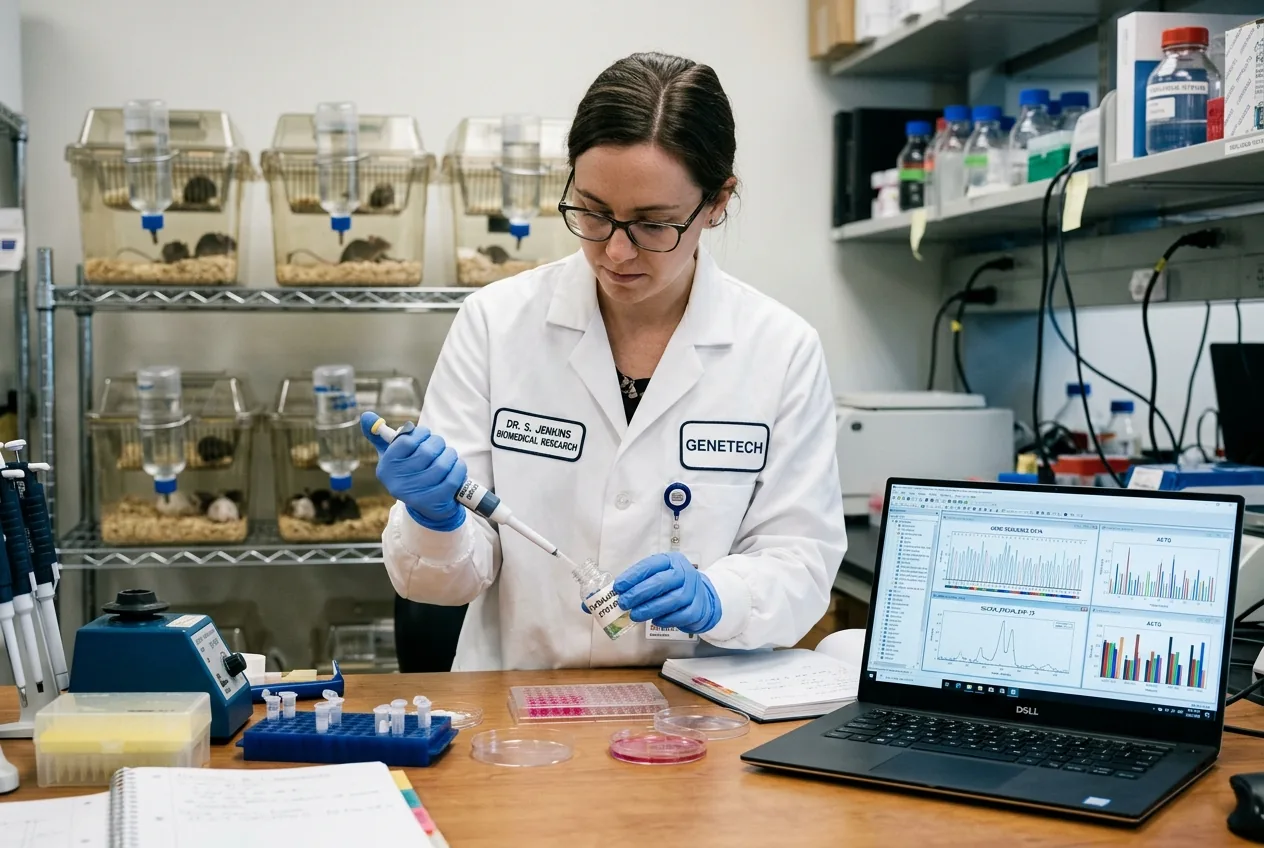
A lab moment that did not stay in the lab
When researchers in Santiago swapped a mouse colony's drinking water for solutions containing sucralose or stevia, the change they were hunting for was modest and specific: shifts in gut bacteria and in a handful of inflammatory and metabolic genes. What stopped the team in their tracks was how some of those shifts survived two generations of offspring that drank plain water. That result — published this week in Frontiers in Nutrition (10 April 2026) and led by Francisca Concha Celume at the University of Chile — raises a headline-friendly question about negative effects artificial sweeteners might pass on to future generations. The study authors and independent scientists all stress one line: the experiment was in mice, not people, and the mechanism remains unresolved.
Negative effects artificial sweeteners in mice: a concise account of the experiment
The team split mice into three groups: control (plain water), stevia in water, and sucralose in water. Doses were chosen to be comparable to typical human consumption in diet products, and after a period of exposure the treated mice were bred. Importantly, the two subsequent generations received plain water: any persistent changes in offspring therefore reflect inherited biological state, not ongoing exposure. The researchers measured glucose tolerance, profiled expression of genes tied to inflammation and lipid metabolism (including Tlr4, Tnf and Srebp1) in intestine and liver, and sequenced fecal microbiomes and short-chain fatty acids (SCFAs), metabolites produced by gut bacteria that influence host metabolism.
Results were heterogeneous but consistent enough to flag concern. Sucralose-fed mice showed intestinal overexpression of inflammation-linked genes and reduced Srebp1 expression in liver; those patterns persisted in first-generation offspring and, for some markers, into the second generation. Offspring of sucralose-exposed mice also had impaired glucose responses. Stevia caused smaller, shorter-lived changes — detectable in the first-generation offspring but not the second. Both sweetener groups exhibited altered microbiome composition, lower fecal SCFAs and greater representation of some potentially pathogenic bacteria compared with controls.
Negative effects artificial sweeteners: microbiome, SCFAs and epigenetic signals
Competing interpretations remain credible. Some researchers expect the microbiome explanation to dominate: maternal microbial metabolites during pregnancy and early life are already known to program immune and metabolic trajectories. Others point out that small molecules from sweeteners themselves or their breakdown products might have direct molecular or epigenetic effects. The authors describe the findings as "early biological signals" — subtle regulatory nudges that could increase susceptibility to metabolic problems under stressors like a high-fat diet, rather than immediate disease.
How worried should public health and regulators be?
Short answer: cautious curiosity. Translating mouse findings into human policy is rarely simple. Mice metabolize compounds differently, have compressed lifespans, and are housed in controlled environments that amplify small effects. The University of Chile paper does, however, deliver two policy-relevant points: first, both a synthetic sweetener (sucralose) and a plant-derived product (stevia) produced inheritable biological changes, and second, those changes included markers linked to inflammation and glucose handling — pathways at the root of diabetes and cardiovascular risk.
Regulators such as the European Food Safety Authority already set acceptable daily intakes for sweeteners and routinely re-examine safety dossiers as new evidence appears. In Europe, and particularly in Germany where public interest in food additives is high, this study will likely be waved across committees as a prompt to revisit long-term, multigenerational endpoints and microbiome data during safety assessments. It is worth emphasizing that the paper does not itself recommend immediate changes to existing approvals; rather, it asks for more targeted human-focused research and epidemiological investigation.
Which sweeteners, and what the literature so far suggests about transgenerational risk
The study examined two common non-nutritive sweeteners: sucralose, a synthetic chlorinated sugar derivative, and stevia (steviol glycosides) extracted from a plant. Their comparative effects in the experiment were telling: sucralose had larger and more persistent impacts on gene expression and glucose tolerance in offspring than stevia. That difference does not mean stevia is harmless — it produced measurable, transmittable shifts in the first-generation offspring — but the magnitude and persistence were lower in this model.
What scientists and clinicians are likely to advise now
Practically, researchers interviewed about the study recommend moderation rather than alarm. For individuals seeking to reduce sugar intake, non-nutritive sweeteners remain a tool with benefits and potential caveats. For policy makers and funders the paper strengthens the case for three priorities: funding longitudinal human studies that include microbiome and epigenetic endpoints, re-assessing safety dossiers to require multigenerational data where feasible, and better consumer information on additive exposure through ultra-processed foods. That last point is politically charged in Europe, where food-labelling rules and health claims remain contested in Brussels and in national capitals such as Berlin.
A European lens on an international question
From an EU industrial-policy perspective, this is a classic coordination problem. Europe has strong regulatory frameworks (EFSA-led evaluations) and public appetite for precaution, but research capacity and funding pathways for long-term human cohorts are unevenly distributed across member states. Germany hosts world-class nutrition and microbiome labs but has limited mechanisms to funnel rapid, large-scale cohort work into regulatory re-assessment. If the EU wants conclusive human evidence, it will need targeted funding calls, cross-border cohort harmonisation and clearer guidance on microbiome and epigenetic endpoints in additive safety dossiers.
Where this leaves consumers and industry
For consumers the pragmatic takeaway is modest: moderation and awareness. Sweeteners are tools with trade-offs, and the University of Chile mouse study puts the trade-offs into a multigenerational frame. For the food industry the signal is also clear — scientific uncertainty costs reputational capital; companies that invest in independent long-term safety studies and that diversify formulation options (reducing absolute additive loads, or using clearly labelled, low-exposure strategies) may avoid being forced into reactive regulatory changes later.
Europe can marshal the labs; Brussels can rewrite the guidance; the private sector will lobby for certainty. Meanwhile, the simplest consumer action is the dullest and most powerful: eat fewer ultra-processed products where cumulative exposures hide in labels. That may not make for a sexy public-health campaign, but it does tidy up a lot of the variables that complicate the science.
It is progress to find new potential hazards in controlled animal work; it is another step entirely to map those hazards into the messy theatre of human lives. The University of Chile study has opened a useful, uncomfortable conversation — and conversations, as any regulator knows, are often where policy begins.
Sources
- Frontiers in Nutrition (research paper: Concha Celume F., Perez-Bravo F., Magne F., Olivares R., Gotteland M., 2026)
- University of Chile (research team and affiliations)
- Frontiers press materials (journal press release associated with the study)




Comments
No comments yet. Be the first!