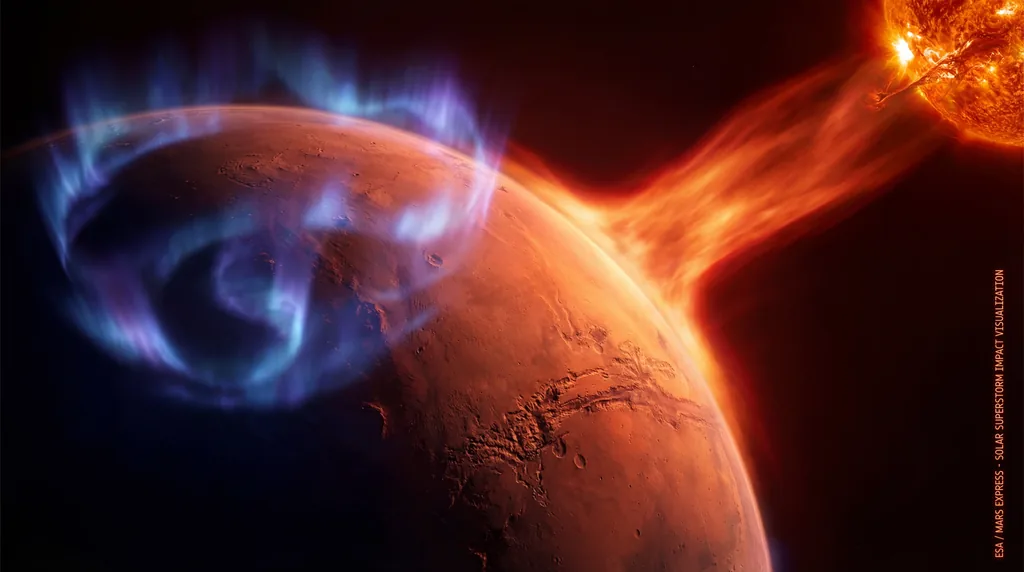

When a massive solar superstorm swept across the solar system in May 2024, the European Space Agency's (ESA) fleet of Mars orbiters provided a rare front-row seat to the event's intensity, revealing that the Red Planet's upper atmosphere became intensely supercharged while spacecraft sensors suffered significant radiation-induced glitches. According to a new study published in Nature Communications on March 5, 2026, the Mars Express and ExoMars Trace Gas Orbiter (TGO) documented the most dramatic atmospheric response to solar activity ever recorded at the planet, including a nearly 300% surge in electron density.
The Solar Superstorm of May 2024
The solar superstorm originated from the hyperactive sunspot region AR3664, which launched a series of X-class flares and coronal mass ejections (CMEs) that impacted Earth before reaching Mars. While Earth experienced G5-level geomagnetic storms and vibrant auroras, the storm continued its journey across the inner solar system, striking the Martian environment with fast-moving, magnetized plasma and high-energy X-rays that flooded the planet's thin atmosphere just days later.
The timeline of the storm's arrival was captured with unprecedented precision by ESA’s deep-space weather monitors. The ExoMars Trace Gas Orbiter picked up a radiation dose equivalent to 200 days of "normal" exposure in just 64 hours. Lead author Jacob Parrott, an ESA Research Fellow, noted that the impact was remarkable, representing the largest response to a solar storm ever observed at the Red Planet. This event allowed researchers to synchronize data from multiple missions, including NASA’s MAVEN, to build a comprehensive map of how solar energy propagates through the Martian system.
Why did Mars spacecraft glitch during the solar event?
Mars spacecraft glitched because high-energy protons from the solar superstorm physically impacted sensitive electronic components, specifically the star trackers used for navigation. These energetic particles created a "snow" effect in sensor data, overwhelming the software's ability to distinguish stars from radiation hits. While the Mars Express and TGO missions are designed with radiation-resistant components, the sheer volume of particles triggered temporary computer errors and data processing delays.
The technical explanation for these glitches lies in the "single-event upsets" caused by solar energetic particles. As the storm peaked, the ASPERA-4 instrument on Mars Express and the radiation monitors on TGO recorded a barrage of particles so dense they threatened to blind the orbital sensors. "The spacecraft were built with these perils in mind," explained Jacob Parrott, noting that specific systems for detecting and fixing these errors allowed the orbiters to recover quickly. This resilience is a testament to ESA's engineering, yet it highlights the ongoing vulnerability of digital systems in the harsh environment of deep space during Solar Maximum.
How does Mars' lack of magnetic field affect solar storm impacts?
The lack of a global magnetic field on Mars allows solar storm particles to penetrate directly into the upper atmosphere, causing widespread ionization and atmospheric inflation. Unlike Earth, which possesses a magnetospheric shield that deflects charged particles toward the poles, the Martian ionosphere bears the full brunt of the solar wind, resulting in a "supercharged" state across the entire planet rather than localized auroral displays.
This fundamental difference in planetary defense means that space weather has a much more invasive impact on Mars. During the May 2024 event, the solar wind interacted directly with the Martian ionosphere, causing the atmosphere to "puff up" or inflate. This phenomenon increases orbital drag for low-altitude satellites and alters the chemistry of the upper layers. Because there is no magnetic "umbrella," the energy deposition is global, stripping away electrons from neutral atoms and creating a dense shroud of plasma that can persist for days after the initial flare.
Atmospheric Supercharging and Particle Escape
The most striking finding of the Nature Communications study was the quantification of atmospheric supercharging, where electron levels at altitudes of 130 km rose by a staggering 278%. This surge represents the highest density of electrons ever recorded in the Martian ionosphere. By using a technique called radio occultation—where Mars Express beams a signal to TGO as it passes behind the planet—scientists were able to measure how these electrons refracted radio waves, providing a high-resolution look at the atmospheric layers.
- Altitude 110 km: Electron density increased by 45% above baseline levels.
- Altitude 130 km: Electron density surged by 278%, creating a "supercharged" layer.
- Ionospheric Response: The storm caused immediate ionization of neutral gases, effectively turning the upper atmosphere into a highly conductive plasma.
- Data Validation: Measurements were confirmed using cross-referenced data from NASA's MAVEN mission and the MARSIS radar instrument.
This atmospheric excitation has long-term consequences for the planet’s evolution. Colin Wilson, ESA project scientist for Mars Express, explained that these events drive the "stripping" of the atmosphere into space. As the solar storm deposits energy, it accelerates ions to escape velocity, contributing to the historical loss of Mars' water and air. Understanding this process is critical to reconstructing the planet's climatic history and determining how a once-habitable world became a frozen desert.
Are there risks to future Mars missions from solar superstorms?
Yes, solar superstorms pose critical risks to future Mars missions, including lethal radiation doses for astronauts and the total disruption of communication and radar systems. Without a magnetic field to deflect particles, surface explorers could be exposed to radiation levels equivalent to dozens of chest X-rays in a single event, requiring the development of specialized habitats and early-warning systems.
Beyond the biological threat, the supercharged ionosphere poses a significant hurdle for mission operations. The high electron density observed during the May 2024 storm can block or distort radio signals used for communication between the surface and orbiting spacecraft. Furthermore, radar instruments used to map underground ice—a vital resource for future colonists—can be rendered useless during solar maximum. Jacob Parrott emphasized that these findings are a "key consideration in mission planning," as they dictate when it is safe for humans to be on the surface and when critical data transmissions should occur.
Implications for Future Human Exploration
The data gathered by ESA’s orbiters underscores the necessity of a robust interplanetary space weather warning system. For future Martian colonists, "safe" periods for surface activity will be dictated by solar cycles and the monitoring of active regions like AR3664. Because Mars lacks a natural shield, astronauts may need to seek shelter in lava tubes or purpose-built radiation vaults during peak solar activity to avoid the 200-day-equivalent doses measured by TGO.
Looking ahead, ESA plans to expand its use of orbiter-to-orbiter radio occultation, a technique that has proven invaluable for monitoring the Martian environment in real-time. By utilizing the Mars Express and ExoMars TGO as a dual-point sensing network, researchers can now predict how a storm hitting Earth might behave by the time it reaches the Red Planet. This proactive approach to space weather is the first step toward building the "weather satellites" of the future, ensuring that the next generation of explorers is prepared for the temperamental nature of our star.




Comments
No comments yet. Be the first!