The Day That Changed Everything
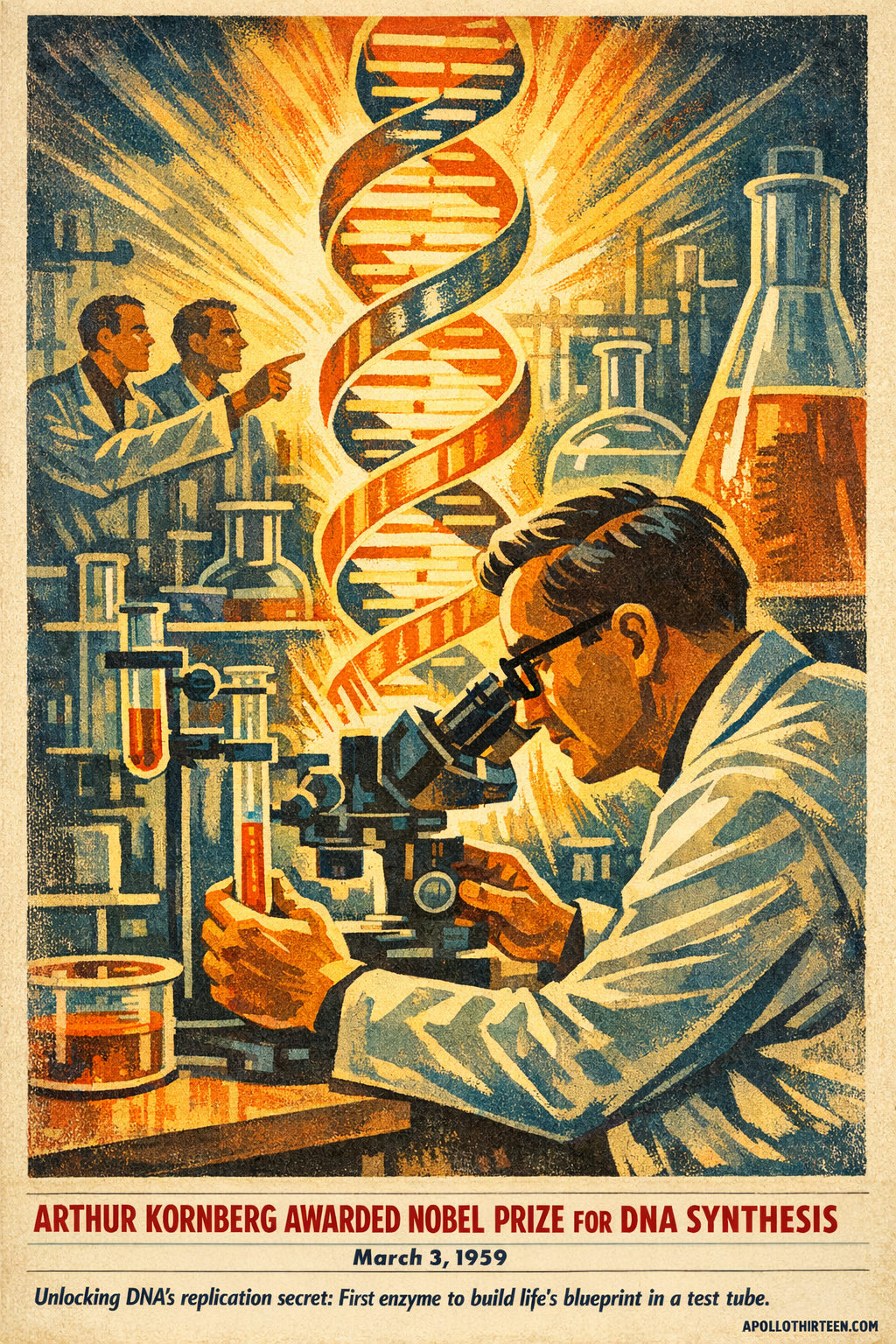
Sixty-seven years ago today a small enzyme in a glass tube did what, until then, had seemed like the work of magic: it copied a molecule that carries the instructions for life. The image is arresting — a scientist peering into a centrifuge’s shadow, a cold bench littered with glass tubes, a radioisotope counter ticking like a metronome — but the real drama was quieter and more stubborn. What Arthur Kornberg’s lab in St. Louis did in the mid-1950s was to take DNA apart from the mystery that had shadowed it since Watson and Crick sketched the double helix and to show that the replication of life’s instruction manual could be rebuilt, piece by piece, outside of any cell.
On March 3, 1959 — a date that doubles as Kornberg’s birthday — the Nobel Prize in Physiology or Medicine was awarded jointly to Arthur Kornberg and Severo Ochoa “for their discovery of the mechanisms in the biological synthesis of ribonucleic acid and deoxyribonucleic acid.” For Kornberg, the prize recognized a single, pivotal triumph: the isolation and characterization of an enzyme — DNA polymerase I — that could assemble DNA in a test tube. It was a moment when biochemistry stopped being an observational science and became constructive. It was the moment when we found not merely the map of life but the tools to redraw it.
What Actually Happened
The mid-1950s were a fast-moving, feverish time in molecular biology. Watson and Crick’s double helix had made the mechanism of heredity conceptually clear: complementary base-pairing suggested a straightforward way for one strand to guide the making of another. But knowing the design is not the same as building the machine. Who lays down the bricks? What makes the mortar set? The central question remained: what enzymes actually synthesize DNA?
Arthur Kornberg approached the problem as one approaches an old engine — by taking it apart to see which pieces do the work. He had a track record for extracting catalysts from messy biological systems. His early work on coenzymes convinced him that the synthesis of large biological molecules would also be amenable to biochemical dissection. If RNA-synthesizing enzymes could be found, why not DNA-synthesizing ones?
The technical challenge was enormous. Cell extracts are full of proteins and nucleases that chew up DNA. To show an enzyme truly synthesized DNA, a lab had to separate that enzyme from a forest of interfering activities and then demonstrate that, with the right raw materials, it could string nucleotides into a complementary strand on a DNA template. Kornberg’s lab set about this with a mix of chemical savvy and patience. They used fractionation techniques — precipitation, ultracentrifugation, columns — guided by assays that detected the incorporation of radioactive nucleotides into acid-insoluble products. After iterative purification steps, in 1956 they isolated an enzymatic activity capable of catalyzing the polymerization of deoxyribonucleotides on a DNA template: DNA polymerase I.
What the enzyme required was simple to state and elegantly revealing. Give it a template strand of DNA, provide four deoxyribonucleoside triphosphates (dATP, dTTP, dGTP, dCTP), a primer (a short stretch of nucleic acid with a free 3'-OH), and the right ions to support catalysis, and the enzyme would add nucleotides one by one, following base-pairing rules, growing a new strand in the 5' to 3' direction. The experimenters had recreated a process fundamental to life inside a glass tube: the templated polymerization of DNA.
These results were not announced all at once. Kornberg’s group published their core papers in May 1958 after a fraught passage through peer review; earlier setbacks had nearly suppressed the work. But by then the field understood the implication: DNA replication — or at least a key chemical step of it — could be performed outside a living cell by a single purified protein. In the years that followed Kornberg and others showed that the enzyme had additional functions — exonuclease activities that could remove nucleotides and so contribute to proofreading and repair. The initial clarity gave way to complexity: DNA synthesis in cells turns out to be a coordinated choreography of multiple polymerases and accessory factors, but Kornberg’s DNA polymerase I was the first to be found and characterized.
A later, equally dramatic milestone came in 1967 when Kornberg and colleagues showed that enzymes could produce biologically active DNA — a viral chromosome that, once introduced into a cell, behaved like its natural counterpart. That achievement closed the circle: not merely assembling test-tube polymers that looked like DNA but making DNA that behaved like life’s own instructions.
The People Behind It
Science is, in the end, a human story, and Kornberg’s discovery was the product of a particular personality, a team, and a network of rivals and contemporaries who pushed the field forward.
Arthur Kornberg was born in Brooklyn on March 3, 1918, the child of Jewish immigrants. He trained as a physician-scientist and spent time at the National Institutes of Health before moving to Washington University in St. Louis in 1953. He was not a flamboyant figure; by all accounts he was tenacious, mercilessly exacting, and happiest doing long sequences of experiments in the lab. He treated biochemical problems like puzzles to be solved by logic and technique, and he believed the fundamental processes of life could be reconstituted from their parts.
Severo Ochoa, who shared the 1959 Nobel, pursued a parallel path on the RNA side. His work on RNA polymerase removed another veil from nucleic-acid biosynthesis by showing that enzymes could synthesize RNA in vitro. Watson and Crick’s double helix had provided the architectural insight, Kornberg and Ochoa provided the tools that built and read that architecture.
Kornberg’s lab was crowded with students and postdocs who did the day-to-day work under his direction; the success was theirs as much as his. One of Kornberg’s notable scientific legacies was familial: his son Roger Kornberg went on to a brilliant career in molecular biology and won the Nobel Prize in Chemistry in 2006 for his studies of the molecular basis of eukaryotic transcription. The research community as a whole — from technicians who ran ion-exchange columns at odd hours to rival groups investigating replication in other organisms — formed the human ecosystem that turned an initial enzymatic activity into the modern science of DNA.
No astronauts were involved in this story. The “crew” was a lab and a field, not a spacecraft; the voyage was inward, into the molecular machinery of the cell.
Why the World Reacted the Way It Did
When the Nobel committee summed up the achievements of 1959 they used plain language: discoveries “of the mechanisms in the biological synthesis of ribonucleic acid and deoxyribonucleic acid.” That phrasing captured a shift as much cultural as scientific. The public and political reaction to discoveries of that era often split in two directions: awe at the new control over life’s processes, and a creeping, sometimes moral anxiety about what such control might mean.
For scientists the reaction was electric. By demonstrating that the central dogma of heredity — the copying of DNA — could be recapitulated outside living systems, Kornberg enabled an experimental approach where hypotheses could be tested in vitro. The discovery made possible a cascade of techniques that would define modern biology: the ability to synthesize DNA, to clone genes, to sequence genomes, and ultimately to edit them. Funding agencies and institutions raced to support molecular biology; new companies were born to exploit the techniques that would later underpin biotechnology.
For the public, in a more muted way, such discoveries began to chip at the notion of biological determinism — at the idea that heredity was inscrutably bound into the fabric of life. Suddenly, the conversation included engineers and entrepreneurs, lawyers and ethicists. If DNA could be built in a test tube, what could be done with that capability? In the decades that followed the answer ranged from the benign — insulin produced by genetically modified bacteria — to the unsettling — concerns about recombinant organisms and biosafety. The scientific community itself was not monolithic; the near-suppression of Kornberg’s papers in the late 1950s reveals a culture that could be both protective and conservative. Peer reviewers initially demanded proof that in vitro-synthesized DNA had biological activity — a reasonable standard, but one that demonstrates how revolutionary ideas often require patience before they pass through the sieve of orthodoxy.
Politically, the Cold War provided its own pressure cooker. Governments invested heavily in the life sciences because of their potential military and economic importance. That infusion of resources accelerated discoveries but also magnified their implications. By the time recombinant DNA controversies flared in the 1970s, the public already saw molecular biology as a field with power to alter the world — a perception that began in part with Kornberg’s demonstration that the mechanisms of heredity were amenable to chemical manipulation.
What We Know Now
Today the machinery of DNA replication is known in far greater detail than in Kornberg’s time, and the initial finding sits inside a much larger, richer narrative.
DNA polymerase I, the enzyme Kornberg isolated, performs key functions in bacterial cells, but it is not the main engine that copies the chromosome during cell division. In Escherichia coli, DNA polymerase III carries the bulk of the replicative load. DNA polymerase I is heavily involved in repair and in removing the short RNA primers laid down to start synthesis on the lagging strand; it has a 5'→3' exonuclease activity that allows it to remove oligonucleotides, and a 3'→5' exonuclease that can proofread and correct errors. Kornberg’s enzyme is thus a workhorse for maintaining genomic integrity rather than the high-speed replicase.
The modern picture of replication is that of a replisome — a multi-protein complex that reels DNA through its core, coordinates leading- and lagging-strand synthesis, clamps polymerases onto the DNA, and uses helicases to unwind the double helix. High-resolution structural biology has mapped many of these components at atomic detail. Genetics has revealed the interplay between polymerases, sliding clamps, primases, and accessory factors. In eukaryotes — the cells of animals, plants, and fungi — replication involves a different suite of polymerases (Pol α, δ and ε) and a more elaborate orchestration reflecting chromatin packaging and cell-cycle control.
Fidelity mechanisms are also better understood. DNA polymerases make mistakes — misincorporations of bases — but proofreading exonucleases and post-replicative mismatch repair pathways reduce the error rate dramatically. These safeguards are essential: they are the molecular guarantors that genomes maintain stability across generations.
On the applied side, the techniques Kornberg’s discovery made possible have matured beyond what any founder could fully imagine. Polymerase chain reaction (PCR), invented in the 1980s by Kary Mullis, depends on DNA polymerase to amplify specific DNA sequences billions-fold, but it uses a thermostable polymerase from Thermus aquaticus (Taq) rather than Kornberg’s E. coli enzyme. DNA sequencing — from Sanger’s method through next-generation platforms and into nanopore technology — ultimately rests on the manipulation and enzymatic copying of DNA. Gene editing tools like CRISPR-Cas systems rely on the ability to design, deliver, and sometimes replace DNA sequences in genomes; this work sits on foundations laid by the first in vitro DNA syntheses.
At the same time, the science has acquired a new ethical and social dimension. The ability to manipulate genomes begins with enzymes and test tubes but ends in public policy choices: who gets to edit germlines, how we regulate genetically modified organisms, how we protect privacy when genomes are sequenced at scale. Kornberg’s work did not create these dilemmas, but it made them inevitable.
Legacy — How It Shaped Science Today
It is often tempting to point to a single invention as the genesis of a revolution. With the wisdom of hindsight Kornberg’s purification of DNA polymerase I is one of those hinge moments. The discovery signaled that the central processes of life could be reconstituted and manipulated. From that pivot point flowed techniques and enterprises that reshaped medicine, agriculture, law, and the economy.
Clinically, DNA’s accessibility has been transformational. Molecular diagnostics that detect pathogen genomes, tests for genetic predisposition to disease, and the design of targeted drugs are all downstream of the ability to analyze and manipulate DNA. Recombinant DNA technology — inserting a human gene for insulin into bacteria to produce therapeutic quantities of the hormone — became practicable because researchers could synthesize, clone, and amplify DNA reliably. Today, treatments that would have been science fiction in 1959 — monoclonal antibodies tailored to tumor antigens, viral vectors delivering gene therapies, mRNA vaccines derived from genetic sequences — trace a line back to the early biochemical reconstitutions of nucleic-acid synthesis.
Beyond medicine, Kornberg’s work reshaped the enterprise of biology. The field moved from description to design. Laboratories transitioned from merely observing living systems to building them: sequencing whole genomes, engineering bacteria to produce biofuels, creating organisms with synthetic chromosomes. Industries matured around these capabilities. Biotechnology companies took basic enzymology into the marketplace; research tools became products; whole new sectors of the economy emerged.
Culturally, Kornberg’s demonstration solidified a view of life as legible and malleable. Depending on your vantage point that is a promise or a provocation. It is, unavoidably, both. The ability to read and write DNA gives humanity tools to cure disease and feed people, but it also obliges us to steward those tools with care.
Finally, there is a human legacy. Kornberg exemplified a style of science that prizes biochemical reductionism, meticulous technique, and the dogged pursuit of a problem. He combined a clinician’s respect for empirical rigor with a biochemist’s obsession with mechanism. The Nobel Committee’s terse language — recognizing “the mechanisms in the biological synthesis” of nucleic acids — honors that focus on mechanism. But mechanism is not merely an abstraction; it is the intellectual property that allows us to build, to fix, and to imagine.
Fast Facts
- March 3, 1918: Arthur Kornberg is born in Brooklyn, New York.
- 1953: Watson and Crick publish the double-helix model of DNA, setting the conceptual stage for enzymatic studies of replication.
- 1956: Kornberg isolates DNA polymerase I from Escherichia coli cell extracts.
- May 1958: Kornberg publishes foundational papers describing DNA polymerase I after a fraught initial peer-review process.
- March 3, 1959: Arthur Kornberg is awarded the Nobel Prize in Physiology or Medicine, jointly with Severo Ochoa, “for their discovery of the mechanisms in the biological synthesis of ribonucleic acid and deoxyribonucleic acid.”
- 1967: Kornberg and colleagues synthesize biologically active viral DNA in vitro, demonstrating that a purified system can produce fully functional genetic material.
- DNA polymerase I functions: synthesizes DNA in a 5'→3' direction, possesses exonuclease activities for proofreading and nick translation, and plays a major role in DNA repair and processing of RNA primers in bacteria.
- Modern impact: DNA polymerases underpin PCR, DNA sequencing, cloning, and genome editing, forming the enzymatic backbone of genomics and biotechnology.
- Legacy lineage: Roger Kornberg, Arthur’s son, later wins the Nobel Prize in Chemistry (2006) for studies of the molecular basis of eukaryotic transcription.
Sixty-seven years on, the image that best captures Kornberg’s contribution is not a single test tube but a hinge: he showed that life’s script could be read and, crucially, written. From that hinge flowed an era in which genomes became manipulable, medicines could be directed at molecular targets, and the raw language of heredity could be edited and synthesized. The challenge for our time is to hold that power responsibly — to use the ability to write the code of life for healing, for knowledge, for the common good, while keeping a steady hand on the ethical and social levers that determine how those technologies are applied. Arthur Kornberg’s enzyme did not answer those questions; it simply made them possible. That is why, 67 years after the Nobel recognized his work, the discovery still matters.



Comments
No comments yet. Be the first!